Greetings for the Feast of St Silouan the Athonite!
Before we gather to celebrate the Leave-Taking of the Nativity of the Mother of God tomorrow, I would like to forewarn you that unless my blood pressure is dramatically lower, we will NOT be celebrating the Liturgy, but rather distributing Holy Communion after the Hours and Typika (Obednitsa).
The unavoidable reality is that my high-blood pressure potentially makes the celebration of the Liturgy impossible.
I felt extremely unwell last Sunday night, at the end of a long day (as Sundays always are), but characteristically ignored it once the week progressed. However, I felt alarmingly unwell on my return from Cardiff last night, and together with the way I felt on getting up this morning it made it obvious that Liturgy may not be possible this weekend, and possibly over the next two or three weeks.
Since taking over from Fr Vitaly, I have only missed Liturgy when I had covid, despite juggling the parish with demanding full-time work for five difficult years, but now is different. I have to face the facts, and until medication and treatment manages the situation, we will have ALL to be flexible, adapt and to face this unpleasant but unavoidable reality, continuing parish life in a slightly different way over the next month.
I ask parishioners to be understanding and to only telephone me out of absolute necessity as I try to rest over the next few weeks. So, if possible, email with any needs that may not be able to wait. My movements will also be limited, as six hours a day on public transport with no time to eat normal meals is not tenable.
Asking your prayers, and happy that our young men are praying for us all on the Holy Mountain…
What is Confession? Confession is the oral avowal of one’s sins which lie heavy upon the conscience. Repentance cleanses the soul and makes it ready to receive the Holy Spirit, but confession, so to speak, only empties the soul of sins.
Let us present a simple analogy and comparison to confession. For example, suppose you had only one vessel of some kind, which you through negligence or laziness let reach a stage where little by little it accumulated all sorts of dirt so that your vessel became not only unusable but even unbearable to look at without repugnance.
But what if a king wanted to give you as a gift some sort of fragrant and precious balm, one drop of which could heal all infirmities and protect – what then? Would you refuse such a valuable gift only because you had no other clean vessel in which to put it? No! It would be very natural for you to accept such a gift and you would try to clean your vessel. How would you begin to clean your vessel? No doubt, before anything else, you would rid it of all uncleanness; you would begin by washing it with water and, perhaps would even burn it out so that it no longer retained any of its former odors. Isn’t that so?
Now let the vessel represent the soul given to you by God, which you have brought to such a state that it has been filled with all kinds of transgression and iniquities; let the sweet-smelling balm, given by the king, signify the Holy Spirit, Who heals all infirmities and afflictions, Whom the King of heaven and earth, Jesus Christ, freely bestows upon us.
To examine your vessel signifies feeling your guilt before God and recalling all sins, which have stolen into your heart.
To clean out the vessel typifies the confession of your sins before your spiritual father, and washing with water and burning with fire signifies a sincere and even tearful repentance and a voluntary resolve to endure all unpleasantness, needs, afflictions, misfortunes, and even calamities that befall us.
Now tell me: Is Confession profitable or needful? Certainly it is profitable and even essential; because, just as it is impossible to cleanse a vessel without ridding it of all uncleanness, so it is impossible to purge your soul of sins without confession.
But tell me, is confession alone enough for the reception of the Holy Spirit? Certainly not, because in order to receive the sweet-smelling and precious balm into a defiled vessel it is not enough to just empty it, but it is necessary to wash it with water and refine it with fire. Just so, in order to receive the Holy Spirit, it is not enough just to confess or recite your sins before a spiritual father, but it is necessary together with this to purge your soul with repentance or contrition and grief of soul, and burn it out with voluntary endurance of afflictions. So then, this is what confession and repentance mean!
What does a true and correct confession consist of?
When we wish to cleanse our conscience of sins in the Mystery of Repentance: Before everything else it is necessary to believe in the Lord Jesus Christ and firmly hope that He is ready to forgive all sins, no matter of what magnitude, if only the sinner repents open-heartedly; it is necessary to believe and hope that the God of all wants and seeks our return.
Of this He assures us through the prophet thus: “As I live, saith the Lord,” i. e., I assure and swear by My life, “In desiring I do not desire”, i.e., I do not at all desire, “the death of a sinner, but entirely desire his conversion.”
It is necessary to have a broken heart. Who is God? And who are we? God is the Almighty Creator of heaven and earth; He is the awful and righteous Judge. And we? We are weak and insignificant mortals. All people, even the greatest people, are less than dust before God, and we can never imagine how disgusting to God is any sin and how any transgression offends Him.
And we, insignificant and weak, we mortals endlessly benefited by our God, dare to offend Him – the All-Good One? Oh! This is so horrible! We are such debtors before God, such transgressors, that not only should we not dare to call ourselves His children, but are not even worthy of being His lowliest servants.
Therefore, picturing all this, you see what contriteness, what lamentation it is necessary to have then, when we want to purge ourselves of sins. And such a feeling must be had not only before confession and during confession, but also after confession. And even more important, do you want to offer a sacrifice to God such as will be acceptable to Him? Naturally we all gladly want this and as far as possible we offer it. But what can we offer Him really acceptable? A broken heart. A sacrifice unto God is a broken spirit; a heart that is broken and humbled, here is an offering to God more priceless than all offerings and oblations!
It is necessary to forgive all our enemies and offenders all the harmful and offensive things they have done to us. Forgiveness—what does it mean to forgive? To forgive means never to avenge, neither secretly nor openly; never to recall wrongs but rather to forget them and, above all, to love your enemy as a friend, a brother, as a comrade; to protect his honor and to treat him right-mindedly in all things. This is what it means to forgive.
And who agrees that this is difficult? So, it is a hard matter to forgive wrongs, but he who can forgive wrongs is for this reason great – truly great, both before God and before man. Yes, it is a hard matter to forgive your enemies; but it is necessary to forgive, otherwise God Himself will not forgive. Jesus Christ said: If ye forgive men their trespasses, your heavenly Father will forgive you also your trespasses. But if ye forgive not men their trespasses, neither will your heavenly Father forgive you yours.
On the contrary to this, though you pray to God every hour, though you have such faith that you can move mountains, even though you give away all of your belongings to the needy, and give your body to be burned, if you do not practice forgiveness and do not wish to forgive your enemy, then all is in vain, for in such circumstances neither prayer, nor faith, nor charity, will save you, in short, nothing will save you.
But if it is needful to forgive our enemies, so likewise it is indispensable to ask also forgiveness of those people whom we have offended. Thus, if you have offended anyone by word, ask forgiveness of him, come and bow down at his feet and say, “Forgive me.” Have you offended by deed? Endeavor to expiate your guilt and offenses and recompense his damage, then be certain that all of your sins, no matter how heavy they be, will be forgiven you.
It is necessary to reveal your sins properly and without any concealment. Some say, “For what reason should I reveal my sins to Him Who knows all of our secrets?” Certainly God knows all of our sins, but the Church, which has the power from God to forgive and absolve sins, cannot know them, and for this reason She cannot, without confession, pronounce Her absolution.
Finally, it is necessary to set forth a firm intention to live prudently in the future. If you want to be in the kingdom of heaven, if you want God to forgive your sins – then stop sinning! Only on this condition does the Church absolve the penitent of his sins. And he who does not think at all about correcting himself confesses in vain, labors in vain, for even if the priest says, “I forgive and absolve,” the Holy Spirit does not forgive and absolve him!
From Orthodox Life, vol. 38, no. 4 (July-August, 1988), pp. 20-22.
All is busy in Llanelli, where Father Luke, son-in-law Simeon, and Simeon’s brother Raphael have been flooring the pritvor of the garden chapel.
In it’s first incarnation in the mid 90’s, a small chapel dedicated to St David and St Nicholas was created using a little summer house with a verandah, but over the years it has grown in height, width and length, with little (if any) of the original structure surviving.
Reader services had originally been celebrated in the home icon-corner, but Father Luke’s ordination brought the need for a small sanctuary, where Liturgy could be celebrated.
In the years since, during which the chapel has grown, the whole round of Orthodox services, fasts and feasts have been celebrated, as well as baptisms and weddings, and the garden chapel has welcomed the Kursk-Root icon of the Mother of God.
In its garden setting, the homely little chapel has been very popular with everyone, especially those from rural Russia, Ukraine and Romania.
We now look forward to the completion of the icons of the Saviour and Mother of God, which are being painted for the ikonostasis. Watch this space!
In the meantime, Chi-Chi greatly resents her peace and quiet being shattered by men with saws and hammers! Feline old age is meant to be all about sleeping, forgetfulness and treats.
As we celebrate the synaxis of the Holy Forebears of God, Joachim and Anna, we wish Jessica-Anne a grace-filled and joyous nameday, and send our greetings to Peter’s wife, Anne.
We pray that the Lord may bless them abundantly, and grant them many, blessed years!
Kontakion of Saints Joachim and Anna in Tone II: Anna now having broken the bond of barrenness; and she nurtureth the all-pure one, calling upon all to hymn the One Who through her womb hath given unto men the only Mother who knew not man.
We have just returned from London, at the end of a very joyful, but very long day, celebrating the altar-feast of our cathedral on this feast of the Nativity of the Mother of God.
As Bishop Irenei was unable to lead the celebrations due to the ongoing session of the Holy Synod, convened to elect our new First-Hierarch, Archpriest Paul our chancellor stood in his place heading the concelebration with the cathedral clergy, our ever-joyful Father Spasimir from Norwich, Father Joseph from the Patriarchal Cathedral and Father Goran from the Serbian parish.
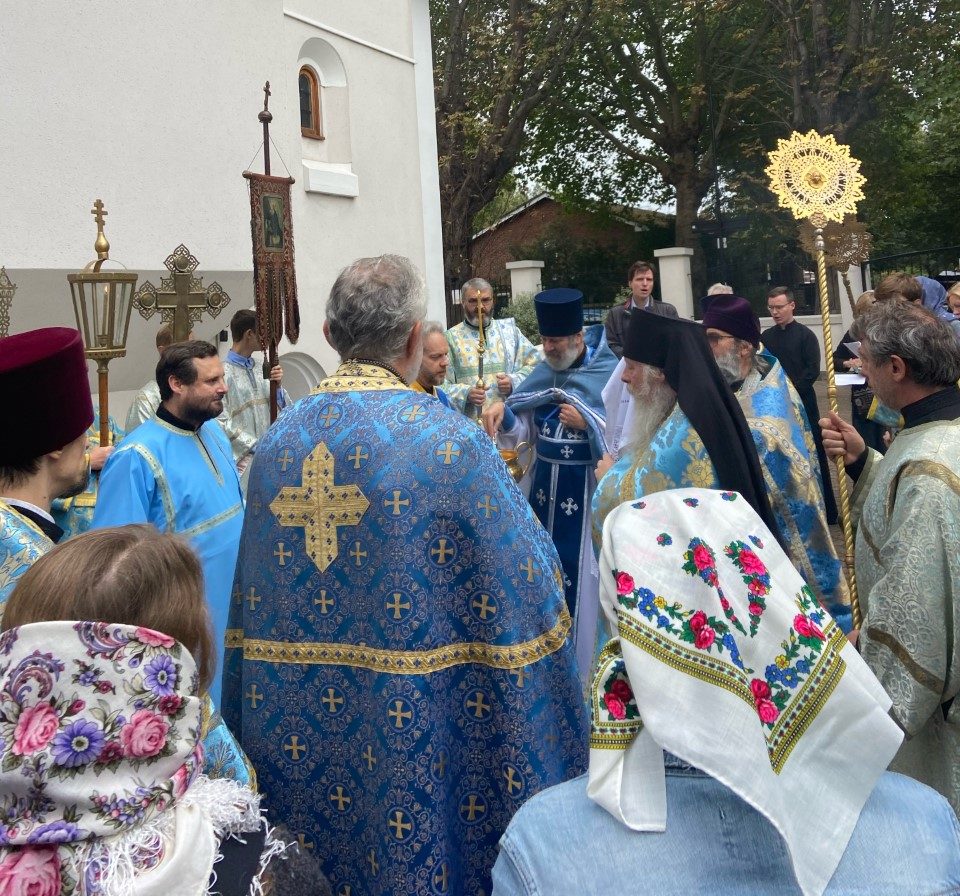
Following the Liturgy, the assembled clergy and faithful celebrated a krestny khod, processing around the cathedral whilst chanting the moleben to the Mother of God in honour of her Nativity, bearing banners, crosses, candles and icons, with the faithful blessed with an generous volume of holy water.
Trapeza welcomed cathedral parishioners and visitors from other parishes (with a few of our Cardiff parishioners) for a wonderful meal, with musical offerings from some of the young people, including our own Aldhelm, who was eager to take his turn at the piano.
It was a joy to catch up with friends, and to have time with our fellow clergy, and – as always – Deacon Mark and I would like to thank the cathedral clergy, staorosta Vera Alexandrovna, and the parish sisterhood for their immense kindness and hospitality.
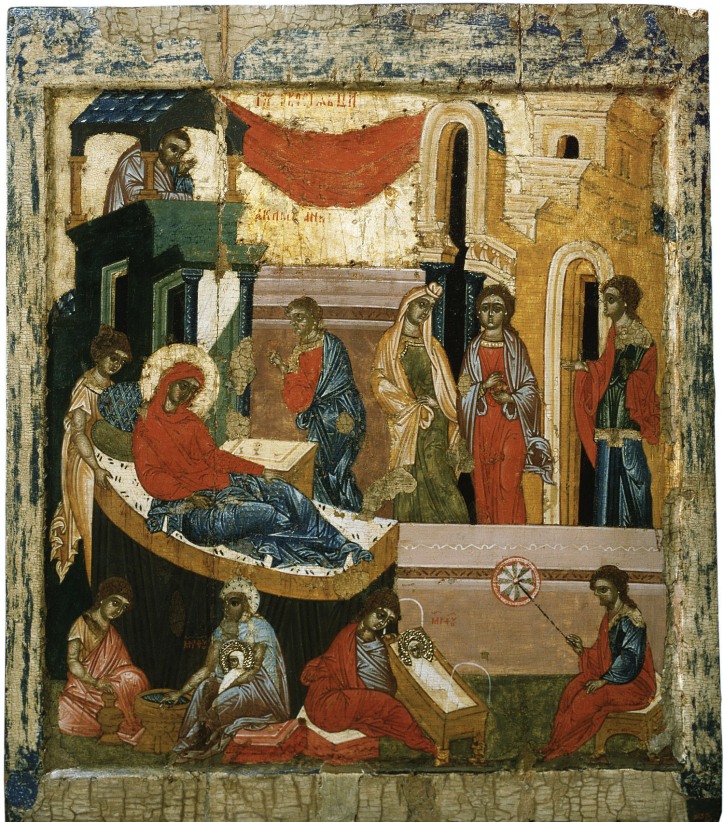
The present Feast is for us the beginning of feasts.
Serving as boundary to the law and to prototypes, at the same time it serves as a doorway to grace and truth. “For Christ is the end of the law” (Rom 10:4), Who, having freed us from the letter (of the law), raises us to spirit.
Here is the end (to the law): in that the Lawgiver, having made everything, has changed the letter in spirit and gathers everything in Himself (Eph 1:10), enlivening the law with grace: grace has taken the law under its dominion, and the law has become subjected to grace, so that the properties of the law not suffer reciprocal commingling, but only so that by Divine power, the servile and subservient (in the law) are transformed into the light and free (in grace), so that we are not “in bondage to the elements of the world” (Gal 4:3) and not in a condition under the slavish yoke of the letter of the law.
Here is the summit of Christ’s beneficence towards us! Here are the mysteries of revelation! Here is the theosis [divinization] assumed upon humankind, the fruition worked out by the God-Man.
The radiant and bright descent of God for people ought to have a joyous basis, opening to us the great gift of salvation. Such also is the present feastday, having as its basis the Nativity of the Theotokos, and as its purpose and end, the uniting of the Word with flesh, this most glorious of all miracles, unceasingly proclaimed, immeasurable and incomprehensible.
The less comprehensible it is, the more it is revealed; and the more it is revealed, the less comprehensible it is. Therefore the present God-graced day, the first of our feastdays, showing forth the light of virginity and the crown woven from the unfading blossoms of the spiritual garden of Scripture, offers creatures a common joy.
Be of good cheer, it says, behold, this is the Feast of the Nativity of the Virgin and of the renewal of the human race! The Virgin is born, She grows and is raised up and prepares Herself to be the Mother of the All-Sovereign God of the ages. All this, with the assistance of David, makes it for us an object of spiritual contemplation. The Theotokos manifests to us Her God-bestown Birth, and David points to the blessedness of the human race and wondrous kinship of God with mankind.
And so, truly one ought to celebrate the mystery today and to offer to the Mother of God a word by way of gift: since nothing is so pleasing to Her as a word and praise by word. It is from here also that we receive a twofold benefit: first, we enter into the region of truth, and second, we emerge from the captivity and slavery of the written law. How so? Obviously, when darkness vanishes, then light appears; so also here: after the law follows the freedom of grace.
The present day solemnity is a line of demarcation, separating the truth from its prefigurative symbol, and ushering in the new in place of the old. Paul, that Divine Trumpet of the Spirit, exclaims about this: “If anyone is in Christ, he is a new creature; old things pass away and behold, all things have become new (2 Cor 5:17); for the law made nothing perfect, but the bringing in of a better hope did, by which we draw near to God” (Heb 7:19). The truth of grace has shown forth brightly.
Let there now be one common festal celebration in both heaven and on earth. Let everything now celebrate, that which is in the world and that beyond the world. Now is made the created temple for the Creator of all; and creation is readied into a new Divine habitation for the Creator. Now our nature having been banished from the land of blessedness receives the principle of theosis and strives to rise up to the highest glory.
Now Adam offers from us and for us elements unto God, the most worthy fruit of mankind: Mary, in Whom the new Adam is rendered Bread for the restoration of the human race. Now is opened the great bosom of virginity, and the Church, in the matrimonial manner, places upon it a pure, truly spotless pearl.
Now human worthiness accepts the gift of the first creation and returns to its former condition; the majesty darkened by formless sin, through the conjoining by His Mother by birth “of Him Beauteous by Goodness,” man receives beauty in a most excellent and God-seemly visage. And this creating is done truly by the creation, and recreation by theosis, and theosis by a return to the original perfection!
Now a barren one has become a mother beyond expectation, and the Theotokos has given birth without knowing man, and She sanctifies natural birth. Now the majestic color of the Divine purple is readied and impoverished human nature is clothed in royal worthiness. Now, according to prophecy, sprouts forth the Offshoot of David, Who, having eternally become the green-sprouting Staff of Aaron, has blossomed forth for us with the Staff of Power: Christ.
Now from Judah and David is descended a Virgin Maiden, rendering of Herself the royal and priestly worthiness of Him Who has taken on the priesthood of Aaron according to the order of Melchizedek (Heb 7:15). Now the renewal of our nature is begun, and the world responding, assuming a God-seemly form, receives the principle of a second Divine creation.
The first creation of mankind occurred from the pure and unsullied earth; but their nature darkened its innate worthiness, they were deprived of grace through the sin of disobedience; for this we were cast out of the land of life and, in place of the delights of Paradise, we received temporal life as our inheritance by birth, and with it the death and corruption of our race.
All started to prefer earth to heaven, so that there remained no hope for salvation, beyond the utmost help. Neither the natural nor the written law, nor the fiery reconciliative sayings of the prophets had power to heal the sickness. No one knew how to rectify human nature and by what means it would be most suitable to raise it up to its former worthiness, so long as God the Author of all did not deign to reveal to us another arranged and newly-constituted world, where the pervasive form of the old poison of sin is annihilated, and granting us a wondrous, free and perfectly dispassionate life, through our re-creation in the baptism of Divine birth.
But how would this great and most glorious blessing be imparted to us, so in accord with the Divine commands, if God were not to be manifest to us in the flesh, not subject to the laws of nature, nor deign to dwell with us in a manner known to Him? And how could all this be accomplished, if first there did not serve the mystery a Pure and Inviolate Virgin, Who contained the Uncontainable, in accord with the law, yet beyond the laws of nature? And could some other virgin have done this besides She alone, Who was chosen before all others by the Creator of nature?
This Virgin is the Theotokos, Mary, the Most Glorious of God, from Whose womb the Most Divine came forth in the flesh, and by Whom He Himself arranged a wondrous temple for Himself. She conceived without seed and gave birth without corruption, since Her Son was God, though also He was born in the flesh, without mingling and without travail.
This Mother, truly, avoided that which is innate to mothers but miraculously fed Her Son, begotten without a man, with milk. The Virgin, having given birth to the One seedlessly conceived, remained a pure Virgin, having preserved incorrupt the marks of virginity. And so in truth She is named the Mother of God; Her virginity is esteemed and Her birth-giving is glorified. God, having joined with mankind and become manifest in the flesh, has granted Her a unique glory. Woman’s nature suddenly is freed from the first curse, and just as the first brought in sin, so also does the first initiate salvation also.
But our discourse has attained its chief end, and I, celebrating now and with rejoicing sharing in this sacred feast, I greet you in the common joy. The Redeemer of the human race, as I said, willed to arrange a new birth and re-creation of mankind: just as the first creation, taking dust from the virginal and pure earth, where He formed the first Adam, so also now, having arranged His Incarnation upon the earth, and so to speak, in place of dust He chooses out of all the creation this Pure and Immaculate Virgin and, having re-created mankind in His Chosen One from among mankind, the Creator of Adam is made the New Adam, in order to save the old.
Who indeed was This Virgin and from what sort of parents did She come? Mary, the glory of all, was born of the tribe of David, and from the seed of Joachim. She was descended from Eve, and was the child of Anna. Joachim was a gentle man, pious, raised in God’s law. Living prudently and walking before God he grew old without child: the years of his prime provided no continuation of his lineage. Anna was likewise God-loving, prudent, but barren; she lived in harmony with her husband, but was childless. As much concerned about this, as about the observance of the law of the Lord, she indeed was daily stung by the grief of childlessness and suffered that which is the usual lot of the childless — she grieved, she sorrowed, she was distressed, and impatient at being childless.
Thus, Joachim and his spouse lamented that they had no successor to continue their line; yet the spark of hope was not extinguished in them completely: both intensified their prayer about the granting to them of a child to continue their line. In imitation of the prayer heard of Hannah (1 Kings 1: 10), both without leaving the temple fervently beseeched God that He would undo her sterility and make fruitful her childlessness. And they did not give up on their efforts, until their wish be fulfilled. The Bestower of gifts did not contemn the gift of their hope. The unceasing power came quickly in help to those praying and beseeching God, and it made capable both the one and the other to produce and bear a child. In such manner, from sterile and barren parents, as it were from irrigated trees, was borne for us a most glorious fruition — the all-pure Virgin.
The constraints of infertility were destroyed — prayer, upright manner of life, these rendered them fruitful; the childless begat a Child, and the childless woman was made an happy mother. Thus the immaculate Fruition issuing forth from the womb occurred from an infertile mother, and then the parents, in the first blossoming of Her growth brought Her to the temple and dedicated Her to God. The priest, then making the order of services, beheld the face of the girl and of those in front of and behind, and he became gladdened and joyful, seeing as it were the actual fulfillment of the Divine promise.
He consecrated Her to God, as a reverential gift and propitious sacrifice — and, as a great treasury unto salvation, he led Her within the very innermost parts of the temple. Here the Maiden walked in the upright ways of the Lord, as in bridal chambers, partaking of heavenly food until the time of betrothal, which was preordained before all the ages by Him Who, by His unscrutable mercy, was born from Her, and by Him Who before all creation and time and expanse Divinely begat Him, and together with His consubstantial and co-reigning and co-worshipped Spirit — this being One Godhead, having One Essence and Kingdom, inseparable and immutable and in which is nothing diverse, except the personal qualities. Wherefore, in solemnity and in song I do offer the Mother of the Word the festal gift; since that He born of Her hath taught me to believe in the Trinity: the Son and Word Without-Beginning hath made in Her His Incarnation; the Father begetting Him hath blessed this; the Holy Spirit hath signed and sanctified the womb which incomprehensibly hath conceived.
Now is the time to question David: in what did the God of all forswear him? Speak, O Psalmist and Prophet! He hath sworn from the fruit of my loin to sit upon my throne (Ps 131/132:11). Here in this He is forsworn and wilt not break His oath, He hath forsworn and His Word is sealed with a deed! “Once — said he — I forswear by My Holiness, that I lie not to David; his seed wilt prevail forever, and his throne, like the sun before Me and like the moon coursing the ages: a faithful witness also in heaven” (Ps 88/89:35-38). God hath fulfilled this oath, since it is not possible for God to lie (Heb 6:18). Consider this: Christ in the flesh is named my Son (Mt. 22: 42), and all nations will worship my Lord and Son (Ps 71/72:11), seeing him sit upon a virginal throne! Here also is the Virgin, from Whose womb the Pre-eternal One issued forth, incarnated at the end of the ages and renewing the ages, likewise sprung forth from my loins! All this is so!
People of God, holy nation, sacred gathering! Let us revere our paternal memory; let us extol the power of the mystery! Each of us, in the measure given by grace, let us offer a worthy gift for the present feast. Fathers — a prosperous lineage; mothers — fine children; the unbearing — the not-bearing of sin; virgins — a twofold prudence, of soul and of body; betrothed — praiseworthy abstinence. If anyone of you be a father, let him imitate the father of the Virgin; and if anyone be without child — let them make harvest of fruitful prayer, cultivating a life pleasing to God. The mother, feeding her children, let her rejoice together with Anna, raising her Child, given to her in infertility through prayer.
She that is barren, not having given birth, lacking the blessing of a child, let her come with faith to the God-given Offshoot of Anna and offer there her barrenness. The virgin, living blamelessly, let her be a mother by discourse, adorning by word the elegance of soul. For a betrothed — let her offer mental sacrifice from the fruits of prayer. All together rich and poor, lads and maidens, old and young (Ps 48:2,148:12), priests and levites — let all together keep the feast in honor of the Maiden, the Theotokos and the Prophetess: from Her has issued forth the Prophet, foretold by Moses, Christ God and Truth (Dt 18:15). Amen.
Greetings on this joyous feast of the Nativity of the Theotokos, by which the imminence of God’s preparation for the Incarnation in time and space was manifested in the world, after centuries in which His prophets preached the coming of the Messiah, and during which the ancestors of Christ looked forward to “the beginning of our salvation”.
This event was long in preparation, and the culmination of God’s interaction with mankind and creation since the ignominy of the Fall and Adam and Eve’s banishment from Paradise. In her “God-bestown birth”, Adam our first-father offers up his offspring, the Mother of God, whom St Andrew of Crete calls “the most-worthy fruit of mankind”, and in the birth of the Virgin, the first-father and first-mother rejoice,
“For, behold! she who was fashioned of the rib of Adam manifestly blesseth her daughter and descendant, saying: “Deliverance hath been born in me, for which cause I am freed of the bonds of hades!”
(First stikheron of the vesperal litia)
The prophet Isaiah, considered an evangelist-before-the-evangelists by St Jerome, had preached,“Behold, a virgin shall conceive and bear a son, and shall name him Immanuel”, and on this feast we celebrate the birth of the Virgin, who would be the Gate through which God would enter the world as its Saviour and Redeemer, with the feast – in the words of St Andrew –“as a doorway to grace to grace and truth.”
Rejoicing, we greet the Mother of God – the portal of our salvation – with hymns, heeding the joyful words of the litia doxastikon at vespers:
“On the right excellent day of our feast let us strike the spiritual harp; for the Mother of Life is born today of the seed of David, dispelling the darkness: the renewal of Adam, the restoration of Eve, the Well-spring of incorruption, our release from corruption. Because of her we have been deified and delivered from death. And we, the faithful, cry out to her with Gabriel: Rejoice, thou who art full of grace, the Lord is with thee, granting us great mercy for thy sake!”
May God bless you all on this wonderful feast, as we ask the Mother of God to intercede for all of her children, who greet her Nativity with joyful thanksgiving. And, greeting one another, let us rejoice together, “for, lo! the Virgin issueth forth from the womb of the barren woman, unto the salvation of our souls!”
Dear brothers and sisters, in thanking those who contributed to today’s Liturgy in so many ways, we really must begin with our singers, who sang so beautifully and joyfully. It was difficult to believe that such chanting was by only four singers, and the Cherubic Hymn was sung particularly well.
We were so happy to hear Metropolitan Nicholas, our newly elected and enthroned First-Hierarch, commemorated in the litanies and at the Great Entrance, and we pray that we may hear that name for many years to come.
As we look forward to this week, we ask the prayers of the faithful for our young parishioners Oswald, Alexander and George as they travel to Greece on pilgrimage – where they will no doubt pray for our parish and paishioners at the many holy places they visit. We also pray for Vladika Irenei as he returns from the Holy Synod in New York; for Masha and her family as they travel back from Bordeaux; and for Peter and Anne, as they fly to the Canary Islands for a well-deserved holiday.
As you know, we had to cancel last week’s catechesis session on Friday and move confessions to Saturday, due to road closures in Butetown, but we will be back in St Mary’s, this Friday at 19:00, for a talk on the themes of confession and repentance. We will meet at the back of the church, as the parish room is still out of use, after the discovery of dry-rot in the kitchen-floor. As the kitchen is out of use, any beverages will need to be brought in flasks!
I intend to hear confessions in church before our talk, and would appreciate requests by Wednesday night to allow me to see whether any afternoon confessions are needed in addition.
As announced at Liturgy, the next two Sunday Liturgies will be followed by baptisms, so please be prepared for simple refreshments, as there will only be 25-30 minutes between Liturgy and the baptisms. If the weather allows, trapeza can be laid out in the garden, allowing more time to eat, drink and chat. Crucially, the Liturgy must begin on time, and there will be no possibility of any additional confessions after the Liturgy, as we must set up for the baptisms, and I must at least have a chance to sit down, given blood-pressure problems at the moment.
Today – and feeling very under the weather this evening – has reminded me of how strenuous Sundays are, and I will have to seriously start placing some limits on activities and slow down for the sake of self-preservation! Please remember that, sometimes, the clergy are on their feet for whole days on end. Some people seem to forget how many others have problems, questions and requests, in addition to themselves. Please watch the clergy when you are with them, and reflect on the fact that they rarely have a chance to stop, sit down, and catch their breath. You can all help on this front, by being sympathetic, and patient when response to communications may appear slow. There is a far bigger picture than the bit you may see.
Several of us will be in Chiswick this Tuesday and Wednesday for the Nativity of the Mother of God and I look forward to being with some of our parishioners in the cathedral for the altar-feast.
The next great feast will be the Exultation of the Life-Giving Cross on Tuesday 14/27, when we will celebrate the Divine Liturgy in the Church of St Mary, Butetown. As there is no daily mass until the evening, we will celebrate the Hours at 10:00 and the Divine Liturgy at 10:30. After the wonderful feast-day Liturgies of the summer, we very much look forward to returning to St Mary’s for the feast.
Having celebrated the feast of Saints Peter and Febronia, during the past day, we pray especially for the married couples of our community, and ask the prayers of the Holy Wonderworkers for all of our parish families – encouraging everyone to turn to them in prayer, for the preservation and strengthening of Christian family life, based on the values of the Gospel and Law of God.
Tomorrow, we will celebrate the feast of the Holy Wonderworkers, Peter and Febronia of Murom, cherished as exemplars and saintly-guardians of Christian marriage.
Their united lives of devotion and their example of righteousness and holiness impressed themselves upon the faithful, who recognised qualities to be emulated in Holy Matrimony, reminding us that the first duty of each Orthodox husband and wife is to nurture one another in Faith and to lead one another into the Kingdom of Heaven.
Though they completed their lives in monasticism, the miraculous movement of their relics to lie beside one another in their tombs remindsus of the equality of marriage with the angelic-life as a way of Christian-living and a path to holiness and salvation.
On the feast, we will pray for the faithful united in holy matrimony, with additional petitions in the Liturgy of Fervent Supplication and a prayer at the end of Liturgy.
The Canon to the Holy Wonderworkers, Prince Peter and Princess Febronia of Murom
Ode 1, Irmos: Having passed through the water as upon dry land, * and having escaped the malice of the Egyptians, * the Israelites cried aloud: * Unto our God and Redeemer let us sing.
Holy, right-believing Prince Peter and Princess Febronia, pray to God for us.
O God, grant that I may offer hymnody unto Peter, Who was pleasing unto Thee and glorified Thee on earth, that I may magnify Thee, the Giver of understanding, with hymns.
Holy, right-believing Prince Peter and Princess Febronia, pray to God for us.
To your homeland hath Christ shown you to be like an all-radiant sun, illumining with miracles all who have recourse to you with faith.
Glory be to the Father, and to the Son, and to the Holy Spirit.
Having given no mind to the things of the body, hated earthly things as corruptible and renounced the world, ye have been vouchsafed the honour of the venerable. With them pray ye for the world.
Both now and ever, and unto the ages of ages. Amen.
O all-pure Ever-virgin Theotokos, who gavest birth in the body to the eternal Word of the unoriginate Father, unto Him do we now cry aloud: Let us chant unto our Deliverer and God!
Ode 3, Irmos: As we who are wise in God celebrate this divine and solemn feast of the Mother of God, come, let us clap our hands, with faith, glorifying Him Who was born from of her.
Holy, right-believing Prince Peter and Princess Febronia, pray to God for us.
Be thou a helper for the helpless and merciful consolation for the grieving, O blessed Peter, that, delivered by your supplications, we may honour thee.
Holy, right-believing Prince Peter and Princess Febronia, pray to God for us.
As thou didst once commit the serpent to utter destruction, slaying him, O thrice blessed one, so now vanquish those who make war upon thy homeland, that we may glorify thee.
Glory be to the Father, and to the Son, and to the Holy Spirit.
Behold our despondency; behold our grief; behold the misfortune that the enemy bringeth upon us! Wherefore, change it by your prayer unto the Lord, O Peter, that we may piously honour thee.
Both now and ever, and unto the ages of ages. Amen.
Thee have all of us Christians acquired as a refuge and bulwark, and thee do we unceasingly glorify, O thou who knewest not wedlock.
Lord, have mercy. Lord, have mercy. Lord, have mercy.
Sessional hymn of the Saints: Tone 4: O ye faithful, let us hasten to the blessed and splendid solemnity /of Peter and Febronia as to the shining sun, /and let us unceasingly cry out: /Even though ye have passed from this earth, O all-glorious ones, /ye have not parted from us, /but stand with the angels before the Trinity, Whom do ye entreat, //that our souls be saved.
Glory be to the Father, and to the Son, and to the Holy Spirit; both now and ever, and unto the ages of ages. Amen.
We know the Word of the Father, Christ our God, wast incarnate of thee, O Virgin Mother of God, O only Pure and only blessed one. Wherefore, we unceasingly glorify thee.
Ode 4, Irmos: O Lord, I have heard the mystery of Thy dispensation; * I have considered Thy works, * and I have glorified Thy Divinity.
Holy, right-believing Prince Peter and Princess Febronia, pray to God for us.
As a mediator and helper of thy homeland, be thou as one who scattereth the adversary, as an ally of thy people, who glorify thee, O Peter.
Holy, right-believing Prince Peter and Princess Febronia, pray to God for us.
As ye dwell in the mansions of heaven with the venerable and the righteous, O all-blessed Peter and Febronia, never cease to pray for thy people.
Glory be to the Father, and to the Son, and to the Holy Spirit.
Thee do we beseech, O all-blessed one: quell the uprisings of adversaries and ease the infirmities of men, that we may magnify thee with voices of praise.
Both now and ever, and unto the ages of ages. Amen.
Grant us cleansing from our transgressions, in that Thou art all-good, and bring peace to Thy world, O God, through the supplications of her who gave Thee birth.
Ode 5, Irmos: Illumine us O Lord with Thy commandments, * and with Thine arm raised on high * grant us Thy peace, * O Lover of mankind!
Holy, right-believing Prince Peter and Princess Febronia, pray to God for us.
The ground that received your precious bodies hath been sanctified, O divinely blessed Peter and Febronia; and receiving healing through you, men glorify Christ Who hath glorified you with might.
Holy, right-believing Prince Peter and Princess Febronia, pray to God for us.
Even though ye have passed from this earth, yet have ye attained unto the abodes of heaven, where ye stand with the angels before the Trinity, Whom do ye entreat, that those who honour you with love may be saved, O blessed ones.
Glory be to the Father, and to the Son, and to the Holy Spirit.
Having acquired you as all-radiant stars and a never-setting sun, your homeland boasteth, cherishing your all-honoured memory, O Peter and Febronia.
Both now and ever, and unto the ages of ages. Amen.
We hymn thee, who art virgin even after giving birth, O Theotokos; for, for us thou gavest birth in the flesh to God the Word, to Whom we all cry out thus: Make straight our paths, we pray Thee!
Ode 6, Irmos: I will pour out my prayer unto the Lord, * and to Him will I proclaim my grief; * for my soul is filled with evils, * and my life unto Hades hath drawn nigh, * and like Jonah I pray unto Thee: * Raise me up from corruption, O God.
Holy, right-believing Prince Peter and Princess Febronia, pray to God for us.
O all-honoured couple! O great luminaries! Sanctify and glorify those who with love glorify you in hymns, O wonderworkers.
Holy, right-believing Prince Peter and Princess Febronia, pray to God for us.
As an all-radiant twain and an all-honoured summit and couple, who took up the yoke of the Lord, ye served Him with all your soul.
Glory be to the Father, and to the Son, and to the Holy Spirit.
As good counsellors for your own way of life, possessing a single mind in two bodies, ye illumine the world with miracles; wherefore, illumine us also by your supplications.
Both now and ever, and unto the ages of ages. Amen.
The voices of the prophets make clear that thou art the Mother of God, O Virgin; and beholding the fulfilment of their honoured prophecies, we also hymn thee, who art truly the abode of virginity and purity.
Lord, have mercy. Lord, have mercy. Lord, have mercy.
Glory be to the Father, and to the Son, and to the Holy Spirit; both now and ever, and unto the ages of ages. Amen.
Kontakion of the Saints, Tone 8: Pondering the transitory glory and governance of this world, /for this thou didst live piously in peace with the all-wise Febronia thy spouse, /O Peter, pleasing God with almsgiving and prayers. /Wherefore, lying inseparably in the tomb even after death, ye invisibly impart healing. //Pray ye now unto Christ, that He preserve your city and the people who glorify you.
Ikos: Make clear my tongue and pacify my heart; enlarge my mouth and fill it with the Spirit and wisdom, that therewith I may give utterance and chant thus to Thy wonderworkers: Rejoice with the all-praised Febronia, O blessed Peter! Rejoice, allies of the land of Russia and helpers of Orthodox princes! Rejoice, preservers of our homeland and confirmation of our city! O all-honoured twain and goodly couple, pray ye to Christ, that He preserve the city and people who glorify you!
Ode 7, Irmos: The Children of Judaea, * who of old came to dwell in Babylon, * trampled underfoot the flame of the furnace * through their faith in the Trinity, * as they sang: ‘O God of our fathers, blessed art Thou.’
Holy, right-believing Prince Peter and Princess Febronia, pray to God for us.
O all-blessed Peter and all-praised Febronia, deliver those who flee unto you amid sickness and who cry out unto Christ: O God of our fathers, blessed art Thou!
Holy, right-believing Prince Peter and Princess Febronia, pray to God for us.
Be ye a refuge for all and tranquility untouched by storms for those amid sins, that with you we also may cry out to Christ: O God of our fathers, blessed art Thou!
Glory be to the Father, and to the Son, and to the Holy Spirit.
Be ye a refuge for me on the day of wrath, O divinely blessed ones, for I walk among many snares; wherefore, deliver me from them, that I may hymn you.
Both now and ever, and unto the ages of ages. Amen.
The Drop, divinely flowing, that was born of thee, O Virgin Theotokos, hath sanctified the world. Pour forth upon me the drops of mercy that sanctify the souls and minds of those on earth.
Ode 8, Irmos: The King of heaven, * Who is glorified by the hosts of angels, * let us praise and supremely exalt throughout all ages.
Holy, right-believing Prince Peter and Princess Febronia, pray to God for us.
Wash away and forgive our offenses, O Sinless One, through the supplications of Peter and Febronia who pleased Thee, that we may hymn Thee, O Christ, forever.
Holy, right-believing Prince Peter and Princess Febronia, pray to God for us.
Accept the praise offered thee offered thee with an unworthy hand from the depths of my heart, O blessed ones, and make entreaty in our behalf unto Christ God.
O Most Holy Trinity, our God, glory be to Thee.
Remit the offenses of the singers who hymn Thee, O all-holy Trinity, in that Thou art all good, through the supplications of Peter and Febronia, that we may hymn Thee forever.
Both now and ever, and unto the ages of ages. Amen.
As thou art the vessel of divinity, O pure one, enlighten me, that I may walk in the commandments of the Light Who shone forth from thy womb and hath illumined the hearts of the faithful, O all-pure one.
Ode 9, Irmos: Saved by thee, O pure Virgin, * we confess thee to be truly the Theotokos, * and together with the choirs of the bodiless hosts * thee do we magnify.
Holy, right-believing Prince Peter and Princess Febronia, pray to God for us.
Possessed of a conscience pure before God from your youth, ye therefore lived in piety and have passed over to the Most High. Entreat Christ God in our behalf, that we may honour you with love.
Holy, right-believing Prince Peter and Princess Febronia, pray to God for us.
As ye stand before the Holy Trinity with the venerable and the righteous, O blessed ones, pray ye that He deliver us from wrath and every threat, that we may unceasingly magnify you.
Glory be to the Father, and to the Son, and to the Holy Spirit.
Thy people beseech thee, O Peter blessed of God: with the all-wise Febronia, with whom ye lived a God-pleasing life in the world, entreat Christ to deliver us from all evils.
Both now and ever, and unto the ages of ages. Amen.
O great wonder! How did Christ God, Whom naught can contain, make His abode in thy womb? Beseech Him on behalf of those who praise thee, O Virgin, that He ever deliver us from misfortunes and from iniquitous men.
Prayer to the Holy & Right-believing Prince Peter & Princess Fevronia
O great favourites of God and all-wondrous wonderworkers, right-believing Prince Peter and Princess Febronia, intercessors for the city of Murom, preservers of honourable marriage and diligent advocates for all of us before the Lord! In the days of your earthly life ye showed forth a model of piety, Christian love and fidelity one to another, and thereby glorified lawful and blessed marriage. Wherefore, we have recourse unto you and pray with mighty zeal: Offer your holy supplications unto the Lord God for us sinners, and ask for us all things of goodly benefit to our souls and bodies: right faith, good hope, unfeigned love, unshakable piety, success in good works; and by your supplications grant even more unto those united by the bond of matrimony chastity, love for one another in the bond of peace, oneness of mind of souls and bodies, an unsullied marriage bed, an undisgraced sojourn, long-lived progeny, the favour of children, homes full of goodness, and the imperishable crown of everlasting glory in eternal life. Yea, O holy wonderworkers, disdain not our prayer which are offered unto you with compunction, but be ye our faithful helpers before the Lord, and vouchsafe that through your intercession we may receive eternal salvation and inherit the Kingdom of Heaven, that we may glorify the ineffable love for mankind of God Who is worshiped in Trinity – the Father, the Son and the Holy Spirit – unto the ages of ages. Amen.
Due to road closures around Bute Town, due to tomorrow’s royal visit, confessions and catechesis group have been cancelled.
Confessions will now be heard in St Mary’s on Saturday afternoon, and those confessing are asked to be mindful of the fact that due to the large number of requests confessions will take in excess of four hours, and they need to be mindful of the time they take.
A list of times will be sent out tomorrow morning, when I have received confirmation from those attending.
Those requiring confessions on Sunday morning are also asked to prepare and be succinct. Whilst the number of Sunday confessions (and the number of commemorations for proskomedia) is growing, the amount of time we have before Liturgy is not.

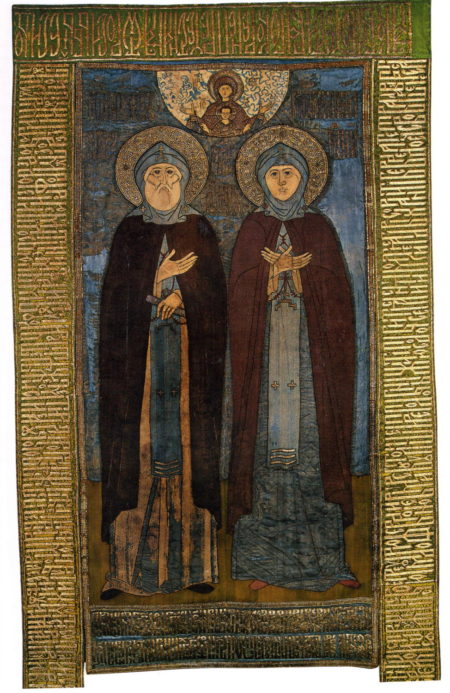 Their united lives of devotion and their example of righteousness and holiness impressed themselves upon the faithful, who recognised qualities to be emulated in Holy Matrimony, reminding us that the first duty of each Orthodox husband and wife is to nurture one another in Faith and to lead one another into the Kingdom of Heaven.