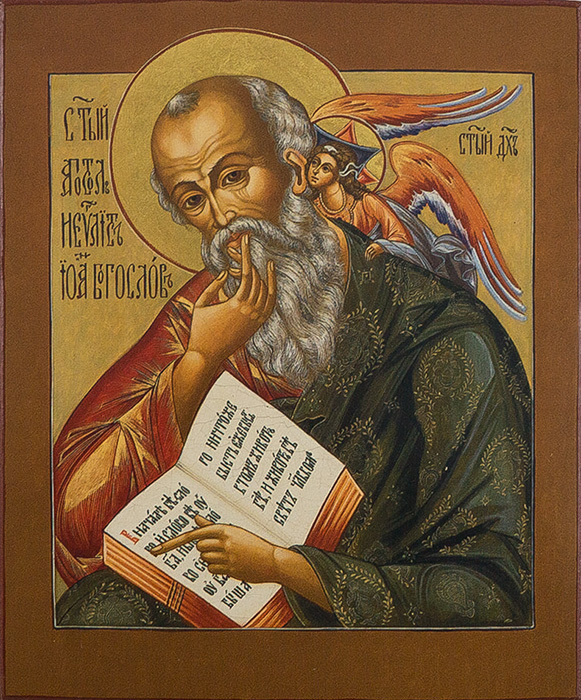
This Sunday’s resumption of the Divine Liturgy will be especially timely, given that it is the feast of St John the Theologian, and therefore the patronal feast of our present home in Canton.
It will be the first time we have been in St John’s for the feast, and it will be a joy and blessing to honour the Holy All-Praised Apostle and Evangelist on his day.
As Allan and Olga will have the good fortune to be worshipping in our San Remo parish on Sunday, and matushka Alla will be attending a conference in Morocco, may I prompt parishioners to bring flowers to adorn the church during Liturgy.
Other parishioners will be heading to Llanelli Liturgy with the newly completed icons for the ikonostas in the little Chapel of St David and St Nicholas, and I very much look forward to seeing them in situ on my return home from our Cardiff Liturgy.
As other parishioners go away, we look forward to the return of our young pilgrims and their accounts of their travels in Greece. Alexander is in our prayers, as he has been off-colour since his return. May God give him good strength. I hope that Oswald will be selling icons after the service, so be prepared!
It has been very good to be able to rest, pray and read in Glastonbury, spending much of yesterday in the abbey and the gardens at Chalice Well with its iron-rich spring waters flowing through the beautiful gardens at the foot of Chalice Hill.
Glastonbury Abbey, a short distance away, claimed the presence, long-stays, pilgimage-visits and relics of many saints, but whether the great monastic house was ever visited by all the saints that the annals claimed, we shall never know, just as we shall never know the voracity of the many relics the monks claimed to possess – some in direct opposition to other claimant-establishments.
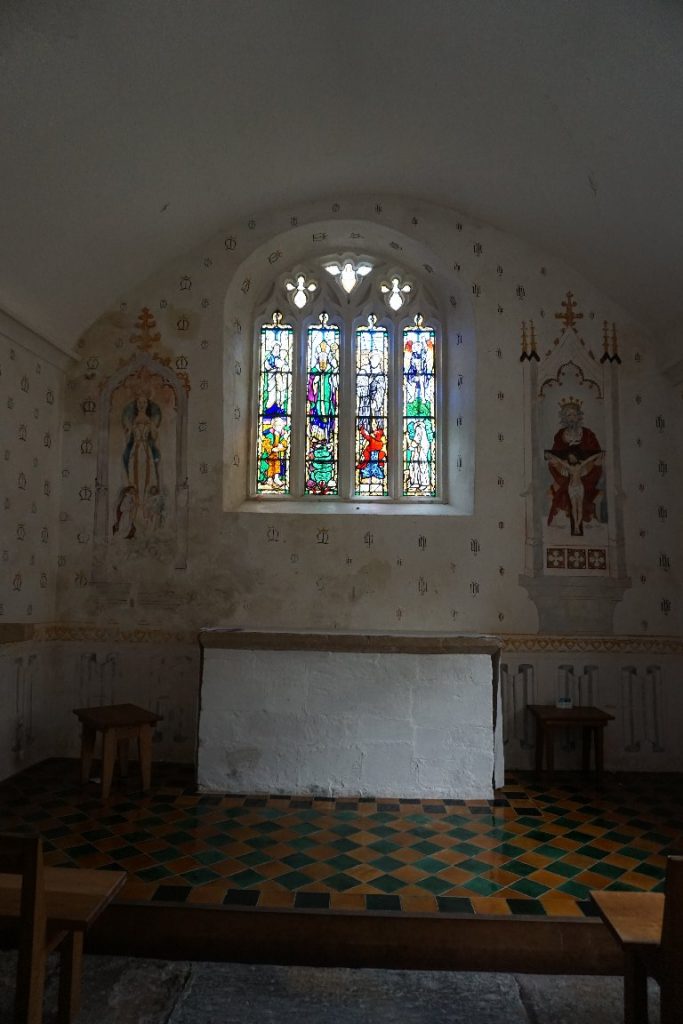
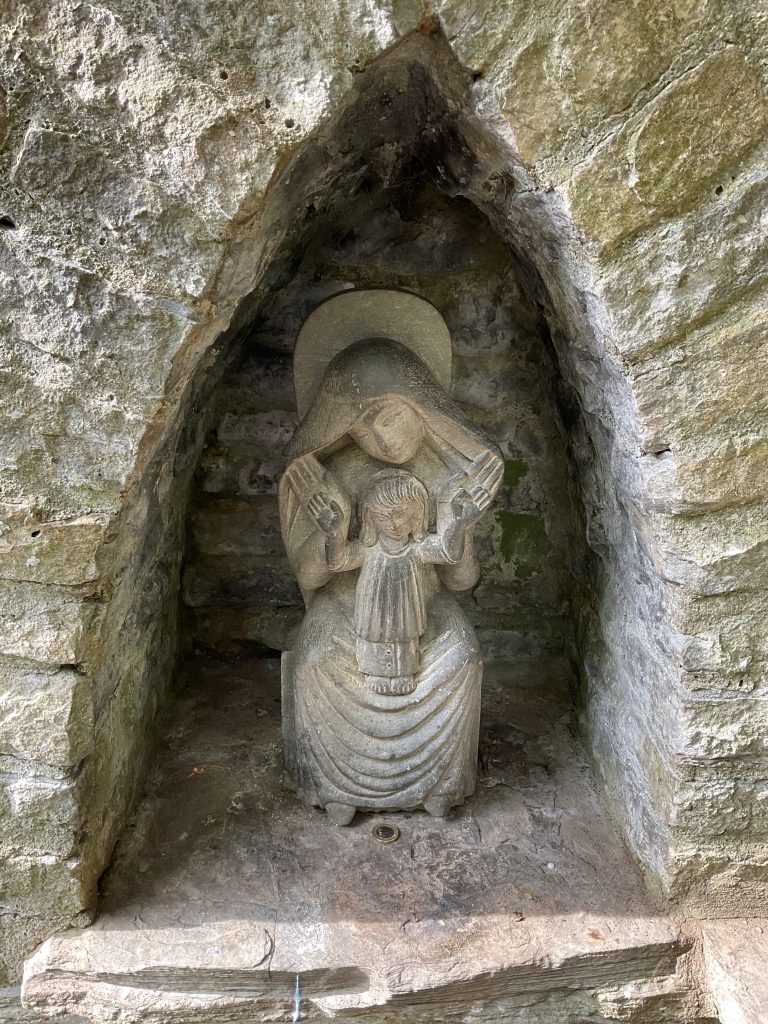
Around the margins of the Glastonbury Icon of the Mother of God, we see many Celtic saints that link Ireland, Wales, Brittany and Somerset – y Gwlad yr Haf – together with the Archangel Michael, St Aristobulus and St Joseph of Arimathea.
The monastic preeminence of Glastonbury Abbey, and its centrality in the growth of Christianity in this part of the British Isles is undeniable, and given the great importance of Glastonbury, it should not surprise us that such eminent saints as David, Patrick and Brigid should be linked with what came to be called Glastonbury with the coming of the English, but was still Ynys Witrin in the age of our great Celtic saints.
As sanctuaries of holiness, culture and learning, the great religious houses of their time were not islands and isolated, but closely interlinked and connected by the much-sailed sea-roads on which monastics – saints among them – visited one another’s communities. Glastonbury was of course an island at that time, making it particularly accessible for those coming from South Wales, with its great religious centres at Llancarfan, Llanilltud-Fawr.
Even though there is now so little to see of the greatest English Abbey that claimed precedence over every other monastic establishment in Britain, and whose abbot sat in the House of Lords, people are still drawn to the ruins, though many through a concocted belief system of their own making.
Yet, whatever people may believe, their coming and going (and I’ve encountered people that repeatedly and regularly come from the far corners of the world) means that the site is loved and cared for, even though it sometimes feels like the Anglican custodians of the ruined abbey have consciously tried to quash any manifestation of spirituality and piety since the millennium: quite ironic considering what the millennium marked.
But, praise God, the site is preserved, even if one can only wonder at the glory of the once great abbey that stood here, and equally wonder at the wanton violence and demonic acts of those who desecrated the great sanctuary on England’s holiest earth. Whilst, in Walsingham England has its Nazareth, in Glastonbury the whole of Britain had its Jerusalem.
Gone are the dazzling colours of gold, paint, jewels and enamel which once adorned the shrines and their treasured relics, but now the colours of nature shine here, especially in autumn.
The abbey has a great many species of trees, soon to be resplendent in their autumn colours, and the flower and herb beds still manage a few flowers after the passing of summer.
I always say to those put off Glastonbury by the New-Age, occult, and and do-it-yourself-pseudo-religious commercially lucrative rubbish, to not be robbed of our holiest site by these works of darkness.
I recall seeing a documentary on the growth of occultism in Glastonbury when I was a teenager, with the camera looking down on the town form the tower of St John’s Church, and its vicar saying what no Anglican incumbent in the town would dare to say now – that the cosmic battle between good and evil is going on right here in this little Somerset town.
This is why must come!
We must come to worship, pray and venerate the holy sites, as I have been doing since I was a teenager – back then, sometimes with the most wonderfully devout friends on the West of England Pilgrimage – a very English, but also very Anglo-Catholic and in-your-face (with all of the senses) demonstration of Christianity.
Much has changed since then. The obvious Christian presence is much diminished, despite the imposing Catholic Parish Church, served by Benedictine monks.
Christianity seems very much in the shadows… which is why we MUST come, honouring the Mother of God in the place of her first British shrine, with David, Patrick, Brigid, Collen, Rumon, Fili, Kea, Indract, Dominica, Beon, Gildas the Wise, Dunstan, and all of the saints who shone forth in Glastonbury.
May they pray for us and for this confused and suffering holy-place.
Even though today only saw the celebration of the Hours, Typika/Obednitsa with Holy Communion, and a moleben before the veneration of the Cross, and no Divine Liturgy, I must admit that it felt so different to last week’s similar liturgical scheme and was such a joyous gathering.
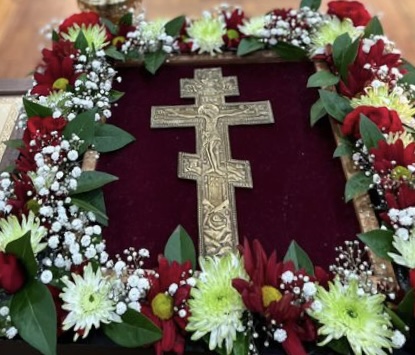
The festal nature of the Sunday after Exultation shone through our aggregate of services, with the chanting of ‘Krestu Tvoyemu’, the veneration and ‘krestotselovanie’ and anointing with oil from Godenovo giving our services a profound spiritual focus.
Thanks are particularly due to matushka Alla for arranging the floral frame for the Cross at very short notice, and to our singers and readers. Thanks are also due to our sisters who provided such excellent home cooked food for trapeza.
We were very happy to congratulate Ludmilla Borisevna on her recent nameday, and I know that her sharlotka was greatly enjoyed by parishioners, and a wonderful autumnal addition to the celebration!
The half-marathon clearly failed to dissuade parishioners from getting to church today, and even though we were without our young pilgrims and a few other parishioners who have commitments elsewhere, there was still a good number of worshippers, and it was lovely to see such a social gathering during trapeza.
It was lovely to have Father Luke and Swansea parishioners with us, and we are very grateful for help with confessions. This made a tremendous difference, and we always value this assistance with the Holy Mysteries.
The appearance of Oswald, fresh from the coach from London, after his return journey from Greece was most welcome, and he has now reactivated his eBay icon-shop, after our having the stock at St John’s and selling icons after Liturgy for the last few weeks.
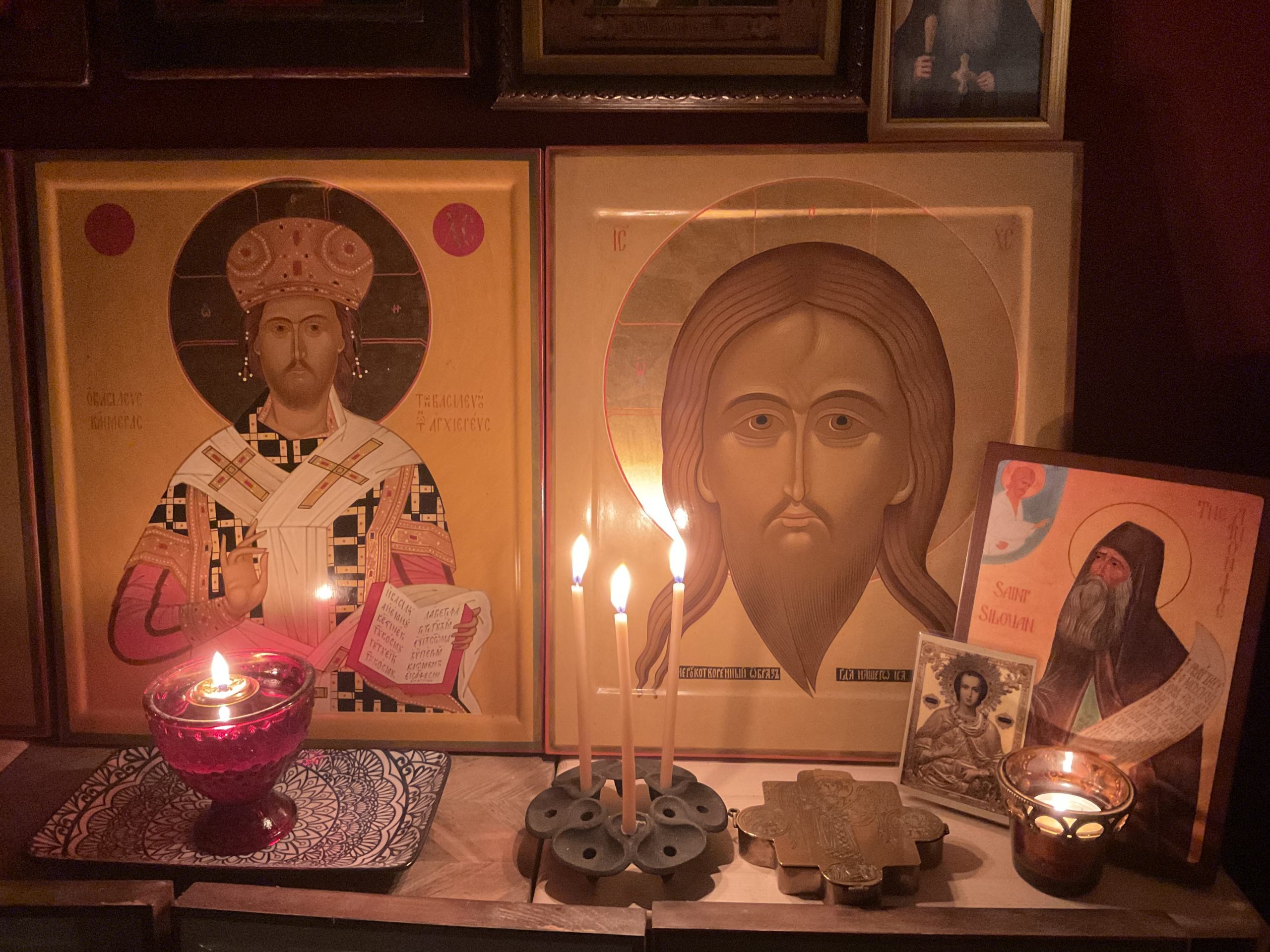
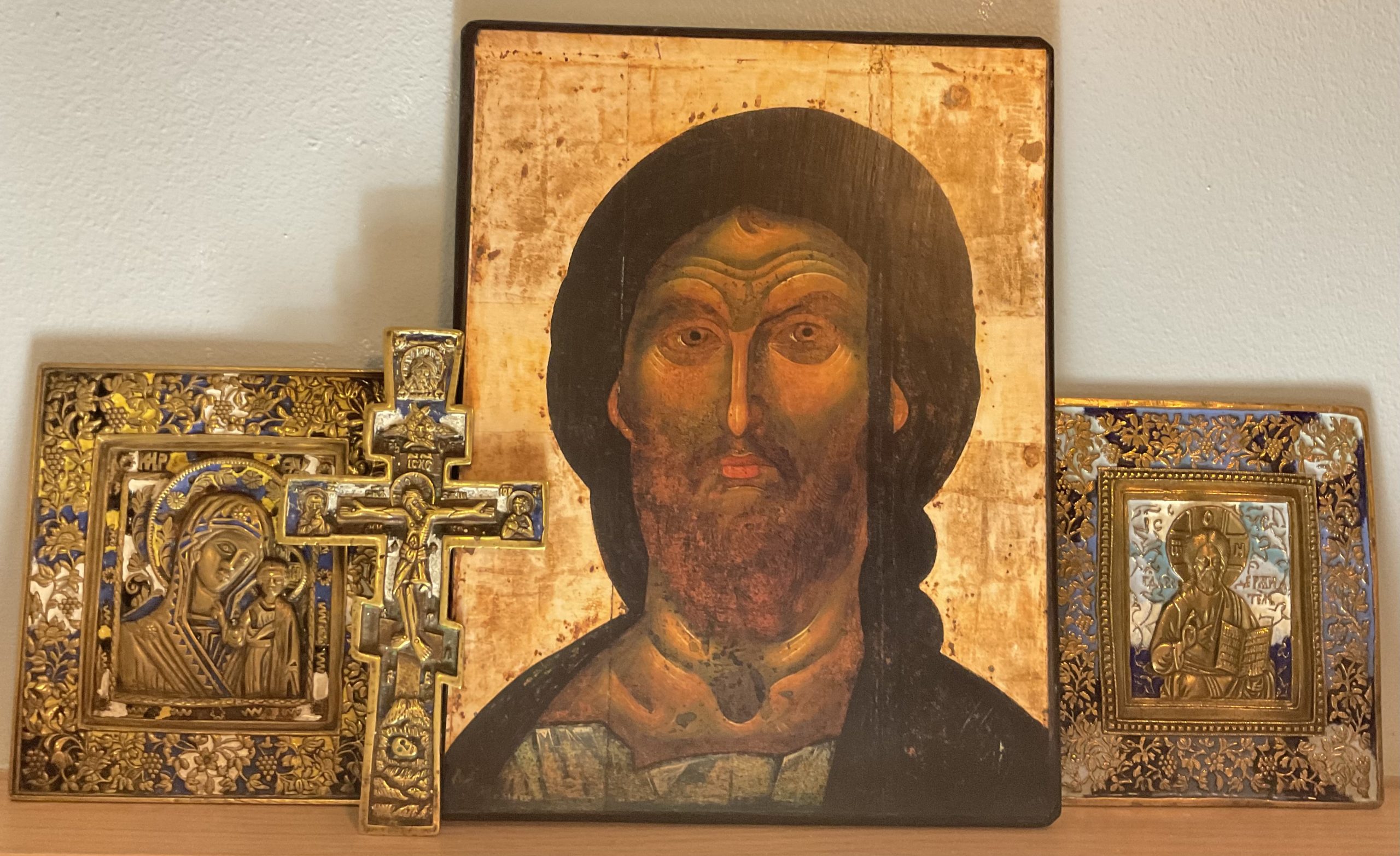
As I sit typing this greeting, in Glastonbury, the Saviour of the Burning-Eye, bought from his lavka today is the focus of my prayers and a most welcome and powerful addition to my ‘travelling icon-corner’.
I hope that icons will continue to be available after Liturgy.
The afternoon saw the baptism of Maxim, who was our first child to desperately want to go back into the font, though last Sunday it was clear at little Pavel’s baptism that four years after his own, Yuriy would have happily done the same! We pray for the newly enlightened Maxim, and for Yevgeniy and Maria his sponsors. May God grant them many blessed years.
I shall be in Glastonbury for a few days of prayer and quiet, having already felt the benefit in just four hours. This is, of course, a place central to the coming of the Gospel to Britain and was the first and most important monastery of these islands. Despite the nonsense and sinister practices that go on here now, it is important that we value the local sacred sights and pray and worship here as Christians grounded in the continuance of the apostolic Church. Saints of Glastonbury, pray to God for us!
Thanks to Father Deacon Mark for dropping me here on his journey to Devon, and thanks to Nataliya for dispatching me with a box of pirozhky for tea.
Again, we will schedule confessions for Saturday, and we greatly look forward to the resumption of the Divine Liturgy. As I said before Holy Communion, remembering the impossibility of Liturgy for so many people during the Soviet period, let us never take it for granted, and thank God for every day that is blessed by the celebration of the Holy Mysteries.
Please email requests for confession by 22:00 on Wednesday, please.
May God bless you all, and I ask you to continue to remember me in your prayers, rejoicing that they are being answered by the All-Merciful Lord.
Even though I am happy to say that my blood-pressure is much lower and my health situation is improving, I do not feel the celebration of the Divine Liturgy is yet possible, so this weekend will see a repeat of last weekend’s liturgical arrangements.
Again, we will begin at 11:00 and celebrate the Hours and Typika (Obednitsa), with Communion administered from the reserved Holy Gifts. I hope that subsequently, after a second week of rest, we will return to the celebration of the Divine Liturgy.
I am very grateful to all of who have sent messages over the last week, and even more to those who have been praying for my health, including our young men on pilgrimage in Greece. May God bless you all!
Sunday will see major disruption to transport, as so many roads will be closed for the Cardiff half-marathon, so please consult the map at the following link:
As we celebrate this feast of the holy martyrs Sophia, Vera, Nadezhda and Liubov, we have so many sisters to congratulate as they celebrate their nameday.
We send our greetings to Sophia in Mumbles; to Sophia of our cathedral sisterhood; to Vera Alexandrovna, our cathedral starosta; to Nadia in Swansea; to Masha’s daughter Nadja; to ‘mama Liuba’ Cheltenham; and to Liuba in Father Paul’s parish.
We pray for God’s blessing, and that He may grant them ‘Many Years!’
Многая и благая лтѣа!
In the reign of the Roman Emperor Hadrian (117-138) there lived a widow called Sophia which in Greek means “wisdom”. She was a Christian, and in accordance with her name, she lived her life wisely. She had three beautiful daughters whom she called by the names of the three Christian virtues: the first was called Faith, the second Hope, and the youngest Love. She taught her daughters to live in u way pleasing to God by prayer, fasting and helping the poor. As the children grew in age, so also they grew in virtue, being obedient to their mother, They read diligently and knew well the books of the Prophets and Apostles; they were fervent in prayer and house-work. Their beauty combined with their virtuous lives attracted the attention of many.
When the fame of their lives reached the pagan Emperor Hadrian, he sent for them to come to him. The wise mother warned her daughters that the Emperor persecuted Christians and would tempt them to worship the pagan idols by promising them great gifts, riches and honor and all the things of beauty and pleasure in this vain world She begged them to choose rather their beloved Lord Jesus Christ and the heavenly beauty such as human eyes have never seen and which God has promised to those who love Him. “0 my dear daughters,” she said, “to remember my words with which I taught you the fear of God and comfort your mother in her old age by your good and courageous confession of faith in Christ.” Encouraging and supporting one another, they promised their mother that with Christ’s help they would put into practice all her valuable advice
When the Emperor’s servants came for them, all four-mother and daughters-protected themselves with the sign of the Cross saying: “Help us,. O God, our Saviour, for the glory of Thy holy Name.”
On reaching the palace, they were presented to the Emperor. Seeing their beauty and their bright and fearless faces, the Emperor began to ask them their names, they answered that they were all Christians and wished to live for Christ alone Who is to be worshipped by all generations.
Hearing this, the Emperor grew angry. Just as the mother had warned he asked the girls to be as his children and worship his gods, promising them glory and honor; but if they would not obey he threatened to torture and kill them. The holy virgins answered him with one voice:
“Our Father is God Who lives in heaven. He takes care of us and our life. We want to be loved by Him and we wish to be called His true children. Worshipping Him and keeping His laws and commandments, we spit on your gods, and we are not afraid of your threats.”
The Emperor was very surprised at the courage of these young girls. At this time Faith was 12 years old, Hope was 10, and Love was just 9
The Emperor again tried to force them to worship his false gods. He commanded Faith to offer sacrifice to the goddess Artemis. When she refused she was beaten and tortured. Faith endured all of this evil bravely by calling upon her Lord, and when she was put in a cauldron of boiling tar and oil she remained unharmed. She sat in it as if it were cool water and sang praises to God. Seeing that no amount of torture could force the girl to give up her faith in Christ, the cruel Emperor ordered her to be beheaded before the very eyes of her mother and younger sisters.
When the second sister Hope also refused to worship the false gods, she was thrown into a fire, but she too remained unharmed and glorified the true God. The torturer was furious that he could not hurt her and ordered her to be thrown into the boiling cauldron, but it at once melted like wax, and the tar and oil poured out and burnt the bystanders. Ashamed that he was unable to shake the faith of such a young girl, the torturer ordered Hope to be beheaded. Knowing that the same cruel torture awaited her younger sister, Hope encouraged her and said, “Do not be left here, sister. Let us stand together be- fore the Holy Trinity.” Then she bent her head and was beheaded with a sword.
When the torturer called the youngest sister, Love, to worship the false gods, she also, even after seeing her sisters’ tortures, did not hesitate to confess her faith in Jesus Christ. She was ordered to be thrown into a stove, but just like the three youths in the Old Testament, Love remained in the stove unharmed; walking about as if in a cool place, singing and praising God. The Emperor ordered still more cruel tortures, but the young girl proved true to her name for love “endureth all things” (I Cor 13:7). Finally, she too was beheaded and went to join her sisters who stood before the throne of their beloved Lord Jesus Christ.
Their mother rejoiced, knowing that each of her daughters had received a heavenly crown. Soon she too passed on to the Lord and shared with her daughters in the heavenly kingdom. St. Sophia also received a martyr’s crown, for, if not in body, at least in her heart, she too suffered for Christ.
We congratulate our parishioner Ludmilla Borisevna on her nameday as we celebrate the feast of her heavenly patron, praying that God will grant her Many Blessed Years!
Многая и благая лтѣа!
The Holy Martyr Ludmilla, a Czech (Bohemian) princess, was married to the Czech prince Borivoy. Both spouses received holy Baptism from Saint Methodius, Archbishop of Moravia and Enlightener of the Slavs (Comm. 11 May).
As Christians, they showed concern for the enlightening of their subjects with the light of the true Faith, they built churches and invited priests to celebrate the divine services. Prince Borivoy died early at age 36. Saint Ludmilla, as a widow, led an austere, pious life and continued to be concerned for the Church during the reign of her son Bratislav, which lasted for 33 years.
Bratislav was married to Dragomira, with whom he had a son, Vyacheslav. After the death of Bratislav, eighteen-year-old Vyacheslav came on the throne. Taking advantage of the inexperience and youth of her son, Dragomira began to introduce pagan manners and customs in the country.
Saint Ludmilla, of course, opposed this. Dragomira came to hate her mother-in-law and tried to destroy her. When Saint Ludmilla moved away to the city of Techin, Dragomira sent two boyars in secret to murder her. Saint Ludmilla was praying at the time, and the two assassins entered the house and carried out Dragomira’s orders.
The relics of the holy Martyr Ludmilla was buried in Techin in the city wall. Numerous healings occurred at her grave. Prince Vyacheslav transferred the body of Saint Ludmilla to the city of Prague and placed it in the church of Saint George.
Greetings as we celebrate the Exultation of the Life-Giving Cross of the Lord.
On this festal day, let each of us embrace the Cross – both physically and spiritually – and contemplate its meaning in our lives.
The Cross should not simply be exalted in the liturgical rites and feasts of the Church, but in our daily lives as those have been sealed with the sign of the Cross in the Mysteries of our baptism and chrismation.
Every day should be our personal Exultation of the Precious and Life-Giving Cross: exalted by our prayers, our actions, our thoughts, and even by the movements of our heart, soul and mind… yet so often we are like the iconoclasts, God-hating Bolsheviks and infidels who trampled upon the Cross; so often, we are hypocrites, constantly making the sign of the cross, wearing it around our necks, kissing it in Church, praying before it in our icon-corners, yet disparaging it by the sinful-rebellion and neglect of our lives.
With every cruel or thoughtless deed and word; by every act of judgment and condemnation; in every selfish rejection and insensitivity to our neighbour; in our neglect of those in need; through every impurity of mind, sense and body; through neglect of prayer and fasting; and in everything that opposes the Holy Gospel, we trample upon the Cross.
As the sign of Christ’s obedience to the will of the Father, even unto the death of the Cross; as the realisation of Christ’s sacrificial love for the world; as the physical manifestation of Christ’s selfless willingness to deny Himself for the sake of all – the Cross must manifest Christ’s obedience and selfless, sacrificial-love in our lives, through our willingness to embrace it as the sign and summation of what it means to be a Christian in deed, not simply in name.
So let us exult the Cross by loving the Lord with our whole heart and mind and soul, and by selflessly loving our neighbour with patience, tolerance and understanding; let us exalt the Cross by putting God and all others before ourselves; let us exalt the Cross by the sobriety and watchfulness of our lives; let us exalt the Cross by struggling to be pure, patient humble; let us exalt the Cross in worship, prayer, fasting and the ascetic-feat of the Christian life; let us exalt the Cross by our repentance and the struggle for holiness; in short, let us exalt the Cross by reflecting its every meaning in our lives.
Then the Saviour’s victory, by which Hell was shattered and the devil defeated, will become real in our lives, even though we are weak and feeble.
Then the Cross will be our strength, our sign of hope, and our invincible weapon – not simply an ornament that hangs around our necks.
It is in this joyful knowledge, as Christ’s children who have been baptised into the mystery of the Cross, that we can approach the Cross with confidence, embrace it and say:
“Let God arise and let His enemies be scattered, and let them that hate Him flee from before His face. As smoke vanisheth, so let them vanish; as wax melteth before the fire, so let the demons perish from the presence of them that love God and who sign themselves with the sign of the Cross and say in gladness: Rejoice, most precious and life-giving Cross of the Lord, for Thou drivest away the demons by the power of our Lord Jesus Christ Who was crucified on thee, Who went down to hades and trampled on the power of the devil, and gave us thee, His precious Cross, for the driving away of every adversary. O most precious and life-giving Cross of the Lord, help me together with the holy Lady Virgin Theotokos, and with all the saints, unto the ages. Amen.”
The Canon of the Cross, the acrostic whereof is: “Having arrayed myself in the Cross, I give utterance to hymnody”; The composition of Cosmas of Maiuma, in Tone VIII:
Ode I, Irmos: Inscribing the invincible weapon of the Cross upon the waters, * Moses marked a straight line before him with his staff * and divided the Red Sea, * opening a path for Israel who went over dry-shod. * Then he marked a second line across the waters * and united them in one, * overwhelming the chariots of Pharaoh. * Therefore let us sing to Christ our God, * for He hath been glorified.
Glory to Thy Precious Cross, O Lord.
Of old, Moses, standing between the priests, prefigured in himself the image of Christ’s most pure sufferings; for, forming a cross with his outstretched arms, he raised up victory, vanquishing the might of the tyrant Amalek. Wherefore, let us hymn Christ our God, for He hath been glorified.
Glory to Thy Precious Cross, O Lord.
Of old, Moses, standing between the priests, prefigured in himself the image of Christ’s most pure sufferings; for, forming a cross with his outstretched arms, he raised up victory, vanquishing the might of the tyrant Amalek. Wherefore, let us hymn Christ our God, for He hath been glorified.
Glory be to the Father, and to the Son, and to the Holy Spirit.
Upon a pole Moses set the cure of the deadly and venomous sting of the serpents, and the deliverance therefrom; for to the tree, in the image of the Cross, he bound a serpent which crawleth upon the ground, triumphing over the sinister bane therein. Wherefore, let us hymn Christ God, for He hath been glorified.
Both now and ever, and unto the ages of ages. Amen.
The sky showed forth the victory of the Cross to the divinely wise Emperor Constantine, the pious ruler; and therein the audacity of the hostile foe was cast down, delusion was destroyed and the divine Faith spread to the ends of the earth. Wherefore let us hymn Christ our God, for He hath been glorified.
Ode III, Irmos: The rod of Aaron is an image of this mystery, * for when it budded it showed who should be priest. * So in the Church, that once was barren, * the wood of the Cross hath now budded forth, * filling her with strength and steadfastness.
Glory to Thy Precious Cross, O Lord.
The rough stone, struck, put forth water for a disobedient and hard-hearted people, and showed forth the mystery of the divinely elect Church, whereof the Cross is the might and confirmation.
Glory to Thy Precious Cross, O Lord.
The rough stone, struck, put forth water for a disobedient and hard-hearted people, and showed forth the mystery of the divinely elect Church, whereof the Cross is the might and confirmation.
Glory be to the Father, and to the Son, and to the Holy Spirit.
When Christ’s most pure side was pierced by the spear, blood and water flowed therefrom, renewing the covenant and washing sin away, for the Cross is the boast of the faithful, the might and confirmation of kings.
Both now and ever, and unto the ages of ages. Amen.
When Christ’s most pure side was pierced by the spear, blood and water flowed therefrom, renewing the covenant and washing sin away, for the Cross is the boast of the faithful, the might and confirmation of kings.
Lord, have mercy. Lord, have mercy. Lord, have mercy.
Glory be to the Father, and to the Son, and to the Holy Spirit; both now and ever, and unto the ages of ages. Amen.
Sessional Hymn, in Tone IV: Spec. Mel. “Go thou quickly before …”: Rejoicing in thee, O thrice blessed and life-bestowing Cross, the people celebrate together with the immaterial choirs, the ranks of hierarchs reverently hymn thee, multitudes of monastics and fasters bow down before thee in adoration, and we all glorify Christ Who was crucified on thee.
Ode IV, Irmos: O Lord, I have heard the mystery of Thy dispensation; * I have considered Thy works, * and I have glorified Thy Divinity.
Glory to Thy Precious Cross, O Lord.
Of old, Moses transformed the bitter springs in the desert with a tree, showing forth the conversion of the gentiles to piety through the Cross
Glory to Thy Precious Cross, O Lord.
Jordan, having hidden in its depths an axe-head, gave it forth again through the power of a stick, signifying the cutting off of deception by the Cross and baptism.
Glory be to the Father, and to the Son, and to the Holy Spirit.
In a sacred manner the people encamped in four divisions; and preceding in this fashion the tabernacle of the witness, they were glorified in the cross-like formation of their ranks.
Both now and ever, and unto the ages of ages. Amen.
Wondrously stretched forth, the Cross emitted rays like the sun’s, and the heavens declared the glory of our God.
Ode V, Irmos: O thrice-blessed Tree, on which Christ the king and Lord was stretched! * Through thee the beguiler fell, * who tempted mankind with the tree. * He was caught in the trap set by God, * who was crucified upon thee in the flesh, * granting peace unto our souls.
Glory to Thy Precious Cross, O Lord.
O ever-hymned Tree, whereon Christ was stretched: the whirling sword which guarded Eden stood in awe of thee, O Cross, and the dread cherubim withdrew, when Christ was nailed to thee, Who granteth peace unto our souls.
Glory to Thy Precious Cross, O Lord.
O ever-hymned Tree, whereon Christ was stretched: the whirling sword which guarded Eden stood in awe of thee, O Cross, and the dread cherubim withdrew, when Christ was nailed to thee, Who granteth peace unto our souls.
Glory be to the Father, and to the Son, and to the Holy Spirit.
The adverse powers of the nether world are stricken with fear when the sign of the Cross is traced in the air in which they live, as are the generations of the earthborn and the heavenly, who bend the knee to Christ, Who granteth peace unto our souls.
Both now and ever, and unto the ages of ages. Amen.
Having shone forth a divine light and revealed itself in rays of incorruption unto the darkened gentiles astray in error, the divine Cross acquireth them for Christ Who was nailed thereto, and granteth peace unto our souls.
Ode VI, Irmos: Jonah stretched out his hands in the form of a cross * within the belly of the sea monster, * plainly prefiguring the redeeming Passion. * Cast out from thence after three days, * he foreshadowed the marvelous Resurrection of Christ our God, * who was crucified in the flesh and enlightened the world * by His Rising on the third day.
Glory to Thy Precious Cross, O Lord.
Bent with age and weighed down with infirmity, Jacob drew himself up when he crossed his arms, showing forth the power of the life-bearing Cross; for God Who was nailed in the flesh hath set aright the obsolescence of the law of the Scripture which was written in shadows, and dispelled the soul-destroying disease of deception.
Glory to Thy Precious Cross, O Lord.
Bent with age and weighed down with infirmity, Jacob drew himself up when he crossed his arms, showing forth the power of the life-bearing Cross; for God Who was nailed in the flesh hath set aright the obsolescence of the law of the Scripture which was written in shadows, and dispelled the soul-destroying disease of deception.
Glory be to the Father, and to the Son, and to the Holy Spirit.
Divine Jacob, in laying his hands cross-wise upon the heads of the youths, revealed that those serving under the law give precedence to the firstborn. Wherefore, when he suspected he had erred in laying his hands cross-wise, he did not alter the life- bearing image, for the newly established people of Christ God, protected by the Cross, shall have precedence over those under the law.
Both now and ever, and unto the ages of ages. Amen.
Divine Jacob, in laying his hands cross-wise upon the heads of the youths, revealed that those serving under the law give precedence to the firstborn. Wherefore, when he suspected he had erred in laying his hands cross-wise, he did not alter the life- bearing image, for the newly established people of Christ God, protected by the Cross, shall have precedence over those under the law.
Lord, have mercy. Lord, have mercy. Lord, have mercy.
Glory be to the Father, and to the Son, and to the Holy Spirit; both now and ever, and unto the ages of ages. Amen.
Kontakion of the Cross, in Tone IV: O Thou Who wast lifted up willingly upon the Cross, * bestow Thy mercies upon the new community named after Thee, * O Christ God; gladden with Thy power Orthodox Christians, * granting them victory over enemies; ** may they have as Thy help the invincible trophy, the weapon of peace.
Ikos: He who was caught up to the third heaven of paradise and heard unspeakable and divine words which the human tongue cannot utter, what writeth he to the Galatians, which, as lovers of the Scriptures, ye have both read and come to understand? God forbid, saith he, that I should glory, save only in the Cross of the Lord, whereon having suffered He slew the passions. Let us all then firmly hold this boast, the Cross of the Lord; for this Wood is our salvation, the invincible trophy, the weapon of peace.
Ode VII, Imos: The senseless decree of the wicked tyrant, * breathing forth threats and blasphemy hateful to God, * confused the people. * Yet neither the fury of the wild beast nor the roaring of the fire * could frighten the three Children: * but standing together in the flame, * fanned by the wind that brought refreshment as the dew, they sang: * ‘Blessed and supremely praised art Thou, * O our God and the God of our fathers.’
Glory to Thy Precious Cross, O Lord.
The first man, tasting of the tree, went to dwell in corruption; for, having condemned himself to a shameful banishment from life, he imparted corruption to the whole race of mankind. But we mortals, finding restoration through the tree of the Cross, cry aloud: O supremely hymned God of our fathers, blessed art Thou!
Glory to Thy Precious Cross, O Lord.
Breaking the commandment of God came about through disobedience, and the untimely partaking of the fruit of the tree brought death to mankind, but to preserve that which is most precious, access to the tree of life was forbidden, until God opened it to the suffering thief who with a proper understanding cried aloud: O supremely hymned God of our fathers, blessed art Thou!
Glory be to the Father, and to the Son, and to the Holy Spirit.
Israel, foreseeing things to come, laid hold of the tip of Joseph’s staff, revealing beforehand that the most glorious Cross would seize the power of the kingdom, for it is the victorious boast of kings and a light for those who cry aloud with faith: O supremely hymned God of our fathers, blessed art Thou!
Both now and ever, and unto the ages of ages. Amen.
Israel, foreseeing things to come, laid hold of the tip of Joseph’s staff, revealing beforehand that the most glorious Cross would seize the power of the kingdom, for it is the victorious boast of kings and a light for those who cry aloud with faith: O supremely hymned God of our fathers, blessed art Thou!
Ode VIII, Irmos: O children equal in number to the Trinity: * bless ye God, the Father and Creator; * hymn ye the Word Who came down * and transformed the fire into dew; * and supremely exalt ye Him Who giveth life unto all, * the most holy Spirit, * throughout the ages!
Glory to Thy Precious Cross, O Lord.
O hosts of heaven, chant ye to the exalted Tree which was drenched in the blood of the incarnate Word of God, and celebrate the restoration of those born on earth. O Ye people, worship the Cross of Christ, by which the world hath been granted the resurrection throughout all ages!
Glory to Thy Precious Cross, O Lord.
O hosts of heaven, chant ye to the exalted Tree which was drenched in the blood of the incarnate Word of God, and celebrate the restoration of those born on earth. O Ye people, worship the Cross of Christ, by which the world hath been granted the resurrection throughout all ages!
Glory be to the Father, and to the Son, and to the Holy Spirit
O ye mortal stewards of grace, with your hands reverently raise on high the Cross whereon Christ God stood and the spear which pierced the body of God the Word, that all the nations may see the salvation which is of God, glorifying Him throughout all ages!
Both now and ever, and unto the ages of ages. Amen.
O faithful Christian kings, forechosen by divine decree, be ye glad! And having received from God the precious Cross, rejoice in it, the weapon of victory, for thereby tribes of enemy warriors seeking to make battle have been scattered throughout all ages.
Refrain: Magnify, O my soul, the all-honored Cross of the Lord!
Ode IX, Irmos: O Theotokos, thou art a mystical Paradise, * who untilled brought forth Christ. * by Whom the life-giving Tree of the Cross hath been planted upon the earth: * Therefore celebrating its exaltation on this day, * Him do we worship * and thee do we magnify.
Refrain: Magnify, O my soul, the all-honored Cross of the Lord!
Let all the trees of the forests rejoice, for their nature hath been sanctified by Him Who planted them in the beginning – Christ Who was stretched out upon the Tree. Wherefore, worshiping it as it is now raised aloft, we magnify thee, O Theotokos.
Refrain: Magnify, O my soul, the all-honored Cross of the Lord!
A sacred horn hath been lifted up, the chief horn for all the divinely wise: the Cross, whereby all the horns of the sinful are noetically broken asunder. Wherefore, worshiping it as it is now raised aloft, we magnify thee, O Theotokos.
Refrain: Magnify, O my soul, the all-honored Cross of the Lord!
That Thou mayest show the Cross, the invincible weapon, to the world, O adored Lord and King, in the sight of all Thou didst form its most glorious image in the skies, radiant with boundless light. Wherefore, all the powers of heaven magnify Thee.
Refrain: Magnify, O my soul, the exaltation of the life-creating Cross of the Lord!
Second canon, Ode IX, Irmos: Today the death that came to man through eating of the tree, * is made of no effect through the Cross. * For the curse of our Mother Eve * that fell on all mankind * is destroyed by the fruit of the pure Mother of God, * whom all the powers of heaven magnify.
Refrain: Magnify, O my soul, the exaltation of the life-creating Cross of the Lord!
Thou didst not permit the murderous bitterness of the tree to remain, O Lord, for thou didst utterly destroy it by the Cross. Wherefore, by a tree Thou didst once sweeten the bitterness of the waters of Marah, prefiguring the activity of the Cross, which all the hosts of heaven magnify.
Refrain: Magnify, O my soul, the exaltation of the life-creating Cross of the Lord!
Thou didst not permit the murderous bitterness of the tree to remain, O Lord, for thou didst utterly destroy it by the Cross. Wherefore, by a tree Thou didst once sweeten the bitterness of the waters of Marah, prefiguring the activity of the Cross, which all the hosts of heaven magnify.
Refrain: Magnify, O my soul, the exaltation of the life-creating Cross of the Lord!
Today Thou hast raised up by the Cross those who remain continually mired in the darkness of our forefather, O Lord; for though our nature was humbled through deceit and an exceeding lack of restraint, the light of Thy Cross hath again guided all of us aright, which we, the faithful magnify.
Refrain: Magnify, O my soul, the exaltation of the life-creating Cross of the Lord!
That Thou mightest reveal to the world the image of the Cross venerated among all, O Lord, Thou didst trace its outline in the heavens, in that it is most glorious, radiant with boundless light: the invincible weapon for the emperor. Wherefore, all the hosts of heaven magnify Thee.
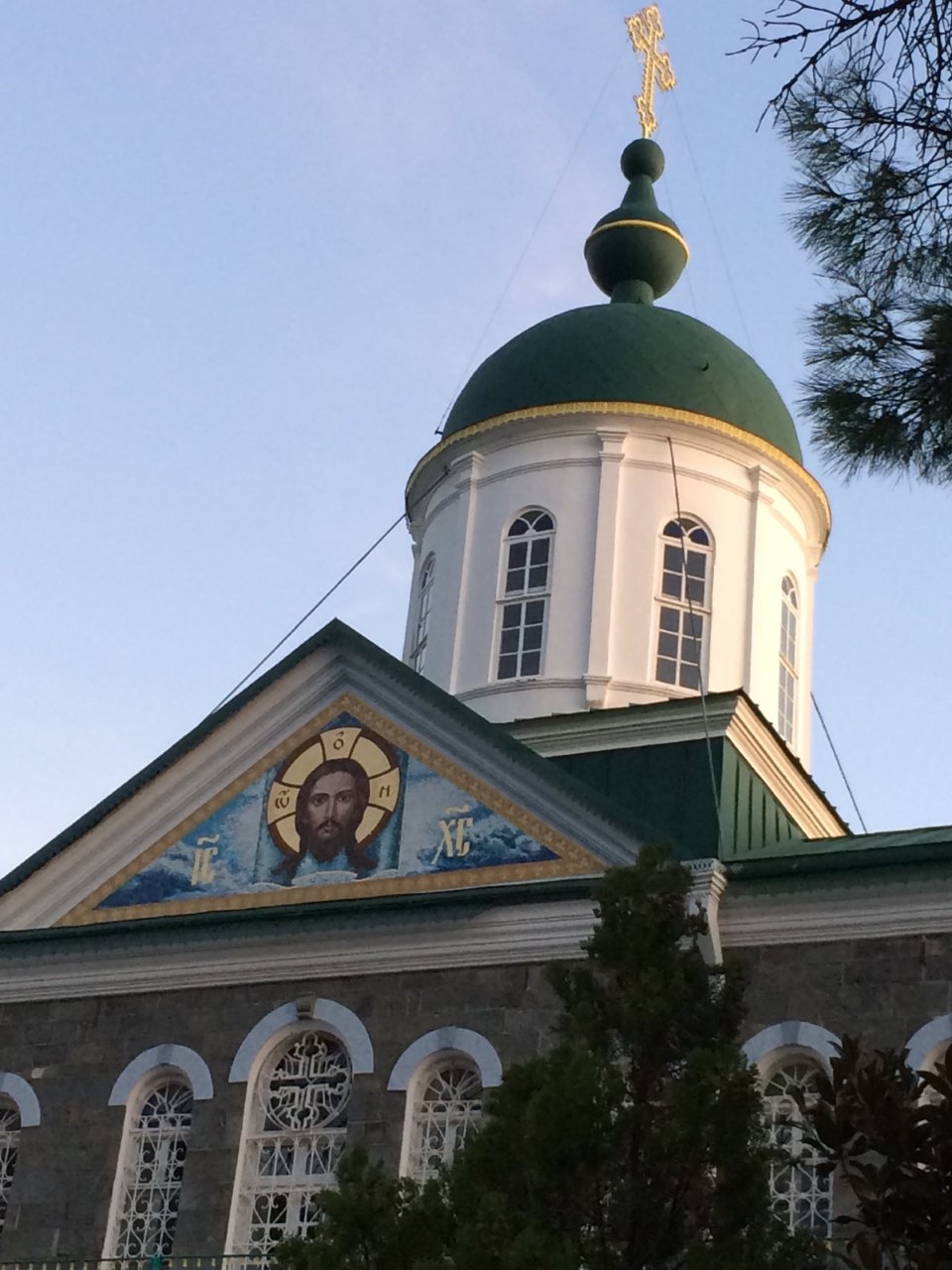
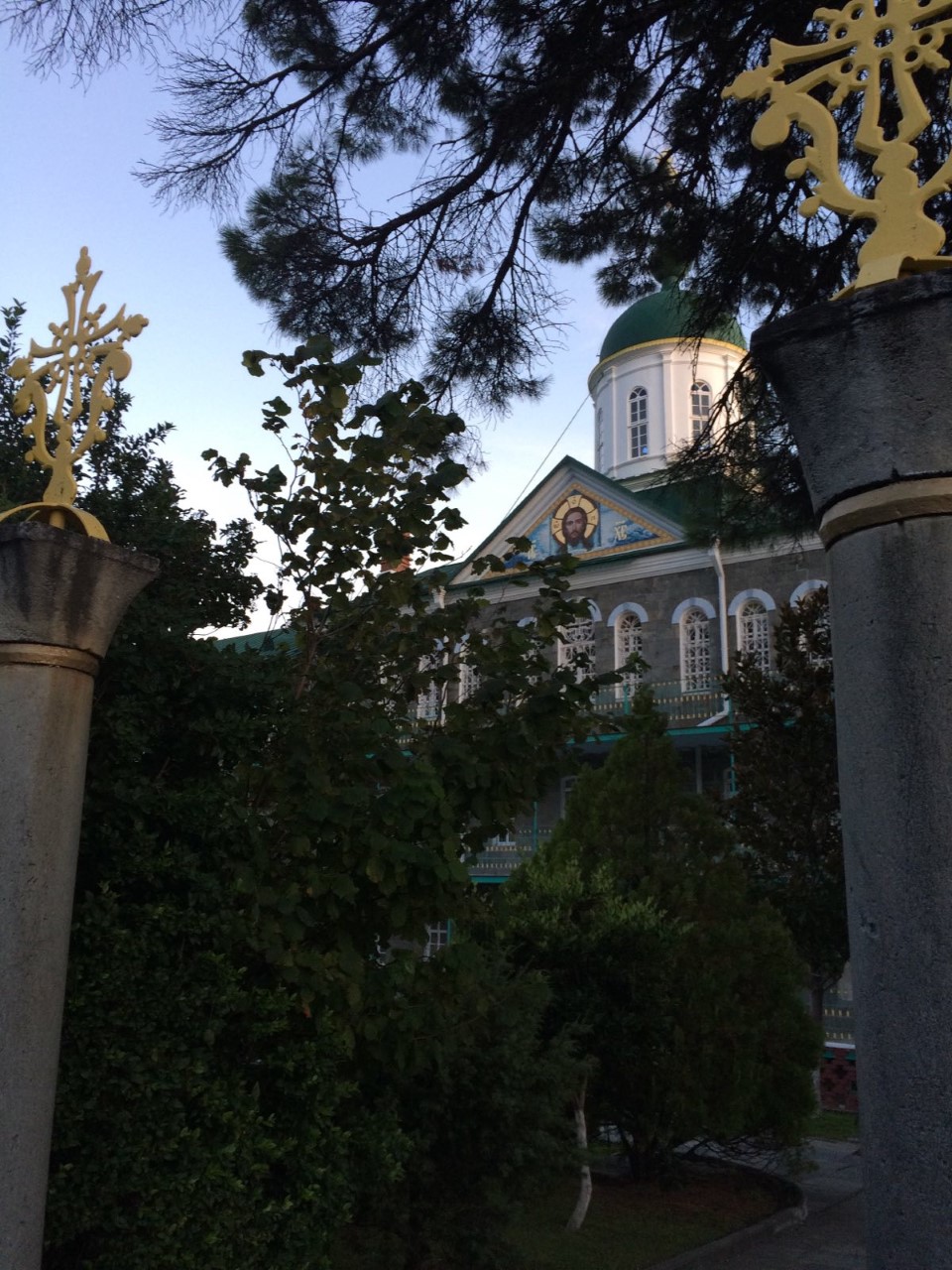
Yesterday evening, it was a joy to hear from Alexander and George, who have been greatly blessed on their pilgrimage to the Holy Mountain, in the sacred monasteries of Docheiariou and St Panteleimon.
In Docheiariou, they had the great privilege of venerating the icon of the Mother of God ‘Quick to Hear’ and receiving the speedy help of the Theotokos in solving accommodation problems, whilst in the Russikon they were able to venerate the skull of the Holy Great-Martyr and Healer, Panteleimon, the beloved heavenly patron of the cenobium.
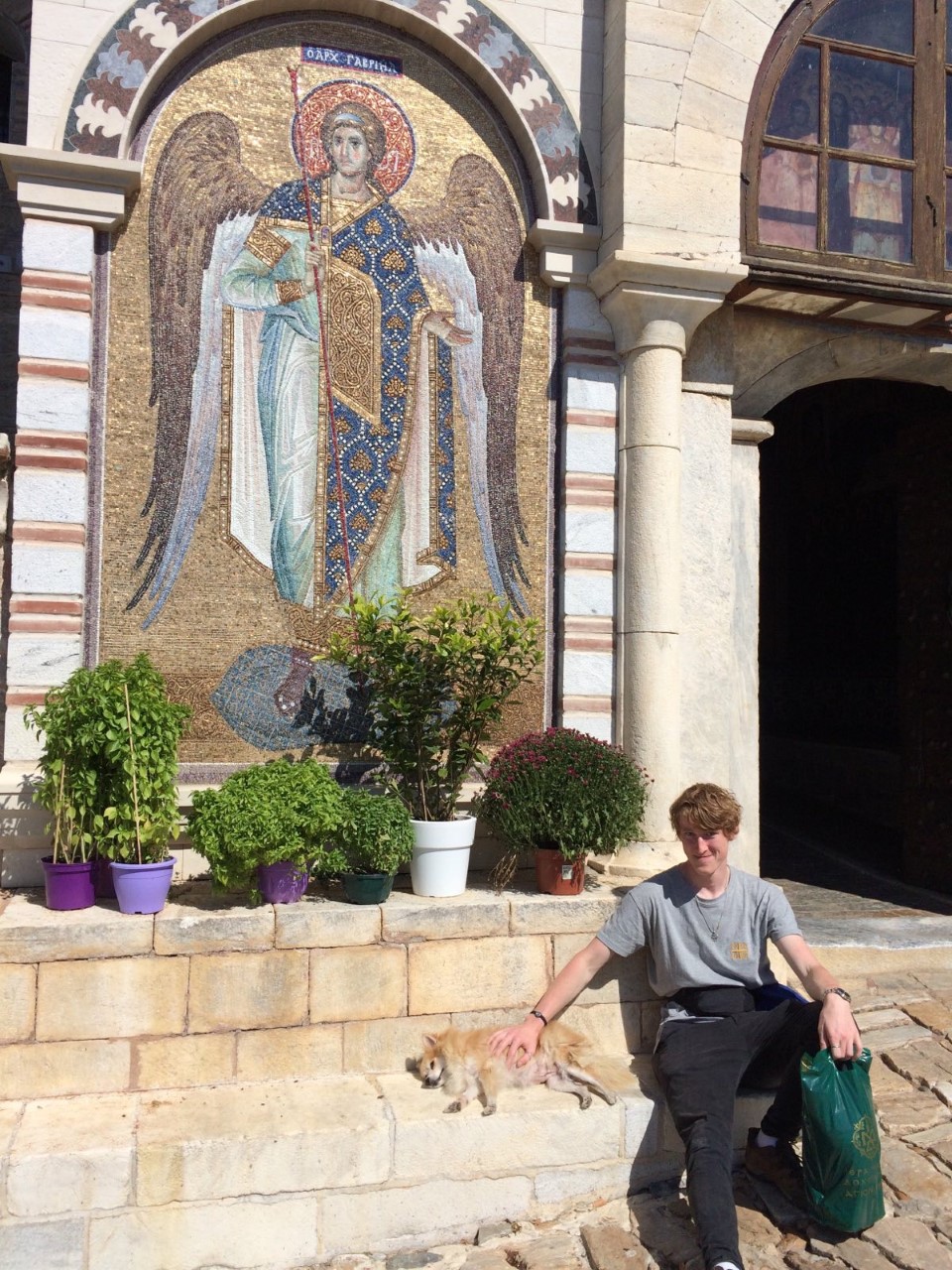
The messages from our young men make clear how much God’s Grace and love has touched them, and how much they have felt His Presence. Glory to God!
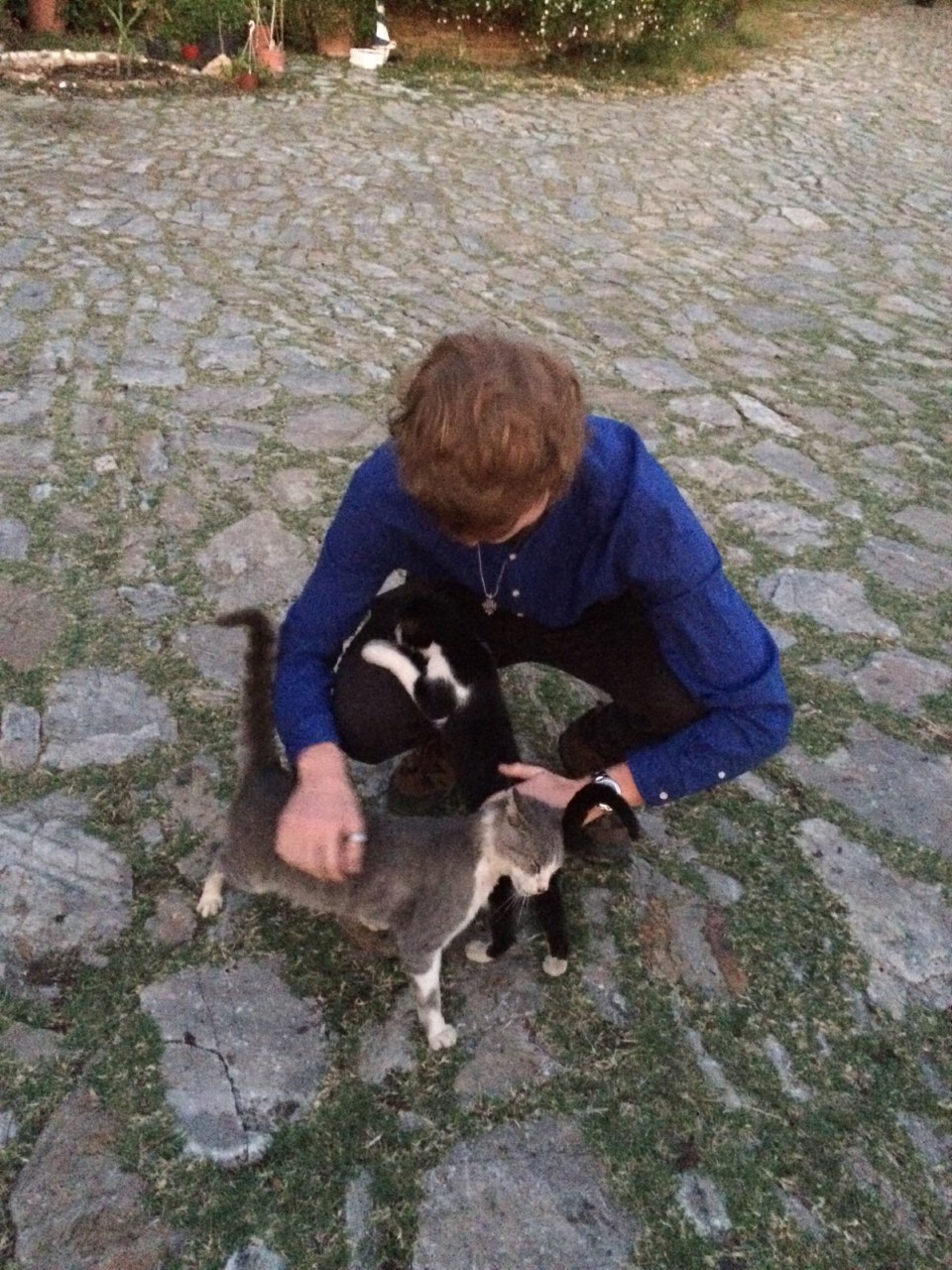
I was very happy to see the photographs of the felines of the Holy Mountain, especially to see George fussing them and giving them devout attention!
May He grant our young pilgrims abundant Grace and mercies in the days ahead, as they visit so many more holy places.
I must start by stressing that I am being sensible and relaxing, and doing nothing to aggravate either blood pressure or the parishioners who are rightly watching the rector until blood pressure lowers!
However, with my feet up, with a cup of herbal tea and the Penguin ‘Complete Father Brown’ next to me, listening to Buxtehude’s organ works, I must express customary thanks for all who supported today’s service.
I instinctively went to type ‘today’s Liturgy’, even though Liturgy was not possible due to health issues, and must admit that celebrating the Hours and Typika, with Holy Communion from the reserved Holy Gifts, felt extremely strange. However, by the time I came to the homily, it was obvious to me that this was the only course today could have possibly taken, other than to cancel the service. Compared to last Sunday evening, when I felt quite unwell, I feel much better and relaxed, having not overexerted myself.
We have a fair number of parishioners away at the moment, and we keep those travelling in our prayers – especially our young pilgrims, Oswald, Alexander and George, also our trustee Peter, enjoying a break with his wife, Anne. It was very odd to have so many familiar faces missing, and we look forward to our parishioners’ return.
Many thanks to our singers/readers for adapting, last minute, and to those who stayed to help at the afternoon baptism, though I didn’t expect this. Help was greatly appreciated.
It was a joy to baptise little Ronald-Pavel, and to welcome his family and sponsors Pavlos and Marc. Although little Ronnie was not very happy going into the font, he took an amazing interest in so much of the service for such a young child, especially in incense and candles, and we compared our crosses at the end of the service. We look forward to blessing his family home and his Holy Communion in the next few weeks. May God grant Ronald-Pavel and his sponsors many, blessed years!
For me, the week ahead, will be one of rest, with lots of prayer and reading, and I will not be in Cardiff until Saturday to hear confessions, asking for your requests by Wednesday 22:00 so that we can arrange times and venue.
I suspect that next Sunday will also see the celebration of the Hours and Typika with Holy Communion, though I hope that improvement in blood pressure might make Liturgy possible. However, though a natural optimist, that seems doubtful.
Let’s all pray with fervour, trusting on God’s healing power, and be flexible for a while.
 As Allan and Olga will have the good fortune to be worshipping in our San Remo parish on Sunday, and matushka Alla will be attending a conference in Morocco, may I prompt parishioners to bring flowers to adorn the church during Liturgy.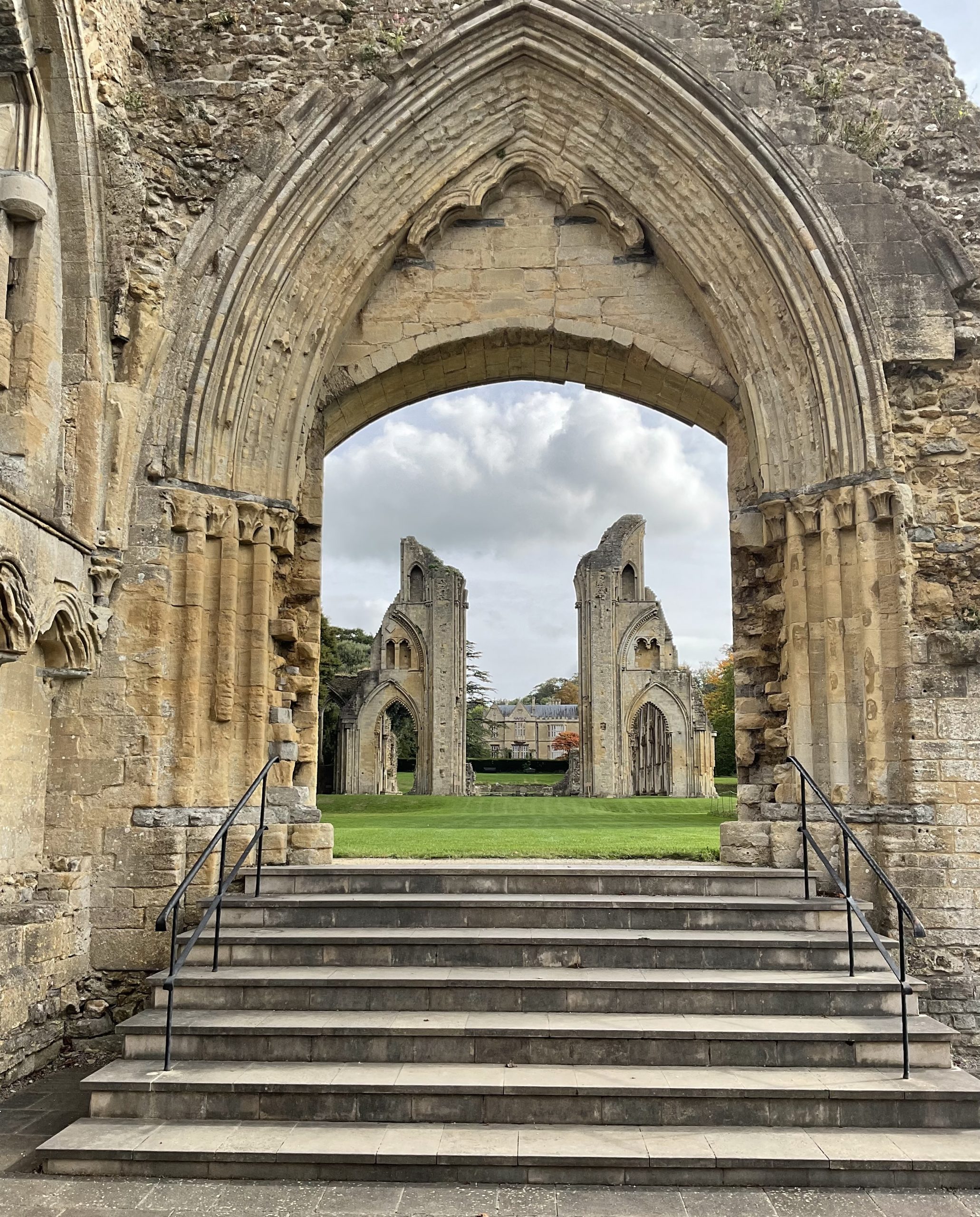
 Again, we will begin at 11:00 and celebrate the Hours and Typika (Obednitsa), with Communion administered from the reserved Holy Gifts. I hope that subsequently, after a second week of rest, we will return to the celebration of the Divine Liturgy.