 In the Name of the Father, and of the Son and of the Holy Spirit.
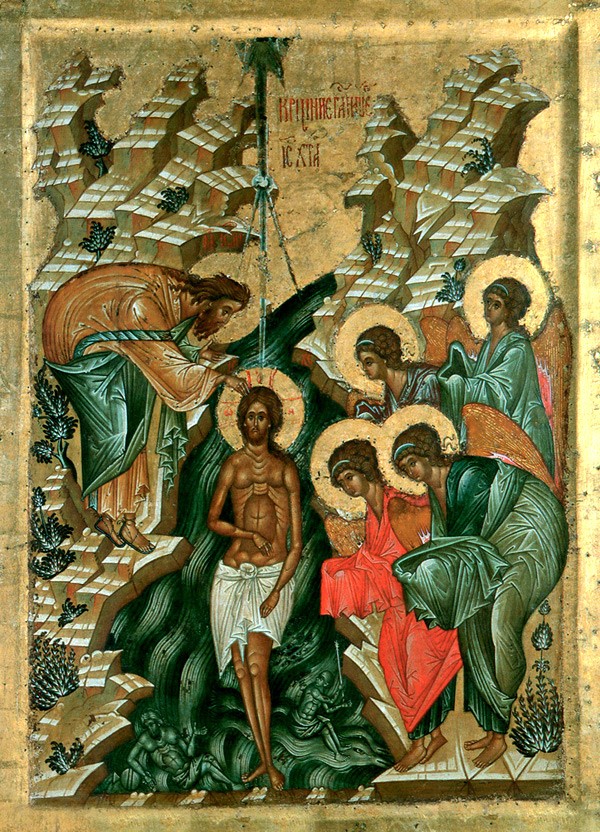
Dear brothers and sisters, greetings as we celebrate the Baptism of Our Lord, and God, and Saviour, Jesus Christ!
The celebration of the Lord’s Baptism, is central not only to our Christian year, but to the very fabric of our Orthodox spirituality, and our understanding and experience of God’s immanence through His sanctification of creation and the gift of His grace.
Whilst the focus of the Christian west on the Lord’s Cross and passion constantly overlooks His baptism, we Orthodox Christians joyfully and enthusiastically celebrate the Theophany in the Jordan as a crucial act in the Saviour’s redemptive work, and which the Church Fathers saw as central to the economy of salvation.
Whilst the Lord’s Cross and passion is the altar of His sacrifice, His descent into the Jordan and baptism by John, is the mystery by which humanity is reclothed in the robe of glory, which Adam wore of old, but lost through his rebelliousness and disobedience.
Theophany is Christ’s baptismal calling to us, through which both individual Christians and their corporate totality, the Church, are betrothed to Christ the Bridegroom, Who mercifully deigned to come to find that which was lost.
St Jacob of Sarug uses Adam’s name and person to represent the whole human race, and in his surviving homily on the Lord’s baptism, He poetically places words into the Saviour’s mouth, as He speaks to John of His baptism being crucial to His descent, incarnation and redemptive mission.
“Our Lord said, “I am not lacking, but in one thing: the recovery of Adam who was lost by me is sought by me.
Allow me to descend to seek Adam, the fair image, and when I shall find him, the whole of my desire will be fulfilled…
In this recovery my desire will come to perfection,
because Adam is needed by me to enter into his inheritance.
Therefore, allow me to descend to cleanse the image that has become faded…”
We are struck with the fact that the Creator’s immovable and unfading love for humanity is such that it impels Him to search and to save.
Having created Adam and Eve as not only the apex of creation, but as the primary recipients of His absolute and all-perfect love, that love demands that humanity is cleansed, and that the divine image and likeness is restored in God’s lost sons and daughters.
How daring to suggest that even though He lacks nothing, the divine will of salvation is manifested in the Saviour’s voluntary “need” to seek the lost, to restore the inheritance of eternal life to his fallen children.
Christ’s descent into the Jordan is an integral part of this restoration of Adam (humanity), and a foreshadowing of His descent into Hades.
This is reflected in the hymns of the feast, in which water is the symbol of spiritual chaos and a place of unrestrained forces, and darkness that mirrors Hades.
In ode four, the second canon of matins speaks of this, and significantly celebrates Christ’s descent into Jordan as not only for the deliverance of humanity, but for the redemption of ALL creation.
“That He might bring His own back to the life-giving pastures of paradise, the Word of God falleth upon the lairs of the dragons, and destroying their manifold snares, he assaileth him who hath bruised all mankind, and, imprisoning him, delivereth creation.”
As He is immersed in the Jordan, in a reversal of the normal spiritual operation of baptism, Christ Himself sanctifies the waters, as they are cleansed by Him, and He establishes the Baptismal Mystery as the rebirth and regeneration of those who follow Him, in the establishment of spiritual order and harmony and the subjugation of chaos and lawlessness.
Just as Christ came down from heaven at the Annunciation, to enter the womb of the Mother of God, so by His descent, the waters of Jordan, become a womb in which humanity is born anew through baptism in the Name of the Trinity, Which is gloriously made manifest as the Only-Begotten Son ascends from the waters, the confirmatory voice of the Father is heard from heaven, and the Holy Spirit descends in the likeness of a dove.
In the verbal iconography of his metrical homily, St Jacob portrays Christ speaking of fallen humanity:
“I am making them enter into the moist womb, so that it will conceive them / and give them the new birth without birth pangs.”
Through the consecration of the Jordan through the Lord’s descent into its waters, the font becomes the spiritual womb in which new life in Him is conceived, as we the faithful are reborn as a new-creation through our joining to Him: in our descent into His death and our ascent in the power of His Resurrection.
Even before the great commission, in which the Lord charged the Apostles to preach to all nations, baptising them in the Name of the Father, and of the Son, and of the Holy Spirit, our baptism was established and sanctified by His own baptism for our sake, and for our salvation.
As St John Chrysostom reminds us, a significant difference between the baptism of John and that established by the Lord in His consecrating entry into the waters, is that the Jordan calls us not only to a baptism of repentance, but to baptism of new life in Christ.
As the third ode of the canon tells us,
“The Master draweth to Himself the divinely fashioned nature of man, which had been overcome by the tyranny of greed; and He restoreth mortal men, granting them a new birth, and accomplishing thereby a mighty work; for He is come to cleanse our nature.”
Our very human nature should be changed by the Mystery of Baptism, and our post-baptismal self should be that of a person radically changed by our mystical descent into Christ’s death, and our ascent in the power of His resurrection, which later sealed the inner meaning of this Holy Mystery, as He went to His voluntary passion.
We should each have put off the old man, to be reclothed in glory, having “put on Christ”, and this glorious Theophany should call us to reflect upon whether this is truly the spiritual reality of our lives, particularly for those who were baptised in infancy and are unable to remember life before their baptism.
As those betrothed to Christ through baptism, and as children of His resurrection, do we really seek to live as a new creation, with lives spiritually and morally set apart from the fallenness, brokenness and dysfunctionalism of the world?
If we find ourselves lacking, then enlivened, fortified and raised up by this glorious Theophany, we must rouse ourselves to action, repentance and newness of life – blessed and set aright as we share in God’s sanctifying grace, partaking of the Holy Water blessed upon this feast, mindful that at its sanctification, we have prayed…
“That these waters may be sanctified by the power, effectual operation and descent of the Holy Spirit…
That there may descend upon thse waters the cleansing operation of the super-substantional Trinity…
That He will endue them with the grace of redemption, the blessing of Jordan, the might, operation, and descent of the Holy Spirit…
That the Lord God will send down the blessing of Jordan and sanctify these waters…
That this water may be unto the bestowing of sanctification; unto the remission of sins; unto the healing of soul and body: and unto every expedient service…
That this water may be a fountain welling forth unto life eternal…
For those who shall draw of it and take of it unto the sanctification of their homes…
That it may be for the purification of the souls and bodies of all those who, with faith, shall draw and partake of it…
That He will graciously enable us to perfect sanctification by participation in these waters, through the invisible manifestation of the Holy Spirit, let us pray to the Lord.”
Take heed to the last petition!
We are not idle bystanders, but are called to be participators in this feast; to not be onlookers, but to spiritually stand on the banks of the Jordan as we enter into the cosmic spiritual renewal to which the Church calls us each and every year.
Let us be in awe, that the Creator of the land, the rivers and seas, the sun, moon and stars, of the angelic hosts and the race of men should humble Himself beneath the hands of the Forerunner for the healing, restoration and raising up of each of us.
Let us be in awe, that the worship of the Trinity should be made manifest in the glorious Theophany of the Father, the Son and the Holy Spirit together.
Let us fall down in humility, penitence and the fear of God, filled with awe that in this feast we have truly seen that “God is the Lord,and hath revealed Himself to us!” calling us to rush to the renewal of Jordan in our temples and parishes and partake of His Grace!
With the fear of God and Faith draw near!
Amen!