At the Transfiguration Liturgy on Sunday August 20th, there will be little baskets of grapes available to be blessed for taking home by the congregation (members of the congregation are also invited/encouraged to bring their own fruit for blessing also during the Liturgy).
The little baskets are to be decorated with ribbon in preparation for this, so the plan is that there will be a basket-decorating activity after Liturgy on Sunday August 13th (ie. at the same time as the Trapeza social/refreshments time) for the children (and any adults who wish to get involved too!). All the materials are provided so no-one needs to bring anything, so if you have children who you think will enjoy this, then bring them along on August 13th.
Two weeks later on Sunday August 27th, we will have another little craft activity after Liturgy to make Dormition items ready for the following week’s Liturgy, so another date to note for any craft-loving children (and adults) in the parish (again, all materials will be provided).
Dear brothers and sisters, greetings to you all as we celebrate the one hundred and twentieth anniversary of the glorification of our dear and greatly loved father, St Seraphim, the Wonderworker of Sarov, so greatly loved by people of many nations and cultures, who recognise in him the realisation of true holiness, the indwelling of the Holy Spirit, and the restored image of Christ.
As an exemplar and intercessor, he shows us the true life of humility, love, patience and ascetic labour – especially in prayer, which he reminds us to the primary way in which we acquire the Holy Spirit, with this acquisition as the very meaning and purpose of our life.
Some may give alms, but others have no means to do so.
Some may perform acts of mercy, but circumstances may mean that others may have no opportunity.
Some may clothe the destitute and house the homeless, but others may be far from those in need, or be destitute or homeless themselves.
But… all can pray: rich or poor; free man or prisoner; young or old; educated or unlearned.
All can seek the acquisition of the Holy Spirit through raising their hearts and minds to God in prayer.
So, as we celebrate St Seraphim’s glorification, let us be inspired by his long vigil of prayer on the rock, and bow down and join ourselves to God in prayerful communion, and honour St Seraphim in chanting canons in his memory.
Ode I, Irmos: When Israel walked on foot in the sea as on dry land, * on seeing their pursuer Pharaoh drowned, * they cried: * Let us sing to God * a song of victory.
Venerable Father, Seraphim, pray to God for us.
O Lord, open mine unworthy lips and grant me a word of understanding, that I may worthily hymn the memory of the blessed Seraphim, who with the angels doth now beseech Thee to deliver us from every grievous circumstance.
Venerable Father, Seraphim, pray to God for us.
Thou wast a great intercessor before the Theotokos, O venerable one, and wast deemed worthy to behold her with the apostles. And now, cease not to visit thy children by thine intercessions.
Venerable Father, Seraphim, pray to God for us.
From thy youth, O venerable one, thou didst surrender thyself in mind unto the Lord, and having subdued the passions of thy body through rigorous abstinence, thou wast adorned with every virtue, O most wise one.
Most Holy Mother of God, save us.
O most blessed Sovereign Lady, who hast given birth unto the supremely good God in the flesh, cleanse thou my heart which is tormented by passions, that I may magnify thee with faith and love.
Canon II to the Venerable Seraphim, in Tone VIII:
Irmos: Having passed through the water as upon dry land, * and having escaped the malice of the Egyptians, * the Israelites cried aloud: * Unto our God and Redeemer let us now sing.
Venerable Father, Seraphim, pray to God for us.
Thou didst tread the straight and narrow path to the heavenly kingdom in accordance with the commandment of Christ the Master, disdaining the broad and spacious path. And now do thou pray for us that keep thy most radiant memory.
Venerable Father, Seraphim, pray to God for us.
Having ascended the mount of dispassion and taken up thy cross from thy youth, thou didst unfalteringly follow after Christ. And having acquired spiritual wisdom, thou didst attain the heavenly Jerusalem, O venerable one. Pray thou to the Lover of mankind on our behalf.
Glory be to the Father, and to the Son, and to the Holy Spirit.
Standing now before the throne of God, O venerable one, intercede thou for the suffering Russian land; and by thy prayers, O venerable one, entreat salvation for the Christ-loving people of Russia.
Now and ever, and unto the ages of ages. Amen.
Hearken, O Lady, unto those who flee to thee with faith and love, and who hymn thee with fear.
Ode III, Irmos: There is none as holy as Thou, * O Lord my God, * who hast exalted the horn of The faithful O good One, * and strengthened us upon the rock * of Thy confession.
Venerable Father, Seraphim, pray to God for us.
Standing before God with the angels in thy prayer, O venerable one, pray thou for the whole world, that the assaults of the enemy be overcome and that Orthodox Christians be granted victory over their adversaries.
Venerable Father, Seraphim, pray to God for us.
From thy youth thou didst cleave with faith and love unto the Master of the hosts on high, O venerable Seraphim; and, shining forth like the sun in the wilderness of Sarov, thou wast a comfort to those who approached thee in sorrow. Pray thou that we be saved!
Venerable Father, Seraphim, pray to God for us.
To those who pray unto thee, thou hast been revealed to be an unshakeable pillar and a refuge for those who have recourse unto the Monastery of Sarov, and abundant grace for those who receive healings.
Most Holy Mother of God, save us.
Our first mother Eve heard: In sorrow thou shalt bring forth children. And thou, O pure Virgin, hearing: The Lord is with thee! Rejoice! didst put to flight the grief of our first mother with this cry of joy!
Another Irmos: O Lord, Creator of the vault of Heaven * and Builder of the Church, * do Thou strengthen me in Thy love, O Summit of desire, * O Support of the faithful, * O only Lover of mankind.
Venerable Father, Seraphim, pray to God for us.
Beseech Christ God, O blessed one, to deliver us from famine and plagues, from sudden death, from secret transgressions and wicked thoughts, that with a pure heart we may cry out to Christ: O Lord, save us by the supplications of the venerable one!
Venerable Father, Seraphim, pray to God for us.
Following after Christ the Master in meekness and humility, thou wast all things to all mankind; tirelessly instructing both rich and poor in piety, thou didst foresee the future as though it were the present. Beseech Christ God, O venerable one, to grant us forgiveness of our sins!
Glory be to the Father, and to the Son, and to the Holy Spirit.
Deliver thy monastery from every assault of the enemy, O venerable one, and fill it with love and grace, that it heed not the cares of this life, but attain unto the goodness and beauty which save the soul.
Now and ever, and unto the ages of ages. Amen.
Our trust and hope art thou, O most holy Sovereign Lady. Save the suffering Russian land and thy people that pray and call upon thy holy name!
Lord, have mercy. Lord, have mercy. Lord, have mercy.
Sessional Hymn of the venerable one, Tone IV: Having utterly overcome the passions of the sea of life by abstinence, and attained unto the haven of dispassion, thou wast revealed as a vessel of abstinence, O venerable Seraphim. Beseech Christ God to grant us great mercy!
Glory be to the Father, and to the Son, and to the Holy Spirit; now and ever, and unto the ages of ages. Amen.
Theotokion, Tone IV: When thou dost stand before the face of my Creator on the day of His righteous Judgment, O Lady, intercede for me, and deliver me from eternal torment, that I go not down into Hades, but that I be saved by thy defence, O most holy Theotokos.
Ode IV, Irmos: Christ is my power, * my God and my Lord, * the holy Church divinely singeth, * crying with a pure mind, * keeping festival in the Lord.
Venerable Father, Seraphim, pray to God for us.
Today the Monastery of Sarov doth radiantly celebrate thy memory, O venerable one, beseeching thee: Ask of the Lord peace for the whole world and great mercy for our souls!
Venerable Father, Seraphim, pray to God for us.
In thy great struggles didst thou flourish like a palm tree, O venerable one, sweetening the hearts of those who have recourse unto thee with fruitful words and a blameless life: Wherefore, do thou now pray that we obtain mercy from Christ our Saviour!
Venerable Father, Seraphim, pray to God for us.
By thy prayers entreat God for us, O venerable Seraphim, and drive away the sinful darkness of our grief. Adorn with dispassion, faith and love all who honour thy most glorious memory!
Most Holy Mother of God, save us.
Rejoice, O Virgin Sovereign Lady, thou beauty of the Churches, might and boast of the suffering Russian land! Pray to Christ God without ceasing, that He preserve us from misfortunes by thy prayers.
Another Irmos: I have heard report of Thy dispensation, O Lord, * and have glorified Thee * Who alone art the Lover of mankind.
Venerable Father, Seraphim, pray to God for us.
It is not the Monastery of Sarov alone, but the whole land of Russia which hath thee, O blessed one, as a fervent intercessor and speedy helper, almighty and invincible defender and mediator for our souls.
Venerable Father, Seraphim, pray to God for us.
Be thou an intercessor and mediator for us before the most holy Trinity, and move thou to pray with thee the choirs of the saints whose life thou didst emulate, O venerable one. With them pray for peace and the good estate of the whole world, that in this age we may live a peaceful and quiet life, and in the future inherit eternal life.
Glory be to the Father, and to the Son, and to the Holy Spirit.
Being great among fasters, O venerable one, thou didst lead an arduous monastic life in the wilderness, and didst end it in compunctionate prayer. Pray that we be saved!
Most Holy Mother of God, save us.
Thou art our refuge and confirmation, O most pure Theotokos. Beseech thy Son and our God, that He grant us salvation and forgiveness of sins.
Ode V, Irmos: Illumine with Thy divine light, I pray, O Good One, * the souls of those who with love rise early to pray to Thee, * that they may know Thee, O Word of God, * as the true God, * Who recalleth us from the darkness of sin.
Venerable Father, Seraphim, pray to God for us.
Unto all who come to thee thou hast been a true teacher and a great intercessor before the Theotokos. And now, O venerable one, cease not to pray for thy children, for thou hast great boldness.
Venerable Father, Seraphim, pray to God for us.
Let the Christian people now enter into the temple of the Monastery of Sarov, bowing down before thy precious relics, O venerable Seraphim, and, glorifying Christ, let them ask of thee healing and salvation.
Venerable Father, Seraphim, pray to God for us.
The invisible enemy desired to affright thee when thou wast praying to God at night, O venerable one. But, put to shame by thy prayer, the most wicked one vanished.
Most Holy Mother of God, save us.: O most pure Mary, beseech God Who was born of thee, that He grant forgiveness of transgressions unto thy servants.
Another Irmos: Illumine us O Lord with Thy commandments, * and with Thine arm raised on high * grant us Thy peace, * O Lover of mankind!
Venerable Father, Seraphim, pray to God for us.
Thou didst glorify the Monastery of Sarov with fasting and unceasing prayer, O venerable one, anointing the infirm with oil from the icon of the Theotokos and granting them healing in abundance. Pray thou now that our souls be saved!
Venerable Father, Seraphim, pray to God for us.
O ye hierarchs and priests, rejoice with the monks of Sarov, and ye people, hymn together the blessed father, the calm haven of those who are tempest-tossed by sorrows, the ready healer of infirmities of body and soul.
Glory be to the Father, and to the Son, and to the Holy Spirit.
Offer up thy prayers, O venerable one, as an acceptable and unblemished sacrifice unto the most holy Trinity, and forget not us who now keep thy memory. Beg mercy for those who hate, wrong and are angered against us, and deliver all from every sorrow.
Now and ever, and unto the ages of ages. Amen.
Guide my mind which is tempest-tossed by many passions, O Sovereign Lady. Save us who have recourse unto thee, O Theotokos, for apart from thee we know none other help, O pure one.
Ode VI, Irmos: Beholding the sea of life surging with the tempest of temptations, * I run to Thy calm haven, and cry to Thee: * Raise up my life from corruption, * O greatly Merciful One.
Venerable Father, Seraphim, pray to God for us.
Thy holy soul was an abode of God, wherein the Father, the Son and the Holy Spirit dwelt. Wherefore, we pray thee, O venerable one, dispel the slanders of the enemy from those who honour thee, and grant peace to the suffering land of Russia.
Venerable Father, Seraphim, pray to God for us.
O venerable Seraphim, we honour thy great struggles and labours in the wilderness and the sweetness of thy teaching, whereby thou hast enlightened many who came to thee, teaching them to hymn the consubstantial Trinity.
Venerable Father, Seraphim, pray to God for us.
Following after Christ the Master in purity of life, thou didst complete the good race, O venerable one. Having ascended to the eternal mansions, thou dost behold there what the angels see. Wherefore, honouring thy memory, we glorify Christ.
Most Holy Mother of God, save us.
I now flee unto thee, O most pure one. Save and preserve me by thy supplications. For whatsoever thou desirest, that thou canst do, in that thou art the Mother of the Almighty.
Another Irmos: I will pour out my prayer unto the Lord, * and to Him will I proclaim my grief; * for my soul is filled with evils, * and my life unto Hades hath drawn nigh, * and like Jonah I pray unto Thee: * Raise me up from corruption, O my God.
Venerable Father, Seraphim, pray to God for us.
We are all full of sin, but thy prayers, O venerable Seraphim, ascend unto the Lord like fragrant incense. We now pray thee: Calm thou the raging storm of evil impiety in the land of Russia, and entreat the Lord for the salvation of our souls.
Venerable Father, Seraphim, pray to God for us.
Truly blessed wast thou, O venerable Seraphim, having acquired riches through poverty, and through tears, joy, which thou didst abundantly bestow upon those who came to thee. And now emitting rays of miracles, thou dost heal all who have recourse unto thee in faith.
Glory be to the Father, and to the Son, and to the Holy Spirit.
Having dug with thine own hands a well in the wilderness, O venerable one, thou didst give drink unto the thirsty that came unto thee. And now thou healest the diseases of the sick with the water of this well. Truly, the Master hath shown thee forth unto all as a miraculous intercessor and wonderworker, O venerable one.
Now and ever, and unto the ages of ages. Amen.
We confess thee to be indeed the Mother of God, the true Theotokos, for by thy birthgiving we have been delivered from the curse of corruption, by the tender compassion of God, the Lover of mankind, and have been called to life incorruptible.
Lord, have mercy. Lord, have mercy. Lord, have mercy.
Glory be to the Father, and to the Son, and to the Holy Spirit; now and ever, and unto the ages of ages. Amen.
Kontakion of the Venerable One, Tone II: Having forsaken the beauty of the world and the corruption therein, * thou didst take up thine abode in the Monastery of Sarov. * And having lived there as an angel, thou didst become a path for many to salvation. * Wherefore, Christ hath glorified thee, O father Seraphim, * enriching thee with the gift of healings and miracles. ** Therefore, we cry out to thee: Rejoice, O our venerable father Seraphim!
Ikos: Having forsaken family and friends, and regarding riches as but dust, thou didst take up thine abode in the wilderness of Sarov; and having struggled against the passions like one of the bodiless hosts, thou wast deemed worthy to stand in the angelic choir. Wherefore, having received spiritual knowledge, grant even us, O venerable one, to chant this unto thee with understanding, saying: Rejoice, O blessed Seraphim, heavenly man and earthly angel! Rejoice, emulator of Christ in thy love! Rejoice, abode of the Holy Spirit! Rejoice, great joy of the despondent! Rejoice, source of healing! Rejoice, sweet consolation for sorrowful souls! Rejoice, calm haven for monks and most wise instructor! Rejoice, boast of the land of Russia! Rejoice, O our venerable father Seraphim!
Ode VII, Irmos: An Angel made the furnace bedew the holy Children. * But the command of God consumed the Chaldeans * and prevailed upon the tyrant to cry: * O God of our fathers, blessed art Thou
Venerable Father, Seraphim, pray to God for us.
Wondrously was thy life shown to be full of the grace of the divine Spirit, O venerable one. Truly thou didst receive the blessed end of the righteous, rejoicing in Christ. And we cry out to Him who hath glorified thee: O God of our fathers, blessed art Thou!
Venerable Father, Seraphim, pray to God for us.
Gathering together at thy holy monastery today, a multitude of people doth bow down before thy precious relics, O venerable Seraphim, and we all draw forth healings therefrom, crying out unceasingly: O God of our fathers, blessed art Thou!
Venerable Father, Seraphim, pray to God for us.
This report hath gone out into all the world, that a most glorious wonderworker hath appeared in Sarov, pouring forth a multitude of healings upon all who with faith approach and cry out: O God of our fathers, blessed art Thou!
Most Holy Mother of God, save us.
O Virgin Theotokos, who ineffably didst give birth unto the Word, thy Creator: With the venerable Seraphim beseech Him to have mercy upon our souls!
Another Irmos: The Children of Judaea, * who of old came to dwell in Babylon, * trampled underfoot the flame of the furnace * through their faith in the Trinity, * as they sang: ‘O God of our fathers, blessed art Thou.’
Venerable Father, Seraphim, pray to God for us.
Have mercy on us, O Lord, and through the prayers of him who pleased Thee, the venerable Seraphim, preserve us from every soul-corrupting evil, that we may all cry out with compunction: O God of our fathers, blessed art Thou!
Venerable Father, Seraphim, pray to God for us.
Who is not astounded, who doth not glorify the unfathomable abyss of Thy tender compassion, O Lord? For Thou hast revealed to the whole world him that pleased Thee, the venerable Seraphim, the fervent intercessor before Thee for us who cry aloud: O God of our fathers, blessed art Thou!
Glory be to the Father, and to the Son, and to the Holy Spirit.
Accept this hymn of thanksgiving which we offer unto thee, O venerable Seraphim, and grant healing unto all of us who keep thy holy memory, and who bow down before the shrine of thy relics and cry aloud: O God of our fathers, blessed art Thou!
Now and ever, and unto the ages of ages. Amen.
Thou art our refuge and confirmation, O most holy Theotokos. Entreat thy Son and our God to grant us salvation and forgiveness of sins.
Ode VIII, Irmos: Thou didst make flame bedew the holy children, * and didst burn the sacrifice of a righteous man with water. * For Thou alone, O Christ, dost do all as Thou willest, * Thee do we supremely exalt throughout all ages.
Venerable Father, Seraphim, pray to God for us.
Having subdued the passions of the flesh and died to the world, thou didst receive the words of eternal life in thy heart, O blessed one, teaching all who had recourse unto thee to cry aloud: O ye works, praise ye the Lord, and supremely exalt Him throughout all ages!
Venerable Father, Seraphim, pray to God for us.
At the glorification of thy precious relics, O venerable one, the Monastery of Sarov was filled with joy. And all the people cried out unto God Who is wondrous in His saints: O ye works, praise ye the Lord, and supremely exalt Him for ever!
Venerable Father, Seraphim, pray to God for us.
Being filled with the grace of the divine Spirit, O venerable Seraphim, through thy prayers beg forgiveness of sins for the faithful people that keep thy holy memory and cry out: Ye children, bless; ye priests, praise; ye people, and supremely exalt the Lord throughout all ages!
Most Holy Mother of God, save us.
O Theotokos, who hast given birth unto the Saviour and Master of all, thou hast been shown forth to us as the mediatrix of salvation; wherefore, we pray thee: Grant salvation unto all who faithfully hymn thee throughout the ages.
Another Irmos: The King of heaven, * Who is glorified by the hosts of angels, * let us praise and supremely exalt throughout all ages.
Venerable Father, Seraphim, pray to God for us.
The most evil enemy, hating thy virtuous life, desired to cause thee to falter, O venerable one. But having put him to shame by the grace of God and the prayers of the Theotokos, thou didst glorify God, singing: O ye works, praise ye the Lord and supremely exalt Him throughout all ages!
Venerable Father, Seraphim, pray to God for us.
As flashing lightning illumineth the firmament, so have the reports of thy wonders gone forth throughout all the world, O venerable one. And marvelling at thy glory, we cry out: O ye children, bless; ye priests, praise; ye people, supremely exalt the Lord throughout all ages!
Glory be to the Father, and to the Son, and to the Holy Spirit.
Heal thou our minds which are disquieted by vain and passionate imaginings, O venerable one; quell thou the waves of evil disbelief in our land, and strengthen our hearts, which are crippled by worldly cares, that we may glorify Christ the Creator throughout all ages.
Now and ever, and unto the ages of ages. Amen.
Rejoice, O fiery throne of the Lord! Rejoice, O ray of immaterial splendour! Rejoice, thou cloud of the radiant Sun of righteousness, Christ our Saviour, Whom we supremely exalt throughout all ages!
Ode IX, Irmos: It is impossible for mankind to see God * upon Whom the orders of Angels dare not gaze; * but through thee, O all-pure one, * did the Word Incarnate become a man * and with the Heavenly Hosts * Him we magnify and thee we call blessed.
Venerable Father, Seraphim, pray to God for us.
Accept, and disdain not, our small tribute, offered unto thee from unworthy lips, O venerable one. Sanctify all who glorify thee, and deliver us from misfortunes, dangers and eternal torments, that we may hymn thee throughout the ages.
Venerable Father, Seraphim, pray to God for us.
Manfully enduring the heat of the day and the cold of night in the solitude of the wilderness, thou wast an abode of the Wisdom of God, and didst hasten toward the unwaning radiance. Pray thou that we be saved!
Venerable Father, Seraphim, pray to God for us.
This day is the monastery glorified, wherein thou didst consent to take upon thyself the yoke of Christ; for there didst thou spend thy days in the wilderness; and, enlightening by thy teachings the many who came unto thee, thou didst teach them to be children of the Church of Christ.
Most Holy Mother of God, save us.
Thou art our strength, thou art our boast and joy, our protectress, help, refuge and invincible intercessor. O most pure Theotokos, save thou thy servants!
Another Irmos: Saved by thee, O pure Virgin, * we truly confess thee to be the Theotokos, * and with the choirs of bodiless hosts we magnify thee.
Venerable Father, Seraphim, pray to God for us.
Emulating the great fathers who of old shone forth in fasting and ascetic struggle, O venerable one, thou didst spend all the days of thy life in prayer, tears and labour, until thou didst attain unto the heavenly mansions. Wherefore as is meet, we bless thee.
Venerable Father, Seraphim, pray to God for us.
With mighty power did Christ God gird thee about and strengthen thee to overcome the wiles of the demons, O venerable one. Wherefore, we now pray thee: Entreat God, the Lover of mankind, to deliver us all from the assaults and temptations of the enemies, and to save our souls.
Glory be to the Father, and to the Son, and to the Holy Spirit.
In our pain and sorrow, we flee to thee, O venerable one, and cry out from the depths of our souls: Be thou a calm haven and ready healer for the sick, and deliver us from every ill and want, that we may unceasingly magnify thee.
Now and ever, and unto the ages of ages. Amen.
O most pure Virgin, thou didst give birth unto One of the Holy Trinity, the Son and Word, Whom do thou entreat with the saints and the righteous on behalf of thy servants who with faith ask forgiveness of sins.
Troparion, Tone IV: From thy youth didst thou love Christ, O blessed one; * and, aflame with the desire to serve Him alone, * thou didst struggle in the wilderness in unceasing prayer and labour; * and with compunction of heart, having acquired the love of Christ, * thou wast shown to be the beloved favourite of the Mother of God. * Wherefore, we cry unto thee: ** Save us by thy prayers, O our venerable father Seraphim.
As we come to last day of July, the summer holidays, as well as the pilgrimage season have most definitely arrived, and we keep parishioners in our prayers: Deacon Mark, Alla and Yuriy as they head to Turkey, where they will meet mama and papa, who are travelling from Crimea; Archpriest Luke to Cornwall; Branka, Stefan and Tara, as they travel to Croatia and Serbia; and Aldhelm, Alexander, Nikolai, Maria and Anne, as they join the diocesan pilgrimage in the Holy Land.
We hold them all in our prayers, and hope that our pilgrims will hold us in their prayers in the holy places.
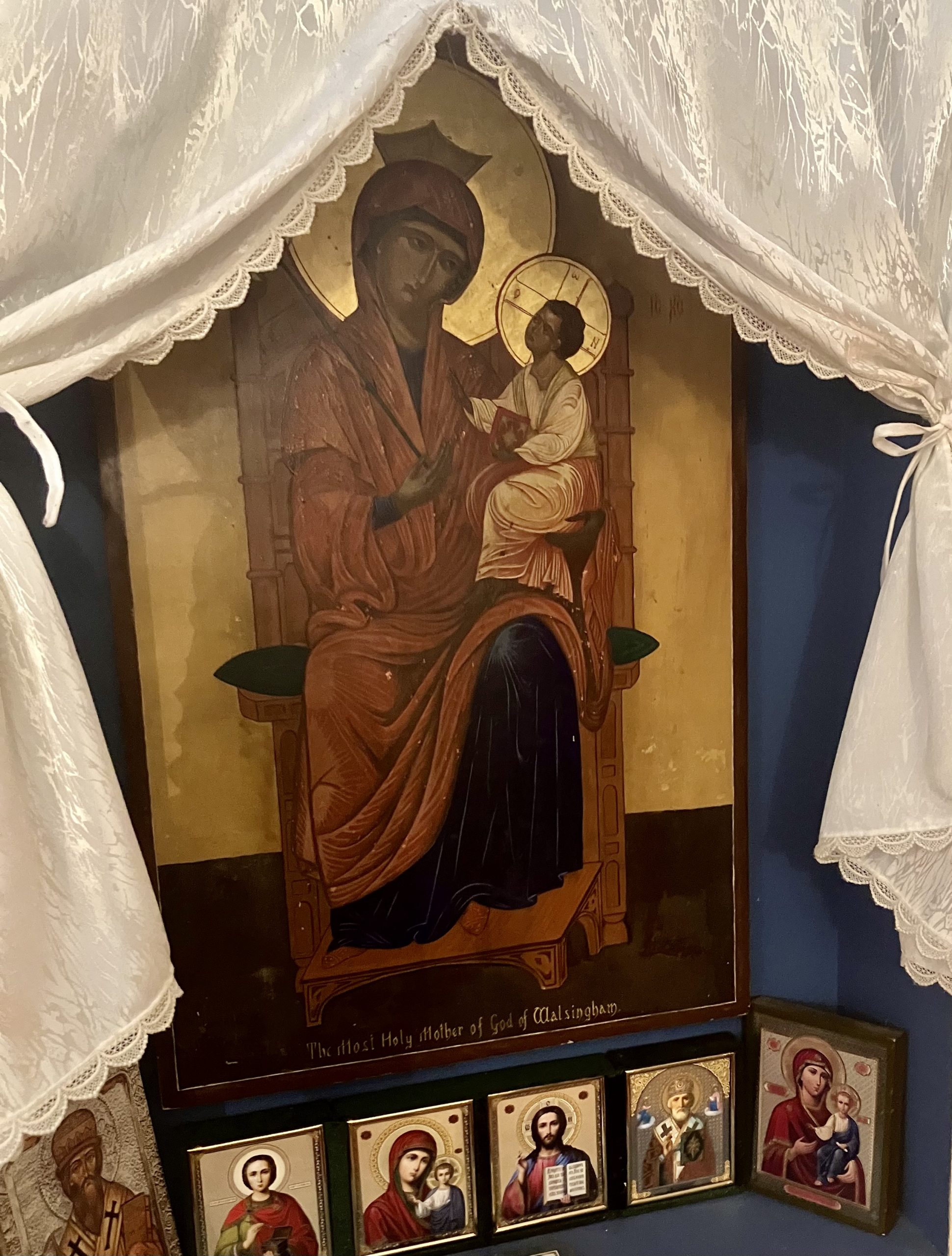
A group of us have, of course, just returned from a rather more local pilgrimage, in Walsingham, where we prayed for the members of our community, and for our parish as it develops in so many new and wonderful ways.
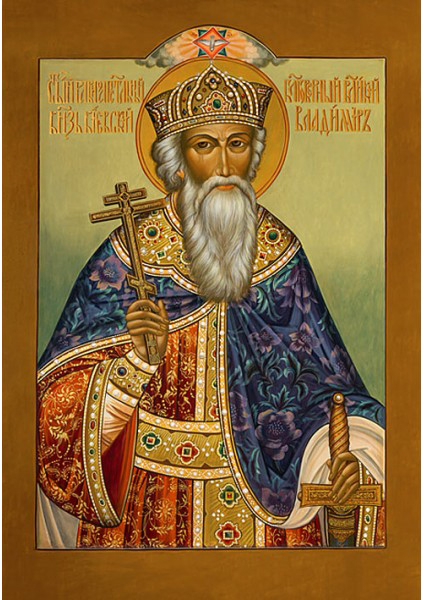
It was a joy to be able to return to Cardiff and celebrate the Divine Liturgy for the Holy Equal to the Apostles, St Vladimir, with the blessing of ancient Russian chants and some Byzantine melodies chanted by Aldhelm and Alexander. Our thanks go to them, as well as to Despina for chanting at Saturday vespers.
Being able to set up church maximally – due to the lack of Sunday morning mass – was a great blessing, allowing the sanctuary and church to be arranged far more fully than is usually possible.
Our sisters are ensuring that the icons are adorned with flowers every week, and this brings so much colour to the service, as well as honouring the Lord, the Mother of God and the saints.
With the holiday departure of Father Deacon Mark, our Hierodeacon, Father Avraamy, very capably served much of the Liturgy in English – something that I most certainly didn’t expect. We are very grateful to him for his devoted labours and his insistence on recognising the importance of English in our parish as the number of British parishioners grows.
This will be a quiet week, as the departure of some of our singers leaves no-one to sing at weekday services.
Though I will be making visits and spending pastoral time with some of our parishioners, there will be no parish activities in Nazareth House until Friday, when I will her confessions in the late afternoon, before our talk on prayer in church at 19:00. As usual, please email confession requests, and by 12:00 on Thursday.
Saturday – 5th August – will see our local(ish) pilgrimage to St Anthony’s Well in the Forest of Dean, before lunch at a parishioner’s home, and our trip to St Mary’s Church, in Kempley. We will gather at St Anthony’s Well near Mitcheldean (GL14 3LQ) at 11:00, and anyone who has not yet expressed interest and would like to take part is invited to contact our parish pilgrimage coordinator Tracy: t_sbrain@icloud.com
I was very happy to hear the announcements regarding planning for our summer feasts from our senior-sister, Menna, and will post them on Facebook separately.
Our pilgrimage to Walsingham has flown by, and the days and evenings have certainly been full and busy, with as much as possible crammed in.
We were so happy to introduce four of our pilgrims to Walsingham for the first time, with much for them to discover, and I am glad that all wish to return for our next Walsingham parish pilgrimage.
Monday’s arrival saw Mother Melangell rather surprised by the unexpected number around the tea-table at the skete, though she remained unfazed and received everyone graciously.
After supper, despite the joyful volume of singing rising from the shrine church, we nevertheless prayed compline in the chapel of the Life-Giving Spring.
Tuesday was centred on our celebration of the Divine Liturgy in the little upstairs chapel, followed by social time over refreshments in the Norton Room. We were very happy to have the company of Father Mark-Tuttum Smith, matushka Katy-Elizabeth, George and Mary in the afternoon, and for our pilgrims to join us and Mother Melangell in silent prayer in the chapel of St Seraphim in the old railway station.
Then, whilst I heard confessions, our Cardiff pilgrims had dinner and a few people joined Mother Melangell for a late vespers in her skete. Those of us who retired to the sitting room in St Anne’s were entertained by Aldhelm playing the melodion he brought with him on the pilgrimage-coach.
On Wednesday, several of our sisters joined Mother for matins at 5:30 in her skete, and after breakfast and time for prayer and reading, a few of us walked to the medieval Slipper Chapel at the Roman Catholic shrine, praying silently on our walk along the route of the old railway line, the embankments thick with summer flowers, with bees and butterflies busily collecting nectar from the swathes of Scabious and Wild Marjoram.
After the ongoing struggle to pray against the background noise of the organ and singing in the Anglican shrine, the peace and silence of the Slipper Chapel at Houghton St. Giles was a great blessing, and we valued the time we had for silent prayer, as well as the warm welcome in the tea-room, where we enjoyed spiritual conversation, before heading across the ford to the lovely medieval parish church across the meadows, with it screen decorated with images of the saints, sadly defaced, but surviving the iconoclasm of the reformation and the desecration of Walsingham’s Holy House, religious houses and churches.
The afternoon saw a lovely trip to the seaside at Wells, with wonderful views of the countryside from the top of the double-decker bus that conveniently stopped at the church gates at Houghton St. Giles.
Our pilgrims met at the quay and enjoyed lunch from the fish and chip shop, before most of us travelled back to Walsingham on the charming narrow-gauge steam railway.
On our return, after supper, I was very happy that a number our pilgrims took advantage of the Orthodox Chapel, going upstairs to pray, whilst I heard confessions.
Today started with an early panikhida for the newly-departed servant of God, the Archpriest Raphael, after his unexpected repose on Wednesday.
Having taken over the role of ‘caretaker’ of the chapel of the Life-Giving Spring from Archpriest Philip Steer, Father Raphael was a great support for the little band of local Orthodox who remain faithful to our patriarchate.
The local faithful will greatly miss his ministry, support and pastoral care. May his memory be eternal!
After breakfast, a last visit to the Holy House and goodbyes, it was already time to travel west to our more familiar surroundings, endeavouring to hold onto and preserve the blessings of the Mother of God and ‘England’s Nazareth’.
Such is the degree of removal of Walsingham from our usual South Wales surroundings, that it seems odd to think that all but two days ago we were together in Cardiff, celebrating the Divine Liturgy in Nazareth House, surrounded by all of the noise and busy-ness of the city.
Here, in rural North Norfolk, we feel as though we are in a different world, surrounded by gently undulating countryside, in a village whose medieval origins are plain for all to see, with flint-knapped cottages and the haphazard twists and turns of lanes and alleys once thronged by the pilgrims who flocked here not only from all parts of Britain, but also from foreign climes to venerate the replica of the Holy House, built at the instruction of the Mother of God by the Lady of the Manor, Rychold, in the immediate years before the Norman conquest.
During the day the carillon and angelus rings across the village with the Anglican Shrine at its centre and the Roman Catholic Shrine at the medieval Slipper Chapel, and – far from noise and light pollution – the night is quiet and the sky is clear.
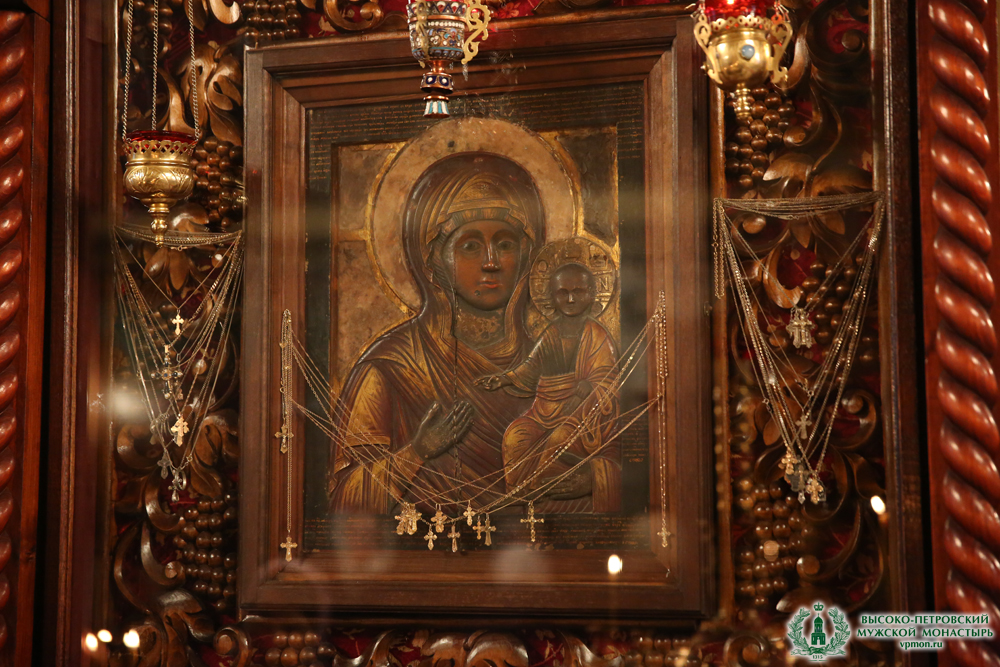
At this moment, I’m sitting in one of my favourite thinking-places, at the desk in the library of St Augustine’s in the College, overlooking the shrine church, looking up to the window of the Orthodox Chapel of the Life-Giving Spring, in which we celebrated the Liturgy for the feast of the Three-Handed Icon of the Mother of God of Chilandar.
Though – at timers – our humble Liturgy, with our small congregation, was almost drowned out by mass in the church below, we endeavoured in our celebration, praying for the brothers and sisters of our community and commemorating those remembered by those at Liturgy.
After the Liturgy, we were pleased to continue the usual local custom of refreshments in the Norton Room of the Anglican Shrine, and the afternoon was blessed by the arrival of Father Mark and his family from Mettingham, with a visit to the former monastic church of St Seraphim with the young brothers of our parish who have been introduced to Walsingham. Though we only sat in silence, it was good to spend time praying together in a place which was – for so many years – a sanctuary of monastic prayer and a place of asceticism and spiritual labour.
Sadly, during early-evening confessions, news reached us of the death of Archpriest Raphael, the priest-caretaker of the little Orthodox Chapel here, with telephones subsequently pinging with the sad tidings of his repose. Memory Eternal.
Given the concentration of Anglican services, it as been hard to find time for silent prayer in the recreated Holy House, at the heart of the shrine, though we hope to find an opportunity in the day ahead, when a few of us will also visit the Sipper Capel and hopefully the parish church with its medieval screen-paintings.
Our faithful are assured of our prayers, here, and we are carrying the parish commemoration books to remember all who are usually commemorated at Liturgy.
May the Mother of God – Our Lady of Walsingham – intercede for us and preserve us beneath her merciful protection.
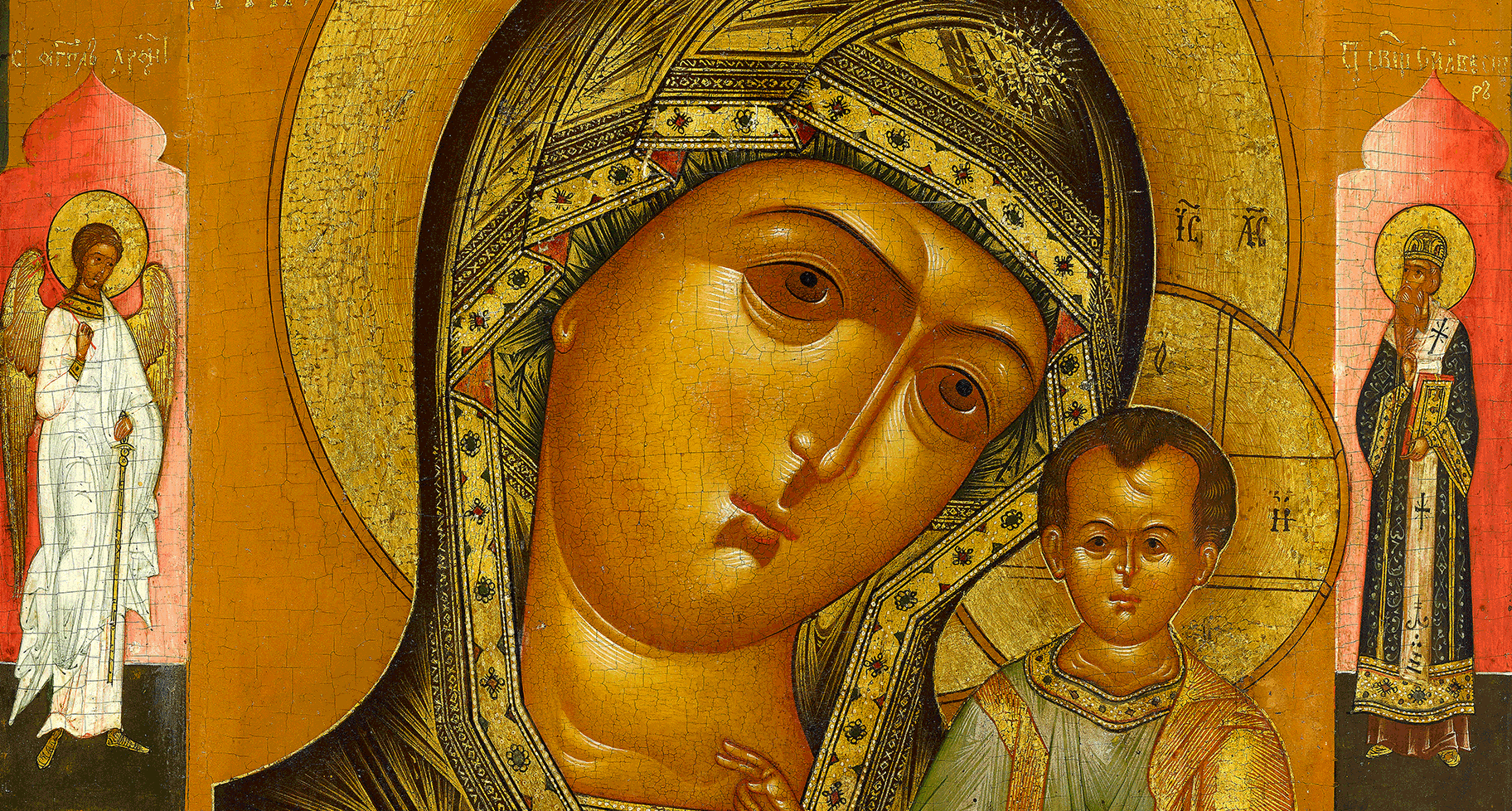
Today’s celebration in Cardiff saw us celebrate the Appearance of the Kazan Icon of the Mother of God and Venerable Anthony of the Kiev Caves, and even though the beginning of school holidays impacted upon us, we still had a little over thirty adults gathered in Nazareth House to honour the Mother of God and the Father of Rus’ Monasticism and founder of what became today’s much-suffering and persecuted Kiev-Caves Brotherhood and Lavra.
We commend the brothers, with their abbot, Metropolitan Pavel of Vyshhorod and Chornobyl to the care of the Mother of God and the intercession of their spiritual-father and ancestor, St Anthony Pechersky.
We were very happy to greet our twins, Stefan and Tara on their 13th birthday and to be able to sing ‘Many Years’ and share birthday cake with them.
As already posted, I am very happy to have been able to spend time with the faithful in Wiltshire, having visited Chippenham and Lacock at the beginning of the week, and I am very happy that the autumn will see us hold a local Liturgy in the pilgrimage chapel of St Joseph of Arimathea, one of the ancient wayside chapels en route for Glastonbury, between Corsham and Box in Wiltshire. It will be lovely to celebrate a Liturgy in the doorstep of our Wiltshire and Somerset parishioners – Chapel Plaister being within the designation of our mission of St Vladimir, in Gloucestershire and the Cotswolds. Once a date has been agreed we will post details of our ‘pilgrimage Liturgy’.
The more immediate pilgrimage will commence in the morning as some of us make our way to Walsingham – England’s Nazareth – with some of the young brothers travelling on the coach with fellow pilgrims from South Wales Anglican Parishes. We are very grateful to Fr Dean Atkins for extending the invitation to us once again, and the seasoned Walsinghamites are very much looking to introducing the first-timers to a place that has been part of our spiritual consciousness for the greater part of our lives!
Sadly, this will preclude the celebration for the feast of St Olga in the morning, but we will honour both Saints Vladimir and Olga at the end of next Sunday’s Liturgy.
Having returned from Norfolk on Thursday, Friday will see the celebration of the Divine Liturgy for the feast of St Vladimir in Nazareth House Chapel at 11:00, after which we will repair to the local cafe.
I hope to hear the bulk of confessions before and after Great Vespers, which will be celebrated in Nazareth House at 17:00 on Saturday. Please email regarding Saturday confessions before 18:00 Thursday.
As announced, on 5th August, our August pilgrimage will see us visit St Anthony’s Well in the Forest of Dean before visiting St Mary’s Church at Kempley, with its extensive Romanesque frescoes and Norman roof. We will gather at St Anthony’s Well near Micheldean at 11:00 before a bring and share lunch at the home of a local parishioner, and then the onward journey to Kempley. Interested parties should email Tracy, our pilgrimage coordinator: t_sbrain@icloud.com
After a well attended discussion group on Friday, our next meeting – continuing to discuss prayer – will be on Friday 4th August, at 19:00 in Nazareth House.
As I wrote a few days ago, please only contact me with requests for prayers/intercessions and confessions over he nexts few days, and in case of emergencies, contact Fr Luke, whose contact details are to be found on our parish web-page: https://russianorthodoxchurchcardiff.com
It was good to have a well-attended study group in Nazareth House last night, continuing our discussion on prayer, and our next meeting will be in two weeks’ time on Friday 4th August at 19:00 when we will meet in Nazareth House, once again.
As few parishioners were free during the day-time today, we will belatedly celebrate the summer feast of the Kazan Icon this coming Sunday, 10/23 July.
For anyone wishing to join in the Lord’s Prayer – Gweddi’r Arglwydd – in Welsh there will be print outs for use in the Liturgy. Please ask our senior sister, Melangell (Menna), who is usually at the back of the church during Liturgy.
Next Friday will be the feast of the Holy Equal to the Apostles, St Vladimir, and we will celebrate the Divine Liturgy in Nazareth House at 11:00.
Thanks to the three young brothers of the parish who chanted the canon in honour of the Kazan Icon in the late afternoon, showing that they are not only confident, but also proficient and competent in leading parish worship.
Just to remind you all. There are no confessions or celebration of vespers tomorrow, as I will not only be preparing for Walsingham, but will also be exiled beyond the River Loughor by the obstacle of the latest train strike.
I am greatly looking forward to serving in Walsingham with a group of parish pilgrims, of whom four are visiting ‘England’s Nazareth’ for the first time. We hope to be joined by Fr Mark Tattum-Smith and Matushka Katy-Elizabeth from Mettingham, and having time with our great friend Mother Melangell and some of the local faithful whom we look forward to seeing on our visits throughout the year.
The seasoned pilgrims amongst the group are eager to introduce parish brothers and sisters to what was the most important pilgrimage-place and shrine in pre-reformation England and hope that they will become enthusiastic supporters of the Orthodox presence in Walsingham.
As I will be a considerable distance from all but the parishioners with me, please only contact me with requests for prayers/intercessions and confessions next week, and in case of emergencies, please contact Fr Luke, whose contact details are to be found on our parish web-page: https://russianorthodoxchurchcardiff.com
With a few arranged exceptions, I will hear confessions on Saturday afternoon before and after Great Vespers, which will be celebrated at 17:00.
Finally, congratulations and best wishes to our parish twins, Stefan and Tara, who are thirteen today, and good strength to Branka as she faces domestic life with two teenagers!
Happy Birthday Stefan and Tara. May God grant you many, blessed years!
Canon to the Directress, the all-holy Theotokos, the composition of the Hieromonk Ignatius, in Tone IV
Ode I, Irmos: I will open my mouth, and with the Spirit will it be filled; and I shall utter discourse unto the Queen and Mother, and shall appear, keeping splendid festival; and, rejoicing, I will hymn her wonders.
Most Holy Theotokos, save us.
O pure one, joyously do I now offer my foremost praise: Rejoice! And with gladsome voice I cry out to thee, O Directress: Rejoice, and fill me with understanding as I begin to hymn thee!
Most Holy Theotokos, save us.
Rejoice, O all-hymned one who gavest birth unto Christ our everlasting Joy! O Directress, thou hope of the Orthodox, all-hymned Virgin, fill me with the joy which the world hath desired.
Most Holy Theotokos, save us.
All men and angels join chorus, ever crying out together in heaven and on earth, O Directress: Rejoice, O Virgin, for by thy birthgiving thou hast filled all things with joy!
Most Holy Theotokos, save us.
O Directress, vouchsafe joy unto those who with fear cry out to thee Rejoice!, in that thou art the Mother of joy who deliverest from all tribulations; and have mercy on all that have recourse unto thee.
Another canon of the feast, in the same tone:
Irmos: Same as that of the preceding canon.
Most Holy Theotokos, save us.
The captains of the angels reverence thee, O Theotokos; and the ranks of the saints minister to thee with honor; the righteous adorn themselves and bless thee as the Mediatress of heavenly things; heaven and earth together praise thee splendidly in gladness. And we sinners ask mercy: Illumine our hearts, O Mistress, that we may chant a hymn to the revelation of thy holy icon.
Most Holy Theotokos, save us.
Come ye, O Christian people, having mystically cleansed your minds, and assemble in the holy church of the Mother of Christ our God; for from her holy icon there poureth forth upon us inexhaustibly a spiritual wellspring which healeth the souls and bodies of those who cry out in song: Blessed is our God Who was born of thee!
Glory be to the Father, and to the Son, and to the Holy Spirit.
The strange wonder of thy divine birthgiving striketh every ear with wonder and awe, O all-immaculate one: how thou didst conceive the Creator of the cherubim; how thou didst bear in the flesh Him Who is life, and for the whole world didst give birth to life: the God and Man!
Now and ever, and unto the ages of ages. Amen.
Beneath thy shelter do all of us, the generations of man, flee, O Virgin Lady. With the light of thy birthgiving enlighten us, thy sinful servants who earnestly pray, bowing down before thine all-pure icon, asking to receive from thee great mercy.
Ode III, Irmos: O Theotokos, thou living and abundant fountain: in thy divine glory establish those who hymn thee and spiritually form themselves into a choir; and vouchsafe unto them crowns of glory.
Most Holy Theotokos, save us.
Rejoice, O unshakable, pure and animate palace of Christ the King Most High! Rejoice, O Directress, Rejoice! For by thee is our city preserved intact!
Most Holy Theotokos, save us.
In thy womb which tasted not of wedlock thou didst bodily contain Him Whom creation cannot contain, O Virgin Directress. Wherefore, magnifying thee as is meet, we chant, Rejoice!
Most Holy Theotokos, save us.
O all-hymned joy of the world, ever hymning thee with joy, O pure one, we are vouchsafed everlasting joy by thy maternal supplications unto Him Who was born of thee, O Directress.
Most Holy Theotokos, save us.
O Directress, we invoke thee as the golden jar, the candlestick, the rod and the table, O pure one, and we ever raise the cry, Rejoice! to thee when we use these terms.
Same Irmos
Most Holy Theotokos, save us.
What worthy praise can our utter infirmity offer thee? For through the manifestation of thine all-pure, divine icon thou pourest forth bountiful streams of healing upon thy servants who faithfully have recourse to thee.
Most Holy Theotokos, save us.
The holy revelation of thy divine icon, O Virgin Theotokos, hath shone upon us like the radiant sun, emitting rays of all-glorious miracles, and dispelling a myriad of evil circumstances by thy sacred intercessions, O Mistress.
Glory be to the Father, and to the Son, and to the Holy Spirit.
Thou didst once fill thy first-painted icon with grace, O Virgin Lady Theotokos; and now that same grace speaketh forth truly in the effulgence of the wonders of faith, as the first one did for the sake of thee who wast first depicted thereon, unto those who with faith have recourse to thee after God.
Now and ever, and unto the ages of ages. Amen.
We bow down before the all-pure image of thee and thy Babe all-sweet, Christ the preëternal and never-waning Light, O Theotokos, by Whom thou hast saved all human nature from cruel evils and mortal corruption.
Lord, have mercy. Lord, have mercy. Lord, have mercy.
Sessional Hymn, Tone VIII, Spec. Mel. “Of the Wisdom…”: The divine apostles of the Word, the clarion-voiced universal heralds of the Gospel of Christ, having founded a divine temple in thine all-holy name, O Theotokos, approached thee, entreating thee to come to its consecration. But thou didst say, O Mother of God: “Go in peace, and I shall be with you there!” And they, going forth, there found, on the wall of the church, the likeness of thine image limned powerfully in colored hues; and seeing it, they did thee homage and glorified God. And we also, with them, bow down before thy divine icon, asking of thee great mercy. Grant remission of sins to thy servants, O thou who alone art blessed.
Glory be to the Father, and to the Son, and to the Holy Spirit; now and ever, and unto the ages of ages. Amen.
The above Sessional hymn is repeated.
Ode IV, Irmos: Seated in glory upon the throne of the Godhead, Jesus most divine hath come on a light cloud, and with His incorrupt arm hath saved those who cry: Glory to Thy power, O Christ!
Most Holy Theotokos, save us.
Rejoice, O Mistress Directress, thou wonder of wonders! Rejoice, joy of all cities and towns, impregnable fortress and bulwark for Christians amid misfortunes, thou victory over the enemy!
Most Holy Theotokos, save us.
Rejoice, rejoice, O boast of Orthodox kings, for thou, O Queen of all, dost accompany Christ-loving armies! Rejoice, O Directress, thou refuge and confirmation of us all!
Most Holy Theotokos, save us.
Rejoice, deliverance for all amid misfortunes! Rejoice, ready consolation for all the sorrowful! Rejoice, O all-hymned one! Rejoice, most blessed Directress, healer of all the infirm!
Most Holy Theotokos, save us.
Rejoice, thou whose mighty works all creation doth make haste to glorify as is meet; yet it is unable, O Directress, and therefore it crieth out to thee: Rejoice, O Mistress, thou dwelling-place which contained God!
Same Irmos
Most Holy Theotokos, save us.
O ye pure people, in purity let us cherish the icon of the Virgin Theotokos and of the divine Infant Christ our God; and let us kiss it and glorify her with fear and trembling; for we right honorably venerate the icon and honor even more the pure Mother of God.
Most Holy Theotokos, save us.
David, the divine and wondrous prophet, foreseeing as from a great distance, said: The rich among the people shall entreat thy countenance. And let us, O ye faithful, bow down and venerate the precious icon, sanctified body and soul.
Glory be to the Father, and to the Son, and to the Holy Spirit.
Luke, the divinely eloquent recorder of the Gospel, at the behest of God set down thine all-immaculate image, O Theotokos, depicting the preëternal Infant in thine arms; and from temptations and misfortunes thou deliverest those who have recourse thereto, and thou protectest and savest them all by thine image.
Now and ever, and unto the ages of ages. Amen.
Thou art the boast and crown of all the saints, O Queen; after God, thou art our hope and helper, and on thee have we all set our hope of salvation. Thee do we entreat as the Mother of God: Rain down thy rich and soul-saving mercies upon thy sinful servants.
Ode V, Irmos: All things are filled with awe at thy divine glory; for thou, O Virgin who hast not known wedlock, didst contain within thy womb Him Who is God over all, and gavest birth to the timeless Son, granting peace unto all who hymn thee.
Most Holy Theotokos, save us.
Thou art an abyss of goodness and compassions. Rejoice, O Virgin Directress! Rejoice, thou who makest all faithful! O rejoice, most speedy helper of those who are in misfortune and sorrow!
Most Holy Theotokos, save us.
Beholding the mighty works of the fullness of thy wonders, we, the faithful, are filled with joy, even those among us who hear of them yet see them not. Wherefore, in every place we all ever chant unto thee, Rejoice, O Directress!
Most Holy Theotokos, save us.
O rejoice, O Virgin Directress, thou dwelling-place of Christ our God and habitation of His ineffable and all-divine glory! O rejoice, palace all adorned! Rejoice, animate city ever reigning!
Most Holy Theotokos, save us.
Looking upon thee as a sea of joy inexhaustible, O Virgin Maiden Directress, rejoicing we all cry out to thee, Rejoice! And chanting, we ever expect of thee divine gifts invisibly bestowed.
Same Irmos
Most Holy Theotokos, save us.
Every being is at a loss how to hymn thee, O all-pure one; for thou art exalted far above the heavenly intelligences, having given birth unto the unapproachable and dread King and God of all. But as thou art merciful and the ready helper of men, attend unto the entreaty of thy servants, and grant us thy help.
Most Holy Theotokos, save us.
Where thy grace overshadoweth, O Theotokos, the demons vanish in fear and their wickedly devised phantasy is destroyed; the dark demons flee and the whole multitude of the faithful rejoice, crying out a hymn of praise to thee from their hearts: Rejoice, thou divine protection of our souls!
Glory be to the Father, and to the Son, and to the Holy Spirit.
Sweet sight is given to the eyeless, hearing to the deaf, goodly speech to the mute, the ability to walk to the lame, cleansing to the leprous, chastity to the demonized, and healing to those who suffer from divers sicknesses, through the overshadowing of thine all-pure icon, O Theotokos.
Now and ever, and unto the ages of ages. Amen.
O joyous Theotokos, let us never fail to hymn thy mighty works with psalms and hymns; for thou truly gavest birth unto the incarnate God unto our universal salvation and deliverance.
Ode VI, Irmos: Celebrating this divine and most honored festival of the Mother of God, come, ye divinely wise, let us clap our hands and glorify God Who was born of her.
Most Holy Theotokos, save us.
Receiving Christ within thyself, O pure Virgin Directress, thou didst hear the cry, Rejoice! And having given birth unto Him ineffably, thou dost ever hear the salutation Rejoice! from all.
Most Holy Theotokos, save us.
Thou hast filled all with joy, and hast united those who are on high with them below, O Directress. Wherefore, with joy heaven and all the earth now cry out to thee together.
Most Holy Theotokos, save us.
Rejoice, O all-hymned Directress, consolation of widows and all orphans! Rejoice, thou who pourest forth inexhaustible riches upon all the destitute!
Most Holy Theotokos, save us.
Rejoice, O Directress, dwelling-place of Christ, more lustrous than any gold and more splendid than the dawning of the sun! Rejoice, O Virgin! Rejoice, O Bride unwedded!
Same Irmos
Most Holy Theotokos, save us.
O Virgin Lady, by thine exclamation of old thou didst impart to thine all-pure image the all-rich grace of thy divine birthgiving, that it work great and all-glorious miracles in abundance, unto the salvation of those who set their hope on thee.
Most Holy Theotokos, save us.
Where the holy name of the joyous Theotokos is glorified, streams of every good thing pour forth. Come ye in purity, O people, for, lo! by the manifestation of the divine icon of the Virgin is the presence of the Queen revealed, unto the salvation of all the faithful.
Glory be to the Father, and to the Son, and to the Holy Spirit.
Approaching with faith, O all-immaculate Mistress and Mother of God, from thine all-pure icon we receive healing of maladies, the dispelling of the passions, salvation which nourisheth the soul, forgiveness of sins, and everlasting deliverance.
Now and ever, and unto the ages of ages. Amen.
To thee, O Lady, do the generations of the earthborn flee, and ask great mercy; and they that are infirm receive healing in abundance, release from the passions, and consolation amid grief. O Mistress, let fall upon me a drop of soul-saving rain, that with all I also may hymn thy magnitude.
Lord, have mercy. Lord, have mercy. Lord, have mercy.
Glory be to the Father, and to the Son, and to the Holy Spirit; now and ever, and unto the ages of ages. Amen.
Kontakion, Tone VIII, Spec. Mel.” To thee, the champion leader…” : O ye people, let us flee to that calm and good haven, the speedy helper and ready and fervent salvation, the protection of the Virgin, and let us make haste to prayer and speed to repentance. For the all-pure Theotokos poureth forth upon us inexhaustible mercies; she cometh in advance to help us and delivereth her good-hearted and God-fearing servants from great misfortunes and evils.
Ikos: Having cleansed thought and mind, let us make haste to the Theotokos, calling her blessed in splendid hymns; and let us glorify and honor her all-pure icon; and falling down before it, let us do homage as to herself; for the veneration shown an icon ascendeth unto the Prototype, and he that honoreth and boweth down before it, honoreth the Prototype Himself, as the divine fathers have said. And if one doth not reverence the all-holy Theotokos, and doth not venerate her icon, let him be anathema. For she putteth to shame and destroyeth those who honor her not, and delivereth from great misfortunes and evils her good-hearted and God-fearing servants.
Ode VII, Irmos: The divinely wise youths worshipped not a creation rather than the Creator, but, manfully trampling the threat of the fire underfoot, they rejoice, chanting: Blessed art Thou, the all-hymned God of our fathers!
Most Holy Theotokos, save us.
Rejoice, rejoice, O Directress, who dost ever direct all the faithful to tread the path to all salvation! Rejoice, O Mistress, for by thee are we ever delivered from the present tribulations brought about by the barbarians!
Most Holy Theotokos, save us.
Rejoice, rejoice, O Theotokos Directress, who keepest watch and prayest to God for us, delivering all the people from every sorrow and from all evil by thy mediation!
Most Holy Theotokos, save us.
Rejoice, rejoice, O all-holy Directress, who fulfillest those of our petitions which are for our profit, and ever desirest for all good and brotherly unity, especially among the leaders.
Most Holy Theotokos, save us.
Rejoice, rejoice, O Directress of ships which must needs sail, who deliverest the faithful, and quickly loosest them from divers and long-standing ailments, O deliverance of all from every sorrow!
Same Irmos
Most Holy Theotokos, save us.
Come ye, let us draw forth remission from the inexhaustible wellspring which poureth forth sanctity, the all-pure Virgin and her all-pure Infant, God the Word, Who became incarnate for our sake. And let us cry out to Him: O Creator and Deliverer Who art God glorified with the Father and the Spirit, blessed art Thou!
Most Holy Theotokos, save us.
Possessed of ever-vigilant and God-pleasing prayer, O pure one, and an insuperable dominion of might, crush thou the audacity of the enemy which is directed against us, that we, thy servants, may rejoice in thee, crying out to thy Son: O God of our fathers, blessed art Thou!
Glory be to the Father, and to the Son, and to the Holy Spirit.
O ye faithful people, let us rejoice and be glad in the wondrous appearance of the icon of the all-pure Mistress, the Theotokos; for it hath been shown to be an inexhaustible river pouring forth the water of healing. For it giveth sight to the blind, hearing to the deaf, the ability to walk to the lame, and free healing to all amid their infirmities.
Now and ever, and unto the ages of ages. Amen.
An unfathomable abyss, an incomprehensible mystery is the unapproachable image of thy conception, O Virgin; for thy conception was seedless; thou gavest birth without a husband; the Incorporeal One became incarnate, the Preëternal One became an infant, the Son of God became thy Son, O Virgin. To Him do we cry aloud: Blessed art Thou, O God!
Ode VIII, Irmos: The birthgiving of the Theotokos saved the pious children in the furnace — then in figure, but now in deed — and it moveth all the world to chant to Thee: Hymn ye the Lord and exalt Him supremely for all ages!
Most Holy Theotokos, save us.
Rejoice, O most blessed Mary, for through thee the most blessed God hath arrayed Himself wholly in me; and having arrayed Himself in man, He hath united man to His divinity in an ineffable union, O Virgin Directress! Rejoice, O joyous one, thou joy of all the world!
Most Holy Theotokos, save us.
Rejoice, dispeller of evil spirits! Rejoice, O Theotokos Directress! Rejoice, thou whom the invisible armies of heaven ever glorify and magnify as the Mother of God! Rejoice, thou who hast joined those who are below with those above!
Most Holy Theotokos, save us.
Rejoice, rejoice, O Directress who without exception surpassest all the heavenly hosts! Rejoice, O all-hymned Mistress, who gavest birth to the God of all creation, and hast dominion over it! Rejoice, O pure one, who even after giving birth remainest a virgin!
Most Holy Theotokos, save us.
Rejoice, glory of all women, all-hallowed temple of our God! Rejoice, O Directress! Rejoice, thou who savest the souls of all the world! Rejoice, protecting cloud broader than the heavens! Rejoice, phial full of divine oil of myrrh!
Same Irmos
Most Holy Theotokos, save us.
The minds of angels and men are filled with awe, O Theotokos, in contemplating how thou gavest flesh unto the God of heaven, containing Him in thy womb, and how, having given birth unto Him as a babe, thou bearest Him as a Son in thine arms. Before Him doth creation stand in awe and the heavenly thrones tremble, crying out unceasingly: Holy, holy, holy art Thou, O God Who art all-hymned and supremely exalted above all forever!
Most Holy Theotokos, save us.
Rejoice, thou who art the joy of all the world! With the Archangel Gabriel we cry out to thee, O Theotokos: Rejoice, thou who didst contain the Infinite One! Rejoice, O thou who art full of grace, bearer of the whole Divinity! Rejoice, restoration of Adam, the Lord is with thee, saving us for thy sake! Him do we hymn and exalt supremely forever.
Glory be to the Father, and to the Son, and to the Holy Spirit.
O sanctified root of Jesse, thou hast plucked forth the root of our sin, O rod of Aaron which blossomed, giving rise to a Blossom, Christ the Bestower of life! O jar which received the Manna, thou hast crushed all the power of death, and hast brought the human race to the generation of life. Wherefore, we hymn thee, the cause of that which is good.
Now and ever, and unto the ages of ages. Amen.
Thou art the boast of Christians, O Mistress; thou art a sword against our enemies and a rampart for those who have recourse unto thee. We now call upon thee for aid, O Lady: permit not the foe to rise up against thy people, for they praise neither thee nor thy Son, O Theotokos, nor do they bow down before thine icon. Vanquish them, and save thou our souls.
Ode IX, Irmos: Let every mortal leap for joy, enlightened by the Spirit; and let the nature of the incorporeal intelligences keep festival, honoring the sacred feast of the Mother of God, and let them cry aloud: Rejoice, O most blessed Theotokos, pure Ever-virgin!
Most Holy Theotokos, save us.
Rejoice, O lamp who bore the never-waning Light and who in thy birth-giving hast destroyed the darkness of polytheism and delivered thy people from the abyss of hades! Rejoice, O Theotokos Directress, mediatress of all good things!
Most Holy Theotokos, save us.
Rejoice, O earth from whence the Ear of heavenly grain hath budded forth for the faithful; and deliver the whole world from soul-destroying famine, O noetic and animate one! Rejoice, O vine who gavest birth to the Cluster of life, O pure Theotokos Directress!
Most Holy Theotokos, save us.
Rejoice, most comely paradise of mystic flowers! Rejoice, Virgin Mother, O Theotokos who by purity hast most strangely vanquished the understanding of the invisible foe! Rejoice, O Maiden, rejoice, O Directress, thou universal wonder and report!
Most Holy Theotokos, save us.
By thine aid, keep thou the remaining time of our life untouched by harm, O Virgin Maiden, and count us worthy to receive a good end, for we hymn thee and cry aloud: Rejoice, O most blessed and pure Theotokos and Directress!
Same Irmos
Most Holy Theotokos, save us.
Thee, the steadfast helper of the human race, O Theotokos Mary, did the choir of the prophets foretell in many and divers ways, as the holy tabernacle more spacious than the heavens, the tablet divinely inscribed, the bush unconsumed by the Fire, the portal through which God passeth, the mountain and the ladder, the bridge and the rod which blossomed forth. And we truly magnify thee as the Theotokos.
Most Holy Theotokos, save us.
The mystery of the depth of thy birthgiving moveth the mind of the angels to awe, O Virgin, and thine all-pure icon driveth the demons away, darkeneth the countenances of the ungodly, and putteth them to shame. For they cannot bear to look upon its power, and they flee and vanish away. And we lovingly bow down and venerate it, and magnify thee as the Theotokos.
Glory be to the Father, and to the Son, and to the Holy Spirit.
As a constant intercessor before the King Most High, in that thou art possessed of undaunted boldness, establish thou the life of the Orthodox in peace profound, exalt our right-believing hierarchs, and ever grant unto thy servants all things profitable, that we may magnify thee as the Theotokos.
Now and ever, and unto the ages of ages. Amen.
O most merciful helper of Christians, the mind of men or angels cannot hymn thee as is meet, for thou art more honorable than all creation, more glorious than all things of heaven and earth; for thou gavest birth unto the Creator and God of all. O Mistress, mercifully accept the hymn which we have composed for thee from the depths of our heart, and ever save us, for on thee have we set our hope.
Troparion, Tone IV: O earnest helper, Mother of the Lord Most High, thou dost entreat Christ, thy Son and our God, on behalf of all, and dost cause all to be saved who have recourse to thy mighty protection. O Lady, Queen and Mistress, help us all who, amid temptations, sorrows and sickness, are heavy laden with many sins, who stand before thee and with tears pray to thee with compunctionate soul and contrite heart before thine all-pure image, and who have unfailing hope in thee: Grant deliverance from all evils, and things profitable unto all, O Virgin Theotokos, and save us all, for thou art the divine protection of thy servants.
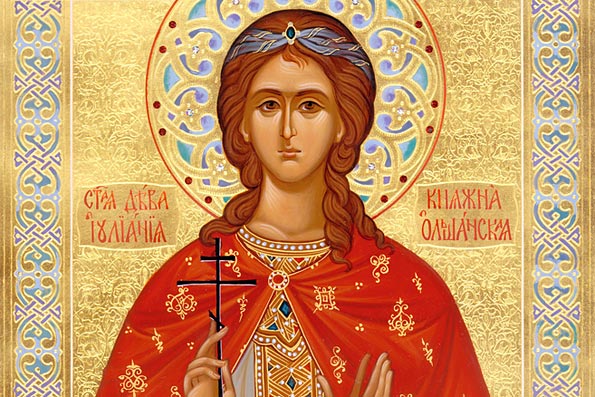
If one takes a close look at the icon of the Synaxis of the Saints of the Kiev Caves Lavra, the figure of St Juliana, Princess Olshanskaya, is to be seen alongside the Fathers of the Caves. Her incorrupt relics, dug up near the Dormition Cathedral in 1540 were enshrined within the temple, but they were moved to the Near Caves after a fire in 1718.
The feast of the translation of her relics having been celebrated in the last day, we would do well to pray her canon for Metropolitan Pavel, the persecuted Abbot of the Lavra, and all of the much-suffering fathers and brethren.
Ode I, Irmos: I will open my mouth, and with the Spirit will it be filled; and I shall utter discourse unto the Queen and Mother, and shall appear, keeping splendid festival; and, rejoicing, I will hymn her wonders.
Holy, Righteous Princess, Juliana, pray to God for us.
O Jesus, King of hosts, immortal Word of God: Grant me the discourse and intelligence, that I may hymn Thine immaculate bride, the righteous virgin Juliana, whom Thou hast radiantly glorified with incorruption and miracles.
Holy, Righteous Princess, Juliana, pray to God for us.
Wounded with desire for immortal life and the beauty of Him Who is more comely than all the sons of men, thy heart captivated thou didst hasten after Him with faith, O divinely wise Juliana.
Glory be to the Father, and to the Son, and to the Holy Spirit.
In godly manner thou didst array thyself in garments of purity, and didst clothe thyself in the vesture of immaculate virginity, O beauteous virgin. Wherefore, Christ loved the comeliness of thy soul.
Now and ever, and unto the ages of ages. Amen.
Strengthened by the grace of Him Who shone forth from thy womb, O all-immaculate one, the choirs of virgins were led in unto Him in thy train, rejoicing and crying out: Thou art the boast of the virginal!
Ode III, Irmos: O Theotokos, thou living and abundant fountain: in thy divine glory establish those who hymn thee and spiritually form themselves into a choir; and vouchsafe unto them crowns of glory.
Holy, Righteous Princess, Juliana, pray to God for us.
Strengthened by the power of God, O Juliana, while yet in thy youth thou didst overcome the uprisings of the passions, having one desire: faithfully to be well-pleasing unto Christ alone, and to serve Him blamelessly in holiness and purity.
Holy, Righteous Princess, Juliana, pray to God for us.
A divine miracle of the goodness of God was revealed in thee, O holy virgin — how thou, a young maiden, didst vanquish the machinations of ancient Belial — for in thy weakness was the power of God gloriously glorified.
Glory be to the Father, and to the Son, and to the Holy Spirit.
Thou didst love heavenly wisdom from childhood, O unblemished ewe-lamb Juliana, and instructed therein, thou didst consider the glory of princely rank, riches and beauty to be as nought, that thou mightest be pleasing unto Christ.
Now and ever, and unto the ages of ages. Amen.
Reasoning in Orthodox manner, we proclaim thee to be the true and most immaculate Mother of God; for through thee was the Creator pleased to unite Himself with us.
Lord, have mercy.Lord, have mercy.Lord, have mercy.
Sessional Hymn, Tone IV: All-adorned with the beauty of virginity, O immaculate bride, holy virgin Juliana, thou didst enter, rejoicing, into the bridal-chamber of Christ, where the choirs of the angels and the councils of the saints lovingly greeted thee, and the King of glory Himself, thy beloved Bridegroom, looked mercifully upon thee, and crowned thee with a crown of immortality. Him do thou entreat, O most blessed one, that He not deprive us, who are made of earth and dust, of the inheritance of His kingdom.
Glory be to the Father, and to the Son, and to the Holy Spirit; now and ever, and unto the ages of ages. Amen.
Theotokion: O pure and most immaculate one, who knewest not wedlock, who alone gavest birth in time to the timeless Son and Word of God: With the holy and honorable apostles, martyrs, prophets and the venerable, entreat Him, that He grant us cleansing and great mercy.
Ode IV, Irmos: Seated in glory upon the throne of the Godhead, Jesus most divine hath come on a light cloud, and with His incorrupt arm hath saved those who cry: Glory to Thy power, O Christ!
Holy, Righteous Princess, Juliana, pray to God for us.
To the sounds of angelic hymnody thou didst enter into marriage with the Lamb, O Juliana, bride of Christ, and didst receive the grace of miracles as a token of your betrothal to Christ, wherewith thou treatest the infirmities of men.
Holy, Righteous Princess, Juliana, pray to God for us.
With divine miracles and the incorruption of thy virginal body dost thou assure us that thy life was well-pleasing unto God, O favorite of God, and that thou hast received a heavenly reward with the saints.
Glory be to the Father, and to the Son, and to the Holy Spirit.
Thou didst offer gifts unto Christ — unsullied virginity, a silent mouth and a meek heart — O blessed Juliana; and by the labors of asceticism thou didst win the kingdom of heaven, wherein thou delightest in everlasting blessedness.
Now and ever, and unto the ages of ages. Amen.
Like rain upon the fleece which the Prophet Gideon beheld of old did the Lord descend upon thy womb, O all-immaculate one. Thou gavest birth to Him in two natures for the salvation of us who cry out: Glory to Thy power, O Christ!
Ode V, Irmos: All things are filled with awe at thy divine glory; for thou, O Virgin who hast not known wedlock, didst contain within thy womb Him Who is God over all, and gavest birth to the timeless Son, granting peace unto all who hymn thee.
Holy, Righteous Princess, Juliana, pray to God for us.
Like a treasure of great price were thy relics, blossoming with incorruption, found in the earth through the wondrous providence of God, O holy virgin Juliana; for thou didst most beautifully rest in the grave with a radiant face and the ornaments of a virgin, unharmed by corruption.
Holy, Righteous Princess, Juliana, pray to God for us.
Having died in the body, thou art alive in spirit, O God-pleasing princess; wherefore, thou didst appear in a vision to Peter [Moghila], the first hierarch of the Church of Kiev, commanding Him to render fitting honor to thy relics.
Glory be to the Father, and to the Son, and to the Holy Spirit.
Acknowledging thy holiness, the holy hierarch Peter had thy holy relics clad in new and magnificent garments, O righteous Juliana; and he placed them with honor in the Great Church, and decreed that thy memory ever be celebrated, in that thou art a true favorite of God
Now and ever, and unto the ages of ages. Amen.
Raise me up who have fallen into the pit of the passions, and guide me to the haven of salvation, O only most immaculate one who gavest birth to God the Helmsman Who by grace hath united those above to those below, who had formerly been separated.
Ode VI, Irmos: Celebrating this divine and most honored festival of the Mother of God, come, ye divinely wise, let us clap our hands and glorify God Who was born of her.
Holy, Righteous Princess, Juliana, pray to God for us.
The mindless and sacrilegious robber who stole the ring from thy hand thou didst punish terribly, O favorite of God, for he straightway bitterly gave up his soul at the entrance to the church and fell prey to the devil.
Holy, Righteous Princess, Juliana, pray to God for us.
Desiring to assure the right reverend abbot that thou truly restest with the saints in the mansions of paradise, thou didst appear to him in a vision among a choir of holy virgins, O blessed Juliana, and didst upbraid him for not believing that thou hadst been numbered by God among the holy virgins who were well-pleasing to Him.
Glory be to the Father, and to the Son, and to the Holy Spirit.
Thy holy relics pour forth healings upon the infirm, O princess Juliana, and the demons tremble before them; for great power is given thee by God against unclean spirits. From their oppression free us also through thy right acceptable supplications.
Now and ever, and unto the ages of ages. Amen.
Beholding the fulfillment of thy words, we magnify thee who hast magnified our race, O Mother of God; for giving birth unto One of the Trinity thou becamest an animate chariot of the Godhead. Wherefore, all generations now truly call thee blessed.
Lord, have mercy.Lord, have mercy.Lord, have mercy.
Glory be to the Father, and to the Son, and to the Holy Spirit; now and ever, and unto the ages of ages. Amen.
Kontakion, Tone VIII: We know thee to be an animate temple of God right beautifully adorned with virginal purity, O holy and righteous virgin princess Juliana; wherefore, celebrating the discovery of thy holy relics with love, we beseech thee, O excellent mediatress of our desires: Carry thy supplications for us to the Lord, and by thine intercession at the throne of the Most High free us from all misfortunes, that we may cry out to thee: Rejoice, O holy virgin Juliana, all-comely bride of Christ!
Ikos: Loving the purity beloved of the angels, O holy and righteous virgin, thou didst blamelessly finish thine earthly life, having acquired in the flesh the ways of the angels; wherefore, thou now dwellest in the mansions of paradise with the incorporeal ones and all the saints, and hearest from us who honor thee these hymns of praise: Rejoice, God-loving daughter of noble parents; rejoice, thou who didst wondrously join a princely diadem with the crown of immortality! Rejoice, thou who didst not desire to know an earthly betrothed instead of the heavenly One; rejoice, thou who didst blamelessly preserve thy virginity for Christ alone! Rejoice, thou who in thy youth didst love Jesus most sweet with all thy soul; rejoice, thou who maintained thy fidelity to Him unto the end of thy life! Rejoice, thou who hast been glorified by the Lord with incorruption and miracles; rejoice, thou who abundantly pourest forth gracious healings! Rejoice, ever-shining lamp illumining the Holy Church; rejoice, priceless treasure given by God to the Lavra of the Caves! Rejoice, cure for our bodies provided without any charge; rejoice, diligent intercessor before the Lord for our souls! Rejoice, O holy virgin Juliana, all-comely bride of Christ!
Ode VII, Irmos: The divinely wise youths worshipped not a creation rather than the Creator, but, manfully trampling the threat of the fire underfoot, they rejoice, chanting: Blessed art Thou, the all-hymned God of our fathers!
Holy, Righteous Princess, Juliana, pray to God for us.
Even though death touched thee through the law of nature, O divinely wise Juliana, yet dost thou emit a ray of immortality from thy tomb; for clothed with life-bearing mortality in Christ, thou didst most beautifully blossom forth with miraculous incorruption.
Holy, Righteous Princess, Juliana, pray to God for us.
The laws of nature were altered in thee in manner past understanding and comprehension, O wondrous virgin Juliana; for lying for many years in a grave in the bosom of the earth, thou wast shown to be incorrupt, thy face blossoming, as one who in the Lord slept the sleep of the righteous.
Glory be to the Father, and to the Son, and to the Holy Spirit.
Desiring to behold the beauty of the all-radiant countenance of Christ, O pure virgin, thou didst reject an earthly bridegroom, that thou mightest wed thyself to Christ forever. And thou didst offer immaculate purity unto Him as a costly dowry. Wherefore, He loved the beauty of thy soul.
Now and ever, and unto the ages of ages. Amen.
Spare me, O Christ, when thou wilt judge the earth with glory. Dispel the gloom of my passions through the supplications of the immaculate Virgin who gave Thee birth, and with her receive also the righteous Juliana who prayeth for me, in that Thou art good and great in mercy.
Ode VIII, Irmos: The birthgiving of the Theotokos saved the pious children in the furnace — then in figure, but now in deed – and it moveth all the world to chant to Thee: Hymn ye the Lord and exalt Him supremely for all ages!
Holy, Righteous Princess, Juliana, pray to God for us.
Thy splendid memorial is joy for the faithful, O blessed Juliana, for therein hath the triumph of Orthodoxy been made manifest; for only in the bosom of the One Orthodox Church doth the grace-bearing incorruption flourish, wherewith thou hast been divinely invested, receiving fitting honor.
Holy, Righteous Princess, Juliana, pray to God for us.
Christ gave thee an inexhaustible wealth of healings, O maiden, and instead of an earthly principality enriched thee with the inheritance of a heavenly kingdom, as one who loved Him sincerely with all thy soul. Wherefore, entreat His goodness, that He not deprive us, the benighted, of enlightenment from on high and the goodly portion of the saints.
Glory be to the Father, and to the Son, and to the Holy Spirit.
Thy holy relics pour forth streams of healing, O God-pleasing princess, wherewith thou dost bedew our souls with grace, and healest our bodies of multifarious ailments: for thou hast received rich gifts of healing from the Lord.
Now and ever, and unto the ages of ages. Amen.
O thou who gavest birth to the hypostatic Wisdom, the preëternal Word, the Physician of souls and bodies, heal thou the sores and wounds of my soul, which are grievous and of long standing, and assuage the pain of my heart, O Virgin.
Ode IX, Irmos: Let every mortal leap for joy, enlightened by the Spirit; and let the nature of the incorporeal intelligences keep festival, honoring the sacred feast of the Mother of God, and let them cry aloud: Rejoice, O most blessed Theotokos, pure Ever-virgin!
Holy, Righteous Princess, Juliana, pray to God for us.
The Holy Lavra of the Caves danceth, having thy wonder-working relics as a priceless treasure, O Juliana, from whence, as from an inexhaustible wellspring, thou pourest forth healings upon the faithful; wherefore, with love we bless thee with hymns of praise.
Holy, Righteous Princess, Juliana, pray to God for us.
Thou hast been shown to be like a radiant star illumining the noetic heaven of the Lavra of the Caves with grace, O righteous virgin; and with the purity of thy life thou shinest upon all who desire to live in holiness of life, that through thee all might be sanctified to the love of Christ God.
Glory be to the Father, and to the Son, and to the Holy Spirit.
O immaculate turtle-dove, thou didst fly beneath the shelter of the heavenly Eagle, and didst find goodly rest with Him, O right laudable Juliana. Bear thou our thoughts up to Him, and teach us to emulate the purity of thy life and thy fervent love for Christ God.
Now and ever, and unto the ages of ages. Amen.
Blessed is the Fruit of thy blessed womb, O pure one, Whom the hosts of heaven and the assemblies of men bless, and Who hath delivered us from the primal curse, O blessed Virgin.
Troparion, Tone VIII: As an immaculate bride of Christ, the incorrupt Bridegroom, O righteous virgin Juliana, with the radiant lamp of good works thou didst enter into His heavenly bridal-chamber, and there dost delight with the saints in eternal blessedness. Wherefore, entreat Him Whom thou lovest, and to Whom thou didst betroth thy virginity, that He save our souls.
Влахернская икона Божией Матери обретена в Иерусалиме императрицей Евдокией во времена святителя Ювеналия, Патриарха Иерусалимского (память 2 июля), и преподобного Евфимия Великого (память 20 января). Святая икона была послана в Константинополь, где императрица Пульхерия поставила ее в церкви Влахернской, там же хранилась честная риза Богородицы (празднование 2 июля).
Эту святую икону называют еще Одигитрией, то есть Путеводительницей. Именно с этой иконой Патриарх Сергий (610–631) обходил в 626 году стены Константинополя с молебнами при осаде столицы аварами. В память этой и других побед, одержанных благодаря заступничеству Пресвятой Девы, было установлено ежегодно в субботу пятой седмицы Великого поста совершать праздник Похвалы Пресвятой Богородице («Суббота Акафиста»). Первоначально празднование совершалось только во Влахернском храме в Константинополе. В IХ веке праздник был внесен в устав монастыря преподобного Саввы Освященного и в Студийский устав, а затем включен в Постную Триодь и сделался общим для всей Православной Церкви.
После падения Константинополя в 1453 году, Влахернская икона была перенесена на Афон, а в 1654 году прислана афонскими иноками в дар царю Алексею Михайловичу в Москву, где была помещена в Успенский собор.
Чудотворная икона сделана из восковой мастики и широко почитается среди православных верующих.
В настоящее время Влахернская икона находится в Успенском соборе Московского Кремля.

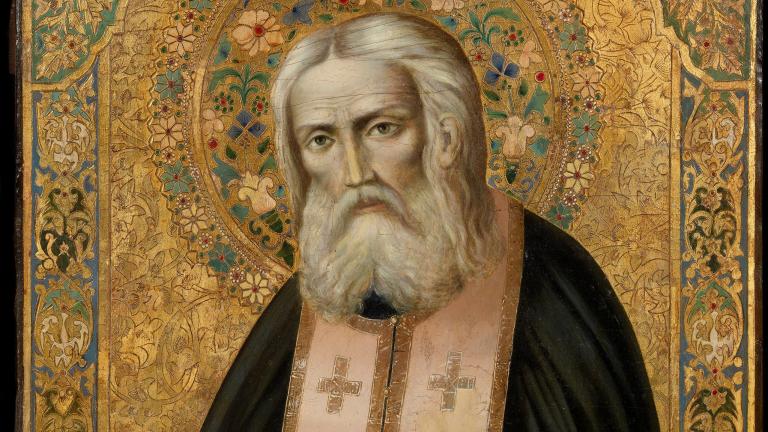


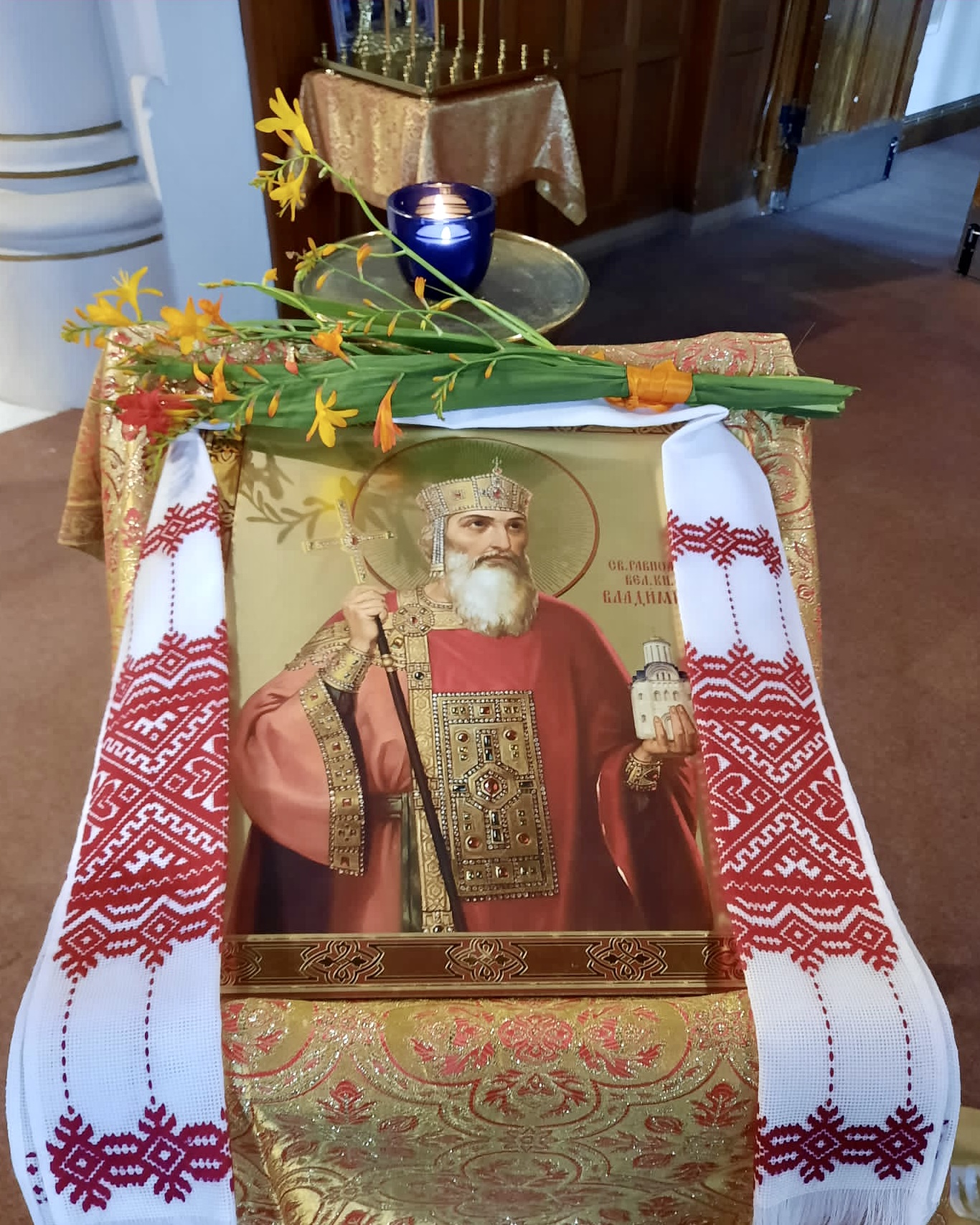
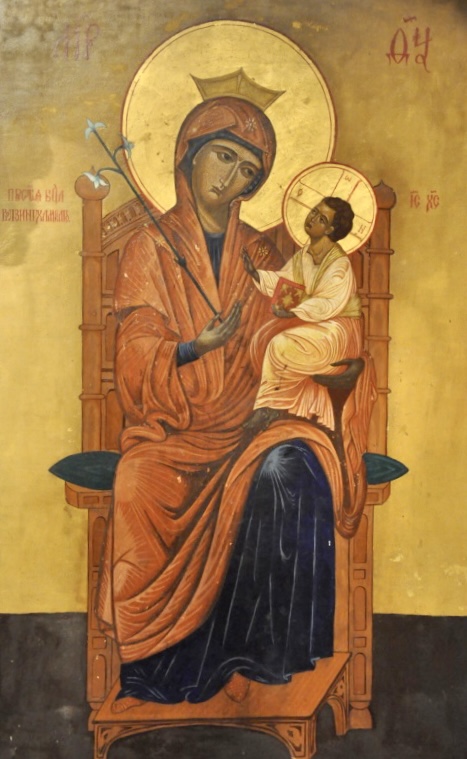 Monday’s arrival saw Mother Melangell rather surprised by the unexpected number around the tea-table at the skete, though she remained unfazed and received everyone graciously.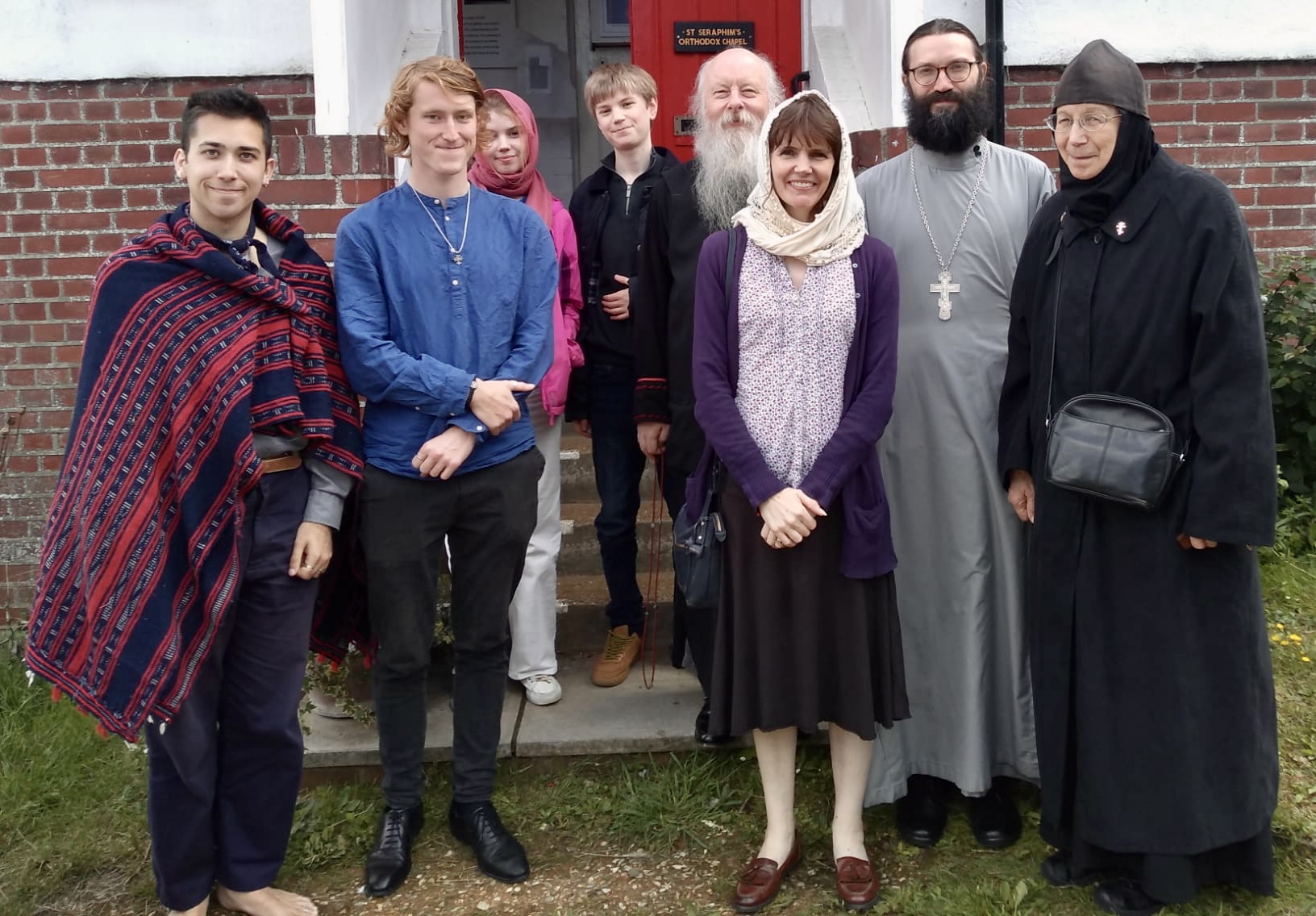
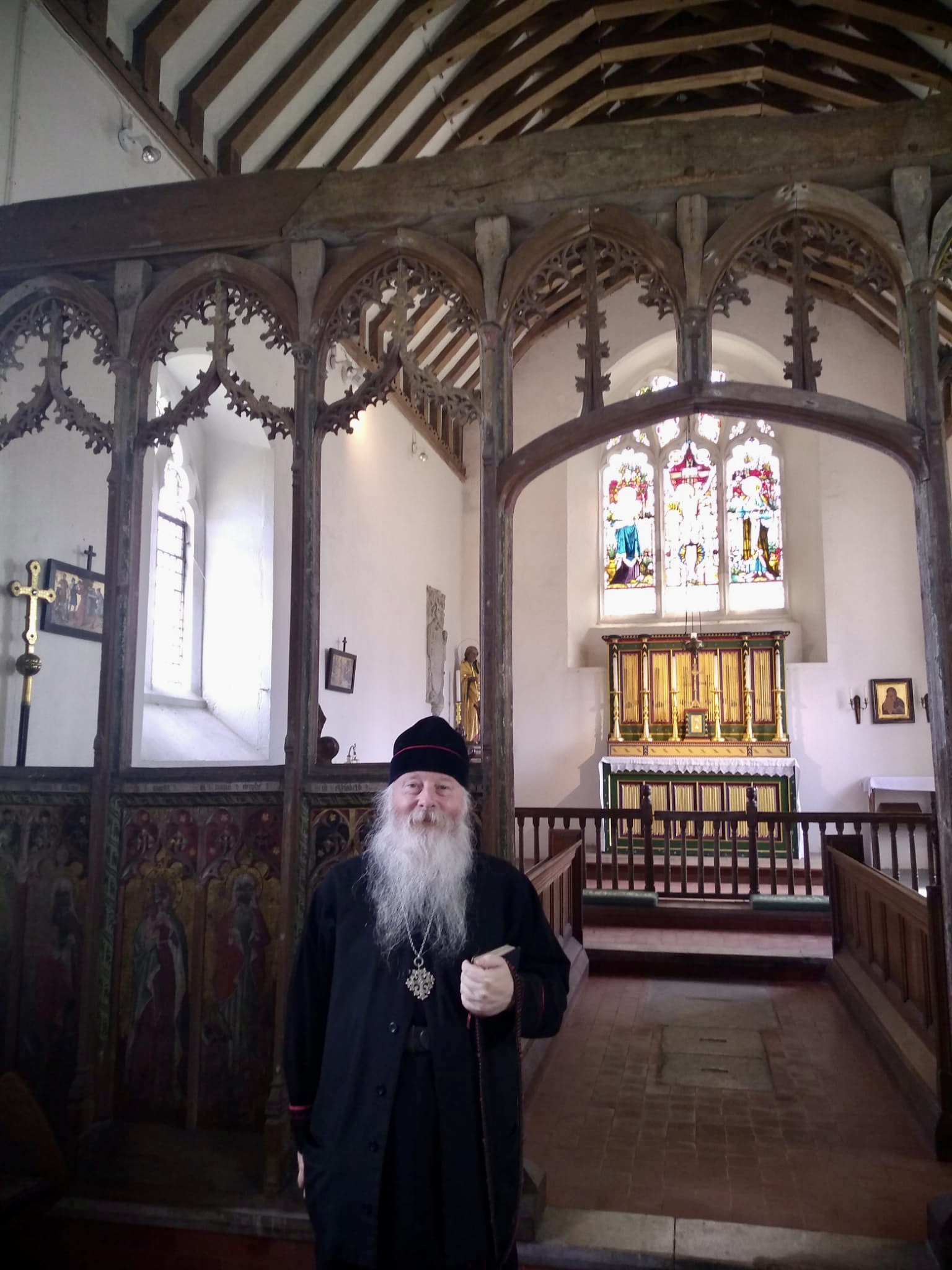
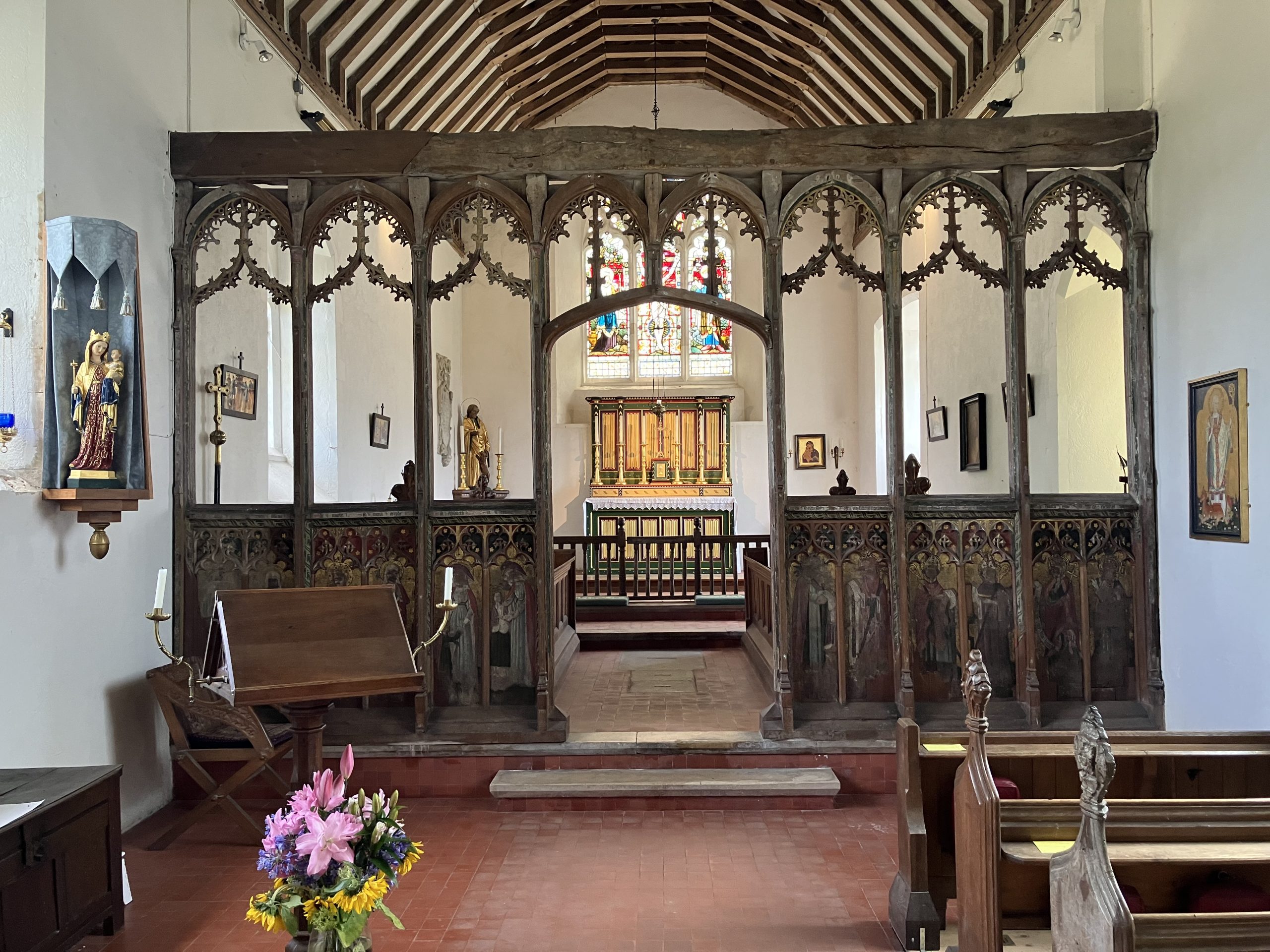
 On our return, after supper, I was very happy that a number our pilgrims took advantage of the Orthodox Chapel, going upstairs to pray, whilst I heard confessions.