 In the Name of the Father, and of the Son, and of the Holy Spirit.
On such a beautiful day, under blue Welsh skies, bathed in sunlight and surrounded by the new green leaves of spring, by blossom and birdsong, it is so easy to forget that in some parts of the world, our brothers and sisters are celebrating this feast of the Annunciation not to the sound of nesting birds and neighbours mowing their lawns, but rather to the sounds of sirens, gunfire and explosions. Yet, wherever there are Orthodox parishes and people, the feast will be celebrated, bringing light and hope to the suffering faithful as they celebrate the conception of the Saviour as the hope of the nations, Who brings light in the darkness, and to Whom we pray for “the peace from above.”
In the Imperial City, the Emperor and Equal to the Apostles, Saint Constantine built the temple of ‘Agia Irini, the Church of the Holy Peace, dedicated not to the Holy Martyr, but to the Divine Peace, for which we pray in every Liturgy.
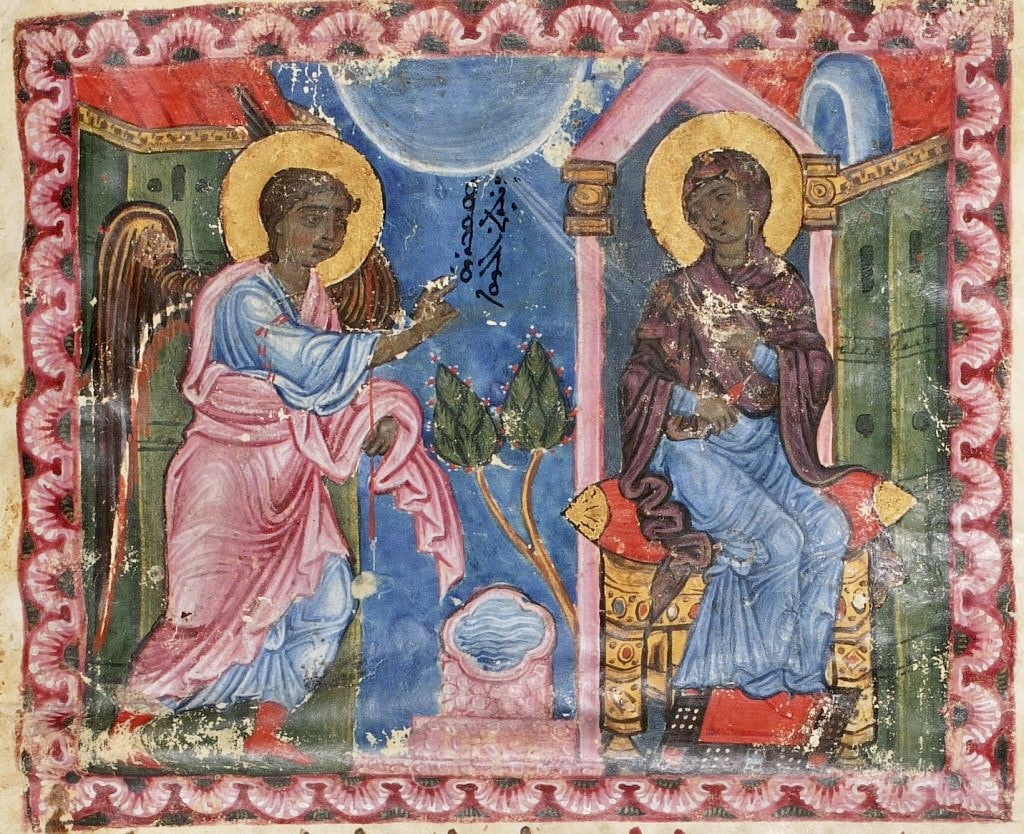
This feast of the Annunciation inaugurates that Divine Peace, in the reconciliation between fallen humanity and God, and not only between heaven and earth, but even between the heavenly heights and the depths of Hades holding the righteous dead of the Old Covenant, who were held captive there.
In his verse homily on ‘The Descent of the Angel’, the great Syrian Father, Jacob of Sarugh celebrates the Annunciation as the peace treaty made between God and humanity, and between heaven and earth.
In the conversation between God’s ambassador, the Taxiarch Gabriel and the Theotokos as the representative of the entire human race, Mar Jacob sees the restoration of “the peace from above”, that will become Incarnate in the Person of the Saviour, the God-Man, the Theanthropos, who will be the living sign of this reconciliation and the peace treaty that will be signed with His Blood, sealed by His last breath, with the words “It is done!” The earthquake and eclipse of Great Friday, and the tearing of the Veil of the Temple will be the heralds of this peace like no other, even as He descends into Hades and shatters its gates, and the chains and shackles of death, bringing light to those in darkness and raising his ancestors-according-to-the-flesh in his own resurrection.
This peace treaty begins today, as the Theotokos, after listening to the message of the Archangel, gives her consent to the plan and will of God, as she humbly says, “Behold, the handmaid of the Lord; be it unto me according to thy word.”
Hidden from the eyes of the world, the Prince of Peace came to dwell within her Ever-Virgin womb, and though the Cross, the Invincible Trophy and Weapon of Peace (Kontakion of the Cross) was far off, the new Life hidden within womb of the Mother of God was already the Bridegroom going to His voluntary Passion, as we describe Him in the services of this Holy and Great Week, and the meaning of this Passion, of the Cross, the nails, the spear and death was to establish “the peace from above, and the union of all”, for which we pray in the Litany of Peace.
This “peace from above” is not the cessation of earthly conflict, be it war in Europe, Palestine, the Middle East, or any corner of the world. It is realised in the end of the enmity caused by the rebellion of man against God, the conquest and vanquishing of hell and death, the reconciliation of creation with the Creator, of man with God, and of children with their Heavenly Father.
Though man may fight against man, regime against regime, nation against nation, the reality of this Divine Peace cannot be changed, and when the Risen Saviour appeared to the Apostles, His first words (the deeper meaning perhaps not apparent or obvious) were, “Peace, be with you!”
Even now, as we pray for earthly peace, and for those (including the relatives of our own parishioners) who suffer the losses, pains and vicissitudes of war, let us celebrate the Divine peace-treaty made this day, and contemplate the words of the divinely inspired, Jacob of Sarugh.
The Descent of the Angel
The Watcher had descended while Mary was standing in prayer;
he gave her the greeting which was sent to her from the Most High:
‘Peace to you Mary, blessed one, our Lord is with you;
Blessed are you and blessed is the fruit of your virginity.’
Then when she heard it, she was prudently reflecting
On what might be the cause of this unusual greeting.
The Watcher said: ‘Do not be afraid, O full of mercy,
The Lord has chosen you that in your virginity you might be his Mother.
‘Behold from this time you will solemnly conceive;
you will give birth to the great One whose Kingdom is without end.’
Mary said: ‘How then will what you say happen
Since man has never been known to me, how will I bring forth?’
‘You have announced a Son to me but I am not conscious of marital union;
I have heard of nativity but I see no marriage.’
That moment was full of wonder when Mary was standing,
Conversing in argument with Gabriel.
One humble daughter of poor folk and one angel
Met each other and spoke of a wonderful tale.
A pure virgin and fiery Watcher spoke with wonder:
a discourse which reconciled dwellers of earth and heaven.
One women and the prince of all the hosts
Had made an agreement for the reconciliation of the whole world.
The two had sat between heavenly beings and earthly ones;
they spoke, attended to and made peace for those who were wroth.
Maiden and Watcher met each other and conversed in argument on the matter
Until they abolished the conflict between the Lord and Adam.
That great strife which occurred amidst the trees
came up for discussion, and it all came to an end; there was peace.
An earthly being and heavenly one spoke with love;
the struggle between the two sides ceased, and they were at peace.
+
Surrounded by the violence, the madness, and the conflict of the world, may the Divine Peace make its home within our hearts and minds, as we abandon ourselves into the embrace of God’s love, Love which become a Person and was Incarnate in the womb of the Virgin-Mother on this Great Feast, as “the crown of our salvation, and the manifestation of the mystery that was before the ages.”
This mystery is the pre-eternal wonder of God’s ineffable, immeasurable, and sacrificial love: the love that came like the father of the prodigal son, to search for us when we were lost and estranged in spiritual exile, and took on human flesh when a young mother in Nazareth surrendered herself to God’s will, and said “yes” to becoming His instrument of reconciliation and the peace between heaven and earth.
Let us try to forget disagreements, arguments, conflicts, the negative memories of the past, and struggle to love and forgive, however hard that may be, so that we may aspire to “the peace from above”, however difficult our struggle may be.
We must pray continually, seeking to continually forgive, continually asking for forgiveness, confessing our weakness and insufficiency, and creating (by humility) a place within our hearts for that peace to make its sacred home.
Unless we at least try to do this, this feast and all it represents will have no meaning, resonance or spiritual significance in our lives.
Amen.