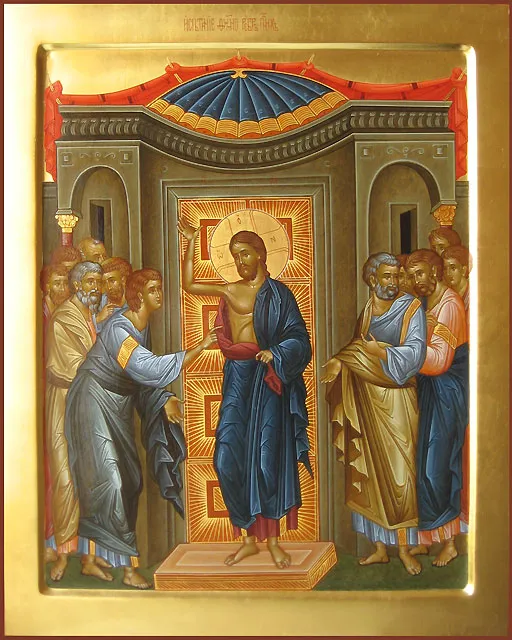
The same day at evening, being the first day of the week, when the doors were shut where the disciples were assembled for fear of the Jews, came Jesus and stood in the midst, and saith unto them, Peace be unto you. And when he had so said, he shewed unto them his hands and his side… But Thomas, one of the twelve, called Didymus, was not with them when Jesus came. The other disciples therefore said unto him, We have seen the LORD. But he said unto them, Except I shall see in his hands the print of the nails, and put my finger into the print of the nails, and thrust my hand into his side, I will not believe.
In the Name of the Father, and of the Son of the Holy Spirit.
Dear brothers and sisters, we have observed so many times before, how harsh a judgement Thomas often receives for his refusal to believe in the Saviour’s resurrection, and insisting that he should not only see, but also physically, and tangibly encounter the Sacred Wounds of the Risen Lord.
But whilst his reputation as “Doubting Thomas” has entered everyday speech as the epitome of doubt, the Church Fathers and the mind of the Church have been far from condemnatory regarding Thomas’s skepticism.
The great Alexandrian Church Father, St Cyril, warns us not to idealise the reaction of the other disciples, as though it was somehow solid and blameless. For St Cyril, Thomas represented the uncertainty of the whole company of the Apostles, but he was the only one with the courage to actually express their confusion and doubt:
“For though of Thomas alone is recorded the saying: Except I shall put my hands and see the prints of the nails, and put my hand into His Side, I will not believe, yet was the charge of lack of faith common to them all; and we shall find that the minds of the other disciples were not free from perplexity, though they said unto the holy Thomas: We have seen the Lord.”
To repeat, “…yet was the charge of lack of faith common to them all; and we shall find that the minds of the other disciples were not free from perplexity…”
The Church has recognised Thomas’s voice as not only the unexpressed doubt of the other disciples, but rather as a doubting and questioning voice on behalf of the whole of humanity, of which future generations in the centuries of growing skepticism and declining faith would demand the ‘scientific’ and empirical knowledge that Thomas demanded: “Except I shall see in his hands the print of the nails, and put my finger into the print of the nails, and thrust my hand into his side, I will not believe.”
At vespers, in the hymns on “Lord, I have cried…” the Church expresses the Saviour’s welcoming of Thomas’s doubt, hearing Him welcome the investigation of His life-giving wounds, saying, “because thou hast disbelieved, all have learned of My Passion and resurrection…”
At the very time of His resurrection, the All-Knowing Lord knew the doubt and denial of generations to come, and how Christian orthodoxy would give way to liberal falsehood that, even as it masquerades as Christianity, denies the reality of the empty Tomb, and the physicality of His Third-Day Rising from the dead, resulting in heretical and perverted neo-gnostic attacks on the physical reality of the incarnation and of the Saviour’s Third-Day resurrection.
The Saviour’s answer was the blessed GIFT of Thomas’s doubt, and the disciple’s courage in demanding to touch the Wounds on the Lord’s Divine-Human Body.
Thus, we are all blessed, confirmed in Faith and are beneficiaries through Thomas’s skepticism and caution, as reflected in St John of Damascus’s seventh ode of the canon of the feast, in which he wrote,
“Thomas the Twin, who alone was bold, and who by his unbelieving belief hath brought us benefactions, doth by his believing unbelief dispel gloomy ignorance from all the ends of the earth.”
(Еди́н дерзну́вый, неве́рною же ве́рою /облагоде́тельствовавый нас Фома́ Близне́ц, /реши́т у́бо мра́чное неве́дение всех конце́в,ве́рным неве́рствием…)
In the fourth ode of the same canon, St John expresses His firm belief that the Saviour rejoiced in Thomas’s doubtful exploration of the Sacred Wounds,
“Thou didst rejoice when Thou wast examined. Wherefore, O Lover of mankind, Thou didst encourage Thomas in this (Ра́дуешися испыта́емь, / те́мже,Человеколю́бче, на сие́ повелева́еши Фоме́…) and didst show Thy side unto the disbelieving one, thereby assuring the world of Thine arising on the third day, O Christ.” (Fourth Ode)
Wheras the Risen Saviour warned St Mary Magdalene, “Touch me not.” He actively invites the apostle to do so: “Put your finger here; see my hands. Reach out your hand and put it into my side. Stop doubting and believe.”
The Church Fathers are approving and affirmative in their assessment of Thomas’ doubt.
St. Gregory the Great says that, “Thomas’s unbelief has been more useful than the faith of the other apostles because by believing through touching the wounds, he strengthened faith and banished all doubt”, and St John Damascene represents Thomas’s unbelief as “the mother of belief for us” (ве́ры роди́тельное нам показа́л еси́… ) and touching on the question of the Faith of future generations, St Cyril of Alexandria wrote,
“I think that the disciple’s want of faith was extremely opportune and well-timed, in order that, through the satisfaction of his mind, we also who come after him might be unshaken in our faith that the very Body that hung upon the Cross and suffered death was quickened by the Father through the Son.”
What incredibly important words.
St Cyril also says, “We… are taught, through the slight want of faith shown by the blessed Thomas, that the mystery of the Resurrection is effected upon our earthly bodies, and in Christ as the Firstfruits of the race; and that He was no phantom or ghost, fashioned in human shape, and simulating the features of humanity, nor yet, as others have foolishly surmised, a spiritual body that is compounded of a subtle and ethereal substance different from the flesh.”
Thomas’s doubt is a blessing and a gift to the Church of all future generations, to say that not only was the Saviour truly God and truly Man, but that His humanity was not a temporary incarnational instrument, to suffer on the Cross, to lie in the Tomb, but then to be cast aside because redemption was completed.
Rather, His rising confirmed that Christ remains Incarnate, the Theanthropos (the God-Man), and that even though He established a New Passover – the Pascha of the Lord – in the resurrection He would not even abandon the wounds upon His Body, but on the contrary would take these supreme marks and wounds of love into the Heavenly Kingdom in His Ascension, and that in this, He would call humanity to follow Him into the Heavenly Kingdom, as the destination of the resurrection.
St Cyril teaches us that Thomas’s blessed doubt reminds us that not only was the Risen Saviour “…no phantom or ghost, fashioned in human shape, and simulating the features of humanity, nor yet, as others have foolishly surmised, a spiritual body that is compounded of a subtle and ethereal substance different from the flesh..”
St Thomas is the apostolic voice that removes ambiguity, doubt and uncertainty, and with him we can say, “I believe in the resurrection of the body”: in both the spiritual and physical resurrection of the Saviour – the God-Man – as with the apostle we look to the Risen Saviour and say, “My Lord and my God.”
Confirmed by his doubt, his questioning, his exploring hand, we have no need to look upon the wounds of the Saviour, to inspect the marks of the nails, to place our fingers in His wounds, or our hand in His wounded side.
Because of Thomas’s witness to the reality of the Risen Lord, we have no need for scientific and empirical proof, realising and understanding that spiritual knowledge is just as potent, real and powerful as scientifically quantifiable fact.
In the Beatitudes we chant, “Blessed are the pure in heart; for they shall see God…” and the heart of the believer, as the centre of our spiritual being, is the noetic organ and means by which we attain to the spiritual knowledge that does not need to prod, poke, inspect and investigate, placing spiritual reality under the magnifying glass.
When we encounter the Lord meeting the disciples on the road to Emmaus, it will not be through speech, conversation, or even vision that they will recognise the Risen Lord, but it will be through the spiritual movement of their hearts in the breaking of bread that their bodily eyes are opened to the reality that Christ is Risen.
As we hear in Luke’s Gospel, “When he was at the table with them, he took bread, gave thanks, broke it and began to give it to them. Then their eyes were opened and they recognized him, and he disappeared from their sight. They asked each other, “Were not our hearts burning within us while he talked with us on the road and opened the Scriptures to us?”
Through drawing near to the Risen Lord, day by day, in this Paschal season, praying to Him in the power of the resurrection, constantly chanting the Paschal Canon and Hymns, the power of the resurrection must fill our hearts with light and spiritual warmth so that we too will know – purely by faith – that Christ is risen from the dead; trampling down death by death; and bestowing life upon those in the Tombs. And, we believe not only in the Lord’s Third-Day Rising, but crucially in the future physical as well as spiritual resurrection of everyone who has come into this world, throughout every century and generation, “…they that have done good, unto the resurrection of life; and they that have done evil, unto the resurrection of damnation.” (John 5:29).
And… as we look for the resurrection of the life of the age to come, let us rejoice in Thomas’s blessed doubt, joining our voices with the voice of the Church in praising God for the truth that Thomas has daringly confirmed:
“O how praiseworthy and truly awesome is Thomas’ undertaking (Canon, Ode 5.) For daringly he touched the side that doth flash forth with the lightning of the divine fire (Canon, Ode 8). The Twin doth fill the world with wisdom and knowledge (Canon, Ode 4).”
О вои́стинну похваля́емаго Фомы́ стра́шнаго начина́ния! Твое́ неудо́бное сокро́вище, утае́ное нам отве́рзе Фома́…(Canon, прему́дрости и ра́зума наполня́ет мир Близне́ц.
Christ is Risen! Христос Воскресе! Amen.