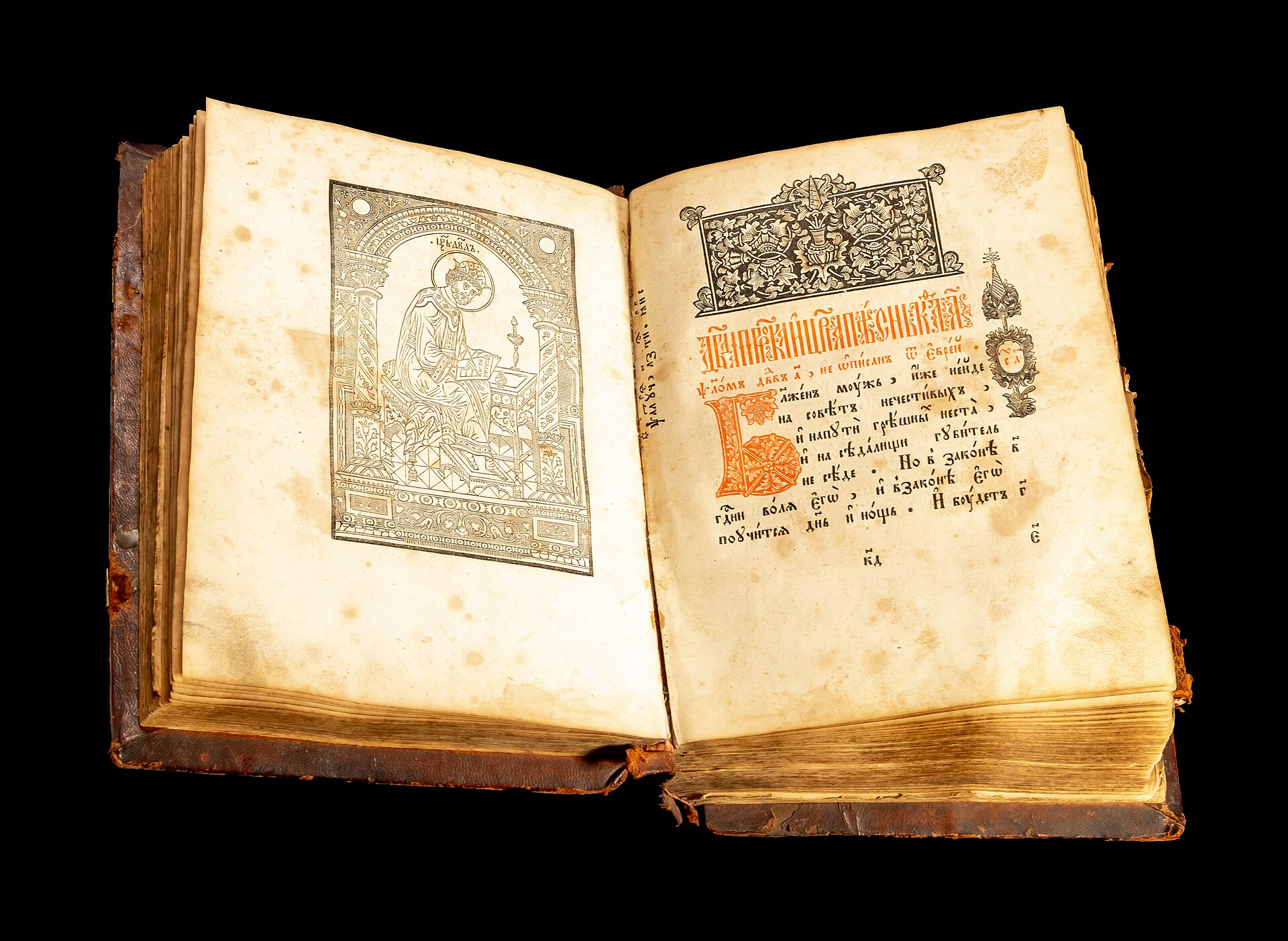
For many of us, the English language Psalms in our heads, are those from Holy Trinity Monastery’s “Psalter According to the Seventy” – and for many years, the Boston translation was the standard one in our ROCOR services. Despite some enigmatic and opaque verses, the “Boston Psalter” is part of the spiritual consciousness of many Orthodox people. However, one great frustration was that it did not contain the traditional troparia and prayers of the Slavonic Psalter, for prayer in the home or monastic cell, especially for keeping solitary vigil, or with one or two companions in prayer.
The Monastery of the Transfiguration, in Ellwood City, Pennsylvania, had a booklet of the kathisma hymns and prayers, but for those of us used to traditional liturgical English texts, the language was a challenge.
Zoom forward nearly four decades, and we are blessed with the “Psalter For Prayer”, based on the Coverdale translation, complete with the prayers before snd after reading the Psalms, the troparia of compunction, and Kathisma prayer at the end if each section.
Whilst the default wording for many of us remains the old HTM translation, the wonderful Jordanville Psalter is a massive blessing in giving the traditional materials for reading the Psalms prayerfully in the home or monastic cell, making it one of the most important spiritual texts for a believer to have together with tgeir Bible and prayerbook.
I have been so glad that parishioners – particularly young ones – are so receptive to praying the Psalter, particularly during Great Lent and Advent, when the prayer-team reads the Psalter in its entirety every day, and encourage everyone to buy the Psalter for Prayer, with the traditional hymns and prayers for the Cell Rule, and the rule of the Twelve Psalms referred to in today’s earlier blog post.
For those unfamiliar with the tradition, here are the prayers and hymn that follow the first kathisma of the Psalter: “Blessed is the man…”
 After the First Kathisma, the Trisagion Prayers, and these troparia, in Tone I:
Conceived in iniquities, prodigal that I am, I dare not gaze upon the heights of heaven; yet, confident of Thy love for mankind, I cry: O God, cleanse me and save me, a sinner!
If the righteous man can hardly be saved, where shall I, a sinner, find myself? I have not borne the burdens and heat of the day; yet, number me among them that were hired at the eleventh hour, O God, and save me!
Glory be to the Father, and to the Son, and to the Holy Spirit.
Make haste to open unto me Thy Fatherly embrace, for as the Prodigal I have wasted my life. In the unfailing wealth of Thy mercy, O Saviour, reject not my heart in its poverty, for with compunction I cry unto Thee, O Lord: Father, I have sinned against heaven and before Thee.
Both now, and ever, and unto the ages of ages. Amen.
O most holy Virgin, hope of Christians, with the heavenly hosts unceasingly entreat God, to Whom thou gavest birth in manner past understanding and recounting, that He grant remission of sins and amendment of life unto all of us who with faith and love ever honor thee.
Lord, have mercy. (40)
And this Prayer: O Master, Almighty, Unapproachable, Origin of light, and Power beyond comprehension, Who art the Father of the hypostatic Word, and from Whom came forth the Spirit Who is one with Thee in power; Who, for the sake of the mercy of Thy loving-kindness and Thine ineffable goodness, hast not scorned human nature, which is held fast in the darkness of sin, but hast illumined the world with the divine beacons of Thy sacred teachings, the Law and the Prophets; Who in latter times wast well pleased for Thine only-begotten Son to shine forth upon us in the flesh and guide us to the effulgence of Thy glorious light, may Thine ears be attentive unto the voice of our supplication; and grant, O Lord, that we may pass the whole night of this present life with a vigilant and watchful heart, awaiting the coming of Thy Son and our God, the Judge of all. And may we, without having lain down to sleep, but keeping vigil and upright, enter together into His joy, where the voice is unending of them that behold the ineffable beauty of Thy face. For Thou art a good God and the Lover of mankind, and unto Thee do we ascribe glory, to the Father, and to the Son, and to the Holy Spirit; both now, and ever, and unto the ages of ages. Amen.
There are different local traditions, with different texts, with the Cherubim Press having published the Psalter with the hymns and prayers according to the tradition of the Athonite monastery of Pantokrator. However, it’s not the greatest English for prayer purposes, though I may just find it jarring as a British man used to traditional liturgical English.
I hope that we might have some input here from brothers and sisters who use the St Tikhon’s Press Psalter, and share their experience. Please share with us!
Whichever texts we use, according to different local traditions and languages, the hymns and prayers greatly enrich our chanting of the Psalter, and its place in our spiritual journeys of prayer and repentance.