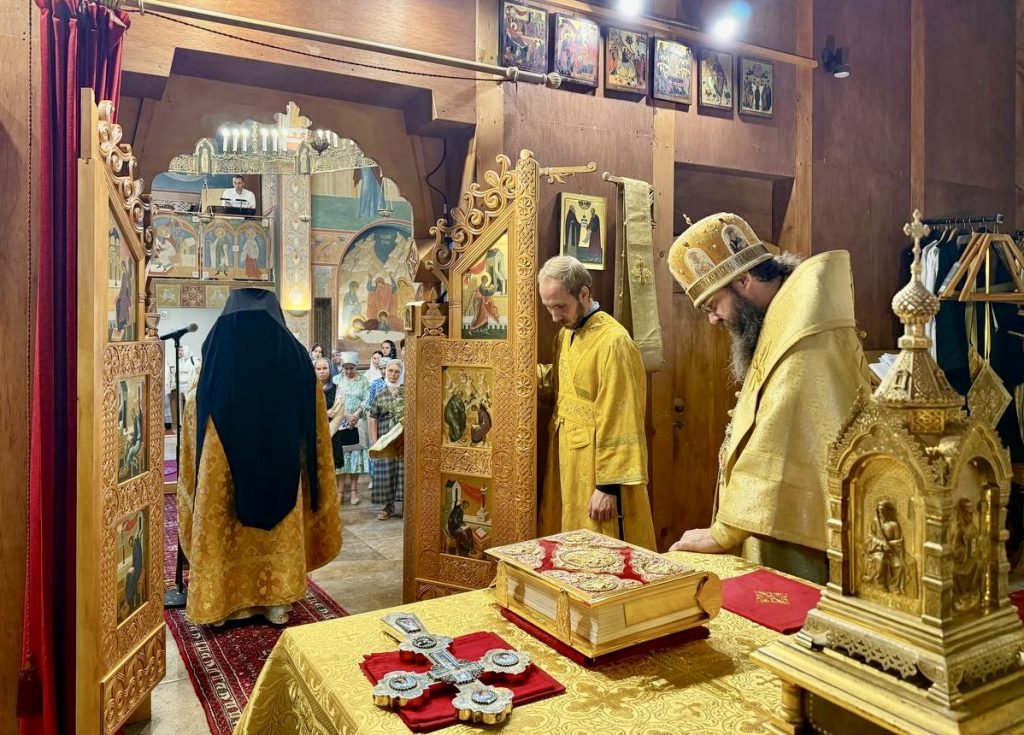
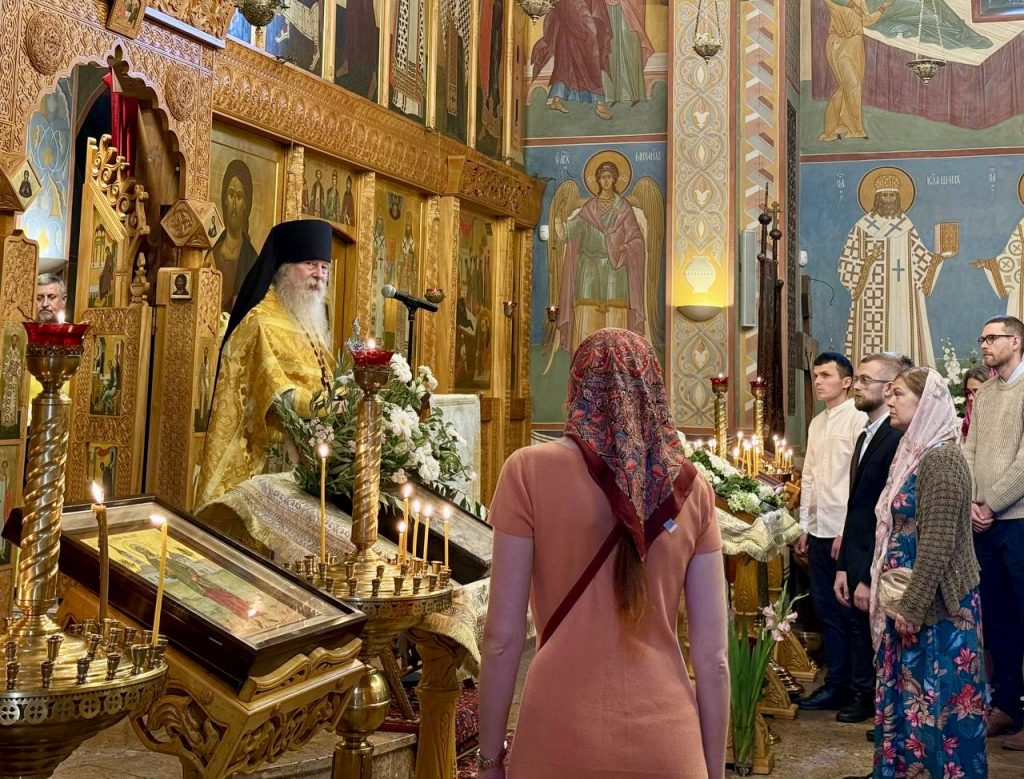
A homily preached by Hieromonk Mark in the London Cathedral of the Nativity of the Mother of God and the Holy Royal Martyrs on the 8th Sunday after Pentecost.
In the Name of the Father, and of the Son, and of the Holy Spirit.
Dear brothers and sisters,
In the Gospel pericope for this eighth Sunday after Pentecost we encounter one of two miraculous feedings of the multitudes. Sadly, some antagonists mistakenly conclude that the differences in the two narratives are contradictions which somehow undermine the credibility of the Gospels, considering them to be nothing more than jumbled different versions of some figurative and symbolic storytelling, rather than miraculous, real and salvific events.
However, the Gospels are actually quite clear that these are separate miracles, and though they are loaded with layers of profound symbolism, they are not some sort of figurative myth or parable. The feeding of the five thousand recorded in all four Gospels, and the feeding of the four thousand, recorded in Matthew chapter 15, are separate, distinct, historic, miraculous events.
The fact that both centre on the common theme of the distribution of loaves and fishes, need not worry us or indicate any confusion of events, given that this was standard street food of the time, and we learn from St John’s record of this miracle that the loaves were barley loaves, cheap and rough peasant food, available on any street corner, carried as a packed lunch by ordinary people.
As we contemplate the events that unfold before us, it is often the case that we rush forward to the miracle itself. However, we can profit by spiritually contemplating the people themselves, and asking ourselves how we could and should be like them.
We should recognise that the inconvenience and the lack of preparedness and planning in this episode essentially stems from the fact that at the end of the day – quite literally – the physical hunger of the people was a consequence of their spiritual hunger in following the Lord into the wilderness to press Him to teach them, and be spiritually nourished by the Gospel, for though St Matthew speaks only of the healing miracles performed by the Lord, St Luke’s wrote that “He received them, and spake unto them of the Kingdom of God”, and St Mark is clear in recording that the Lord was teaching and instructing the multitude: feeding them spiritually, even as they began to grow weak, hungry and tired from lack of physical sustenance.
And, as the day went on and they began to hunger and grow weak, we might say that they were already fulfilling the Lord’s teaching, recorded by the Evangelist Matthew, “Take no thought for your life, what ye shall eat, or what ye shall drink… But seek ye first the kingdom of God, and His righteousness; and all these things shall be added unto you.” To repeat, St Luke’s tells us before performing this great miracle, that He spoke to them of that very Kingdom.
In the lack of provisions and preparedness of those following and listening to Jesus, we might even say that they were already embracing the spirit of the Cherubic Hymn, in laying aside all earthly cares to encounter the King of All, and in doing so took no thought for bodily sustenance as they followed the Saviour into the wastes and wilds.
Even as the Lord was seeking solitude after the death of his kinsman, John the Baptist, the spiritually hungry crowds were seeking words of everlasting life, following him in great droves as news of his retreat into the desert spread rapidly by word of mouth.
They already knew the pressing news of the moment, that Herod had executed the Forerunner, and perhaps even sensed what the Church Fathers touch upon: that the Lord was escaping from Herod’s blood lust and paranoic fear, “because His hour was not yet come”.
Blessed Theophylact of Ochrid instructs us, “Jesus departed on account of Herod’s bloodthirstiness… For if Herod had seized Jesus, he would have attempted to kill Him…” and those who followed the Lord, must have been aware of this danger, knowing and understanding that Jesus was being watched and observed, suspected by the collaborationist Jewish powers, despised as a threat to the religious status quo, to the authority of the Sanhedrin and the Temple, and the authority of the Pharisees and the rabbis.
Already in the preceding chapters of Matthew’s Gospel, we have encountered the Saviour opposed by the Gerasenes after exorcising the demoniac man who lived in the tombs; accused of blasphemy for proclaiming the forgiveness of sins; attacked for healing on the sabbath; the accusation that the He cast out devils by the power of Beelzebub; and the fourth chapter of the Gospel has already set the scene, in telling us that already, “His fame went throughout all Syria: and they brought unto Him all sick people that were taken with divers diseases and torments, and those which were possessed with devils, and those which were lunatic, and those that had the palsy; and He healed them. And there followed Him great multitudes of people from Galilee, and from Decapolis, and from Jerusalem, and from Judaea, and from beyond Jordan.”
Those who hungered at the end of the day, having listened to the Saviour’s preaching, and seen their loved ones healed, were part of this tide of humanity, and they most likely knew that not simply their association, but their determination in following Him into this desert place, to hear His teachings, could easily be considered heretical and seditious, but any associated danger did not put them off or dull their determination.
As St John Chrysostom comments, “but so the multitudes do not withdraw themselves from Him, but they follow, riveted to Him, and not even John’s tragic end alarmed them. So great a thing is earnest desire, so great a thing is love; in such wise does it overcome and dispel all dangers.”
Love and spiritual desire caused these crowds to forget all thought of food, all concern about hunger, all personal need.” They were already heeding the Saviour words, “Therefore take no thought, saying, What shall we eat? or, What shall we drink? …for your heavenly Father knoweth that ye have need of all these things.” (Matthew 6:31, 33)
And, when we come to the miracle itself, the location of this wondrous act, far from settlements, markets, vendors and food would provide no occasion for accusation or doubt.
St John Chrysostom stresses that, “He leads them into the wilderness, that the miracle might be very far beyond suspicion, and that no one might think that any village lying near contributed ought to the meal.”
There is no easy answer to this hungry situation: no market sellers, no road-side food. The multitudes are totally reliant on the Lord’s intervention, through the self-same compassion which led the Him to heal those sick and possessed they brought to Him.
He was, of course, already well aware of the situation when the disciples came and said, “This is a desert place, and the time is now late; send the multitude away, that they may go into the villages, and buy themselves food.” And when He said to the disciples, “They need not depart; you give them to eat”, He was equally well aware that there was nothing more than five rough loaves, little more than bread rolls, and two small fish, possibly salted opsaria, a garnish of a few bites, little more than sprats.
What did the disciples and the crowds think as He gave instructions for the organised seating of the people, ready to be fed, in groups of hundreds and fifties, according to the Evangelist Luke?
They had already seen Him work miracles and heal the sick. Just in the preceding chapters of Matthew we have encountered the healings of the leper, of the centurion’s servant, of Peter’s mother-in-law; the calming of the storm on Lake Galilee; the restoration of two demon-possessed men; the forgiveness and healing of the paralyzed man; the raising of a sick girl; the healing of the woman with an issue of blood; and, the healing of a blind man and a mute.
All were ready for miracles, indeed, they had seen miracles that very day in the healing of their sick, but we might say that this present miracle stands out, looking both backwards and forwards, in as much as this it is one supremely manifested in sharing and fellowship, a sign of the New Covenant, even as it echoes the old.
The mention of the Passover season in St John’s account, gives us a hint of the exodus, and the Lord’s provision of heavenly manna to sustain the Israelites in the wilderness, just as the Lord feeds the multitude in this latter day wilderness, but in this shared meal with the ancient eucharistic symbols of bread and fish (the fish subsequently becoming a symbol of the Lord, Himself) the shared experience of grace points forward to the future sacred fellowship of the Church.
This miracle and all of the previous ones that had established the Lord’s reputation as a wonderworker, are signs of Him, not only as sustainer of all, but as Creator Who, “looking up to heaven, blessed, and broke, and gave the loaves to his disciples, and the disciples to the multitude.”, so that not only are people fed, but they are full, and not only are they full, but there are twelve baskets of leftovers. We should be neither uncomfortable in the face of sceptics, nor surprised, the Pre-Eternal Word, Who created heaven and earth and all that therein is, performed a great creative act in order to feed the people.
As in the history of creation, “in the beginning”, He could have performed this miracle, ex nihilo – from nothing – but the depth of the miracle’s meaning lies in the fact that the Lord performs this miraculous act using the ridiculously little that humanity had to offer in this isolated and deserted place.
When the Lord was in the wilderness, being tempted after His baptism, even the devil – in testing Who He was – suggested that He could make bread out of stones, but, here, the Lord performs the miracle using whatever little the people have to offer. As such, humanity is in its own tiny and almost ridiculous way a participator in the great wonder performed.
From an embarrassingly small offering the Lord created far more than was needed, and whilst not doubting the historicity of the miraculous event, this should encourage us to see a far broader spiritual depth and meaning in the Lord’s wondrous works, as we recognise and understand that whatever each of us has to bring the Lord in the offering of our lives may be seemingly unspectacular and lack-lustre, yet our Lord and Creator is able to make something truly wondrous and spiritual significant, if we offer ourselves and our gifts to Him in humility, in willingness, selflessness and faith. We, as poor chaff filled barley loaves, and small fry of little significance, can be transformed and created anew by the Lord, according to His plan, purpose and will.
But for this to become possible, reflecting on the Gospel of this wondrous miracle, we must be determined and fearless in our willingness to not only follow the Lord, but to pursue Him to ends of the earth and the end of our earthly days, ignoring all threats and dangers, overcoming all inconveniences and obstacles, zealous to hear His life-giving words, seeking to be made whole, to be touched by His Divine Grace, and in so doing be able to offer ourselves and all that we have into His hands as our Creator, Fashioner, and our God.
And when, every day, we pray, “give us this day our daily bread”, we must do so with total faith in the Lord’s power to give us everything we need, even to do what is seemingly impossible, never doubting His providence, mercy, and incomprehensible and immeasurable love, through which He gives far more than we could ever merit or deserve.
Amen.