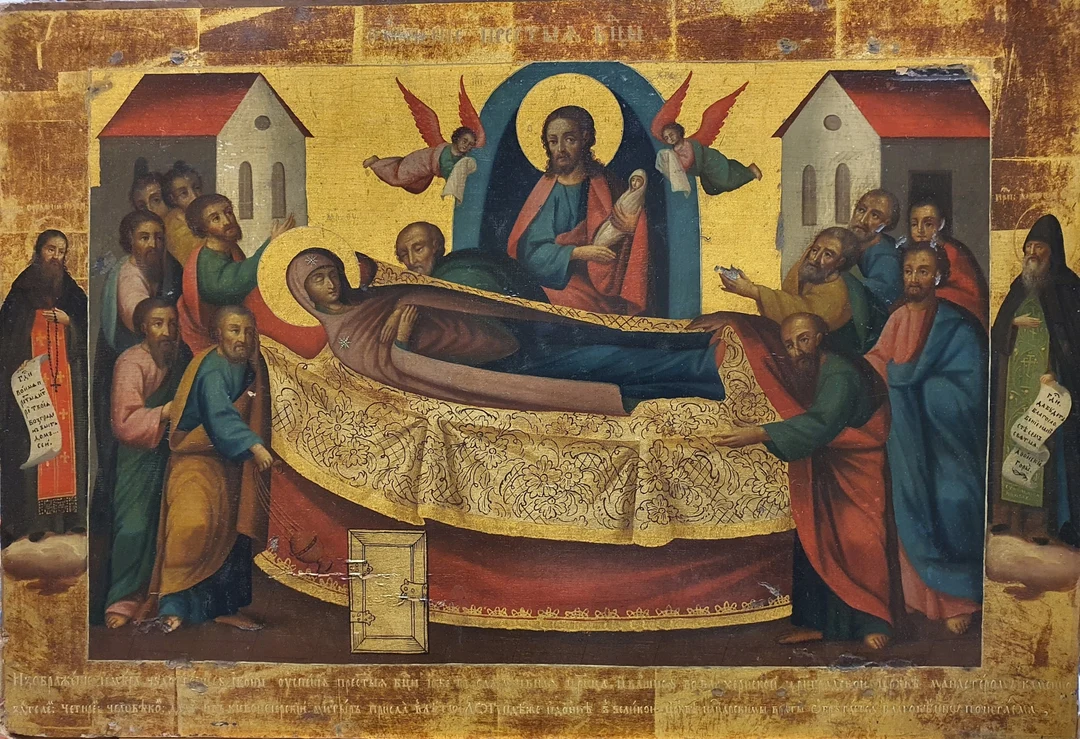
 In the Name of the Father, and of the Son, and of the Holy Spirit.
Dear brothers and sisters – How blessed we are, that in His infinite mercy, love and compassion, our Lord, and God, and Saviour, should grant us not only the wonderful and radiant feast of His own Life-Giving Resurrection, but also this triumphant and joyful feast of the Dormition: the falling asleep, resurrection and heavenly Assumption of His All-Pure Mother.
This glorious, second Pascha shows that the mystery of His third-day rising, and glorious Ascension into heaven was not simply for Him by right, as the Victor over Death and Giver of Life, but also the intended gift and calling of all of the children of Adam and Eve, whose flesh He assumed in the salvific mystery of the Incarnation.
For those baptised into the mystery of His death and Resurrection, the heavenward translation of the Mother of God, is the very meaning of His Incarnation, and the Dormition is the foretaste of what the Saviour mercifully wills and desires for each and everyone of us.
Speaking of the theosis to which we are called as heirs of the Kingdom, St Athanasius famously declared that, “God became man, so that man may become God”, through adoption and grace (not of course, according to nature). The Dormition is the preeminent passage of humanity – in the exulted person of the Theotokos – into the heavenly life; into the theoria – the vision of Divine Glory; and into the inheritance, which the Lord has prepared for us.
At the salutation of the Archangel, by the Divine planting of the seed of the Incarnation within the womb of the Most Holy Mother of God, the Only-Begotten Son and Pre-Eternal Word assumed human flesh to open the Kingdom of Heaven to all believers, and to call the children of both the Old Israel of the Abrahamic Covenant and the New Israel of the Church to the glory of the Kingdom of Heaven.
But, we may anticipate this salvific moment, and say that the Lord was already affecting His saving Incarnation even before the message of the Archangel was heard, and before the Mother of God rendered humble acceptance to God’s Economy of Salvation.
Was the Lord not already calling us to the same glory of the resurrection and ascension of the Mother of God, when at three years of age she climbed – without any human aid – up the steps of the Temple into the Holy of Holies?
Was not this physical ascent a sign and prophecy that in the fullness of time, the Theotokos would climb not only into the earthly dwelling place and abode of the Lord Most-High, but also the supra-heavenly sanctuary, of which the haikal of the Temple was but a image and type.
The earthly infancy of the infant Virgin Mary, instructed by the angels and enclosed within the Temple, was not only a preparation for her calling to be the Theotokos and Mother of our Salvation, but also to stand beside the heavenly throne, far higher than the Mercy-Seat above the Ark of the Covenant, and far more exalted than the cherubim and seraphim.
Had David the King and Prophet not already prophesied, “The Queen didst stand at Thy right hand, arrayed in vesture of gold, adorned in varied colours.” (Psalm 44)
It is through her glorious translation from the sleep of death to heavenly life that the Mother of God was glorified and honoured at her Son’s right hand, like Bathsheba, enthroned at the right hand of King Solomon, as advocate and intercessor of all who would seek the favour of her Son.
But what is this golden robe, adorned with varied colours?
St Gregory Palamas teaches us that,
“By “vesture wrought with gold” understand her divinely radiant body arrayed with divers colours of every virtue.” ”
It was through her God-centred and sacrificial life of prayer, spiritual labour, and virtue that the Theotokos wove for herself such a glorious and resplendent robe of grace, in which to stand at the right hand side of her Son and Lord.
By this salvific example, she calls us to emulate her journey, seeing her life of grace and virtue as the sure and certain way to approach the Gates of the Kingdom of Heaven.
But, today, on this solemn and joyous feast, this must even be the very way in which we approach the celebration of her falling asleep and translation to the heavenly life – coming not only with flowers, bearing candles and incense, but above all approaching her bier with the precious virtues which will weave for us a radiant spiritual robe – adorned with humility, patience, obedience, love, mercy, compassion, and ever jewel of spiritual virtue and grace.
On this wondrous and joyful feast, these are the offerings which will truly please the Mother of God and bring great joy, as our heavenly protectress and intercessor.
When her tomb in Gethsemane was opened for the Holy Apostle Thomas to bid farewell to her sacred body, he discovered that even though she drank from the common cup of death, the tomb and corruption could neither hold nor contain the body of the All-Immaculate Mother of the Giver of Life.
Thus, having been translated to heavenly life – she has no need for precious perfumes, but rather desires that we draw near to her Dormition with the spiritual perfume of divine grace, anointed and fragrant with spiritual virtues.
Recognising her salvific and guiding example, with the great Palamas, we acknowledge,
“thou art a vessel containing every grace, the fulness of all things good and beautiful, the tablet and living icon of every good and all uprightness…”
…and seeking to reflect this icon of life-in-Christ, we must hasten to her Dormition with prayer, repentance, and desiring above all to live and die in holiness, dedicated to the Lord, fulfilling His will in all things, “wholly
consecrated to God, divinely pleasing unto all…” (Ode 5 of the matins canon).
Let us not dare to draw near to the Dormition and prostrate ourselves before the plashchanitsa with malice, envy, anger, envy, judgement, hardness, or any spiritual poison in our hearts; not daring to kiss the image of the repose of the Mother of God with judgement, complaining, gossip or words of ill-will upon our lips; not thinking that we can acceptably bring her both the sweet perfume of flowers and the stench of sinfulness at the same time.
Rather, let us approach the Dormition with repentance and the desire to follow in the footsteps of the Theotokos, filled with rejoicing, fortified with hope, and seeking to live lives reflecting her singular devotion, humility and obedience.
“Let us all bow down before her, praying: O Mistress, forget not thy kinship with those who celebrate thy most holy Dormition with faith!” (Vespers Litia)
Amen.