It was an great blessing to follow yesterday’s celebration of the raising of St Lazarus the Four-Days-Dead with that of the Saviour’s short journey from Bethany to Jerusalemand the Lord’s Entrance into the Holy City.
After a rather rushed set-up, due to lack of access to Nazareth House last night and a later Mass today, everything came together very well, with confessions finished and the covering of the Gifts and completion of the Hours leading seamlessly into our Liturgy, with the faithful standing ready with their willows and palms.
It was lovely to see our deacons censing the church bearing bunches of willows, palms and flowers, and the festal feel to the Liturgy echoed that of yesterday’s humbler but equally jubilant celebration in Cheltenham.
Parishioners with none-Orthodox spouses and some of our students were unable to be with us due to western Easter, but we were to happy to welcome new Ukrainian and Georgian visitors on this happy day, and hope that they will be with us for Pascha. So… all in all, numbers were hardly dented by western celebrations.
We are very grateful to our choir and oltarniky, and to the sisters who prepared food to celebrate the feast before the austerities of Holy Week. We are also grateful to those who brought flowers. May God bless you all!
We now look forward to a busy week of services and confessions, and as Deacon Mark reminded the faithful, if confessing during the ‘open’ times before and after services, we should endeavour to be mindful of others and the shear number of confessions to be heard.
This may be very pertinent on Wednesday, when we will celebrate ‘soborovanie’ – the Holy Unction.
Those approaching the Mystery should have made a recent confession. If confessing before the service of the Holy Oil, please try to keep your confession to five minutes. I will be in Nazareth House during the afternoon, and may hear longer confessions before 17:00, when I will be more generally available for those needing to confess.
We have many new people in the parish, so I recommend them to read a very good articles on Holy Unction on orthochristian – reminding all that this is a Holy Mystery, so only Orthodox Christians may partake of it.
I am very pleased that will have Archpriest Luke with us for this service, and greatly value his help with confessions. Fr Luke will be with us from 18:00, and I know that there will be those who will wish take advantage of being able to make their confession to him. But… again, please be mindful of the time.
Parishioners who are NOT able to be with us on Wednesday should be reassured that anointing with the oil from the service is possible after all of the evening services during Holy Week for those who have prepared.
In addition to the previously advertised services, the Vesperal Liturgy of Holy Thursday will now be celebrated in Nazareth House (like all of the services from Wednesday to Friday) and will commence at 11:00, after the daily Mass.
Unfortunately, due to the use of the chapel on Friday morning, it will not be possible to celebrate the Royal Hours in our Cardiff home.
Having celebrated the Lord’s Entry into Jerusalem today, the matins of the coming days will look forward to His return as the judge of the world and Bridegroom of His Church, and the beginning of Holy Week calls us to vigilance, so that we may be ready and waiting for His return – like the wise virgins, who tended their lamps and took care that they were vigilant and watching.
At the beginning of this Great Week, let us be like them as we keep vigil, remembering the last week of the Saviour’s earthly life before His crucifixion, life-giving Cross, and the wonder of His resurrection.
Let us endeavour to watch and pray, and to not fall asleep as we spiritually journey to the upper room, the Mount of Olives, the praetorium and thence to Golgotha and the sepulchre.
“Behold the Bridegroom cometh in the midst of the night, and blessed is the servant whom He shall find watching; and again unworthy is he whom He shall find heedless. Beware, therefore, O my soul, lest thou be borne down with sleep, lest thou be given up to death, and lest thou be shut out from the Kingdom.”
May God bless you all, and give you strength and grace in this Holy and Great Week.
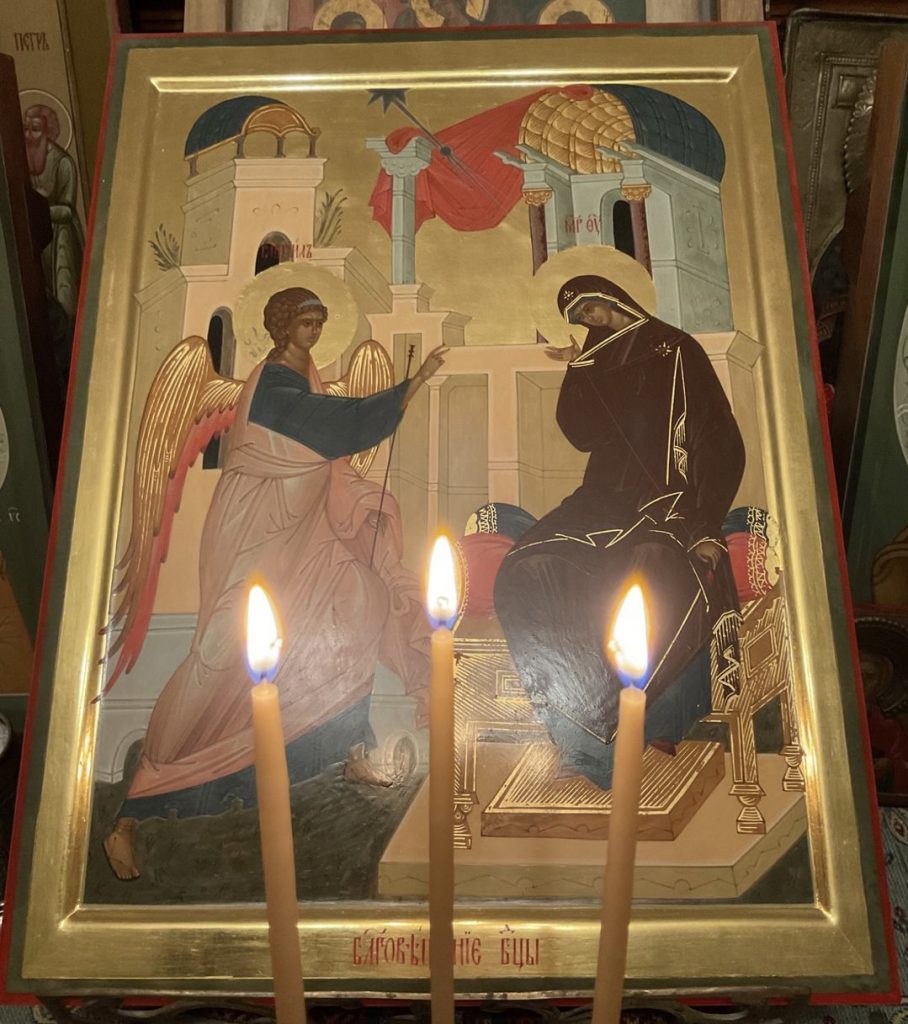
The feast of the Annunciation, which we celebrated today marked the end of Great Lent, but before we begin the Holy and Great Week of the Lord’s Passion with Palm Sunday, tomorrow brings the joy of Lazarus Saturday.
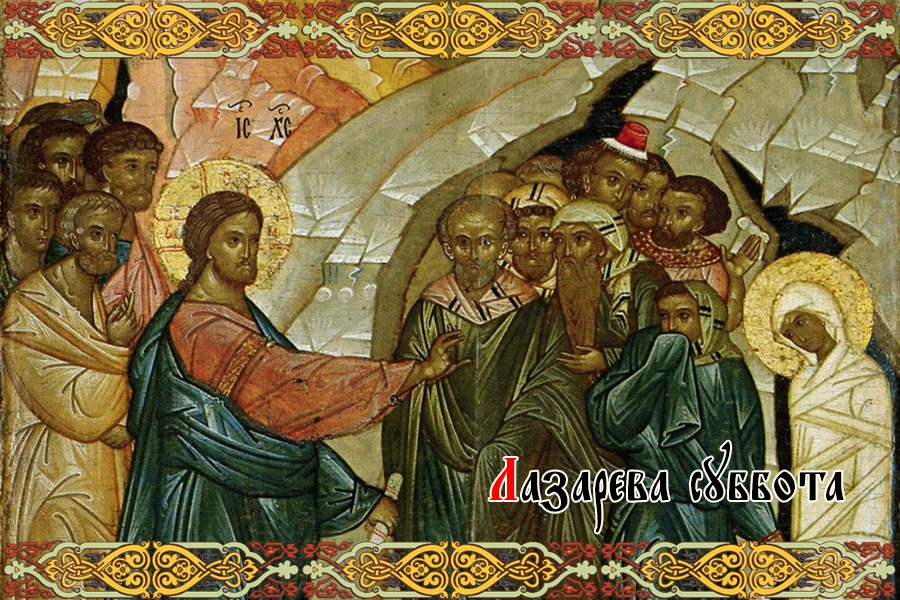
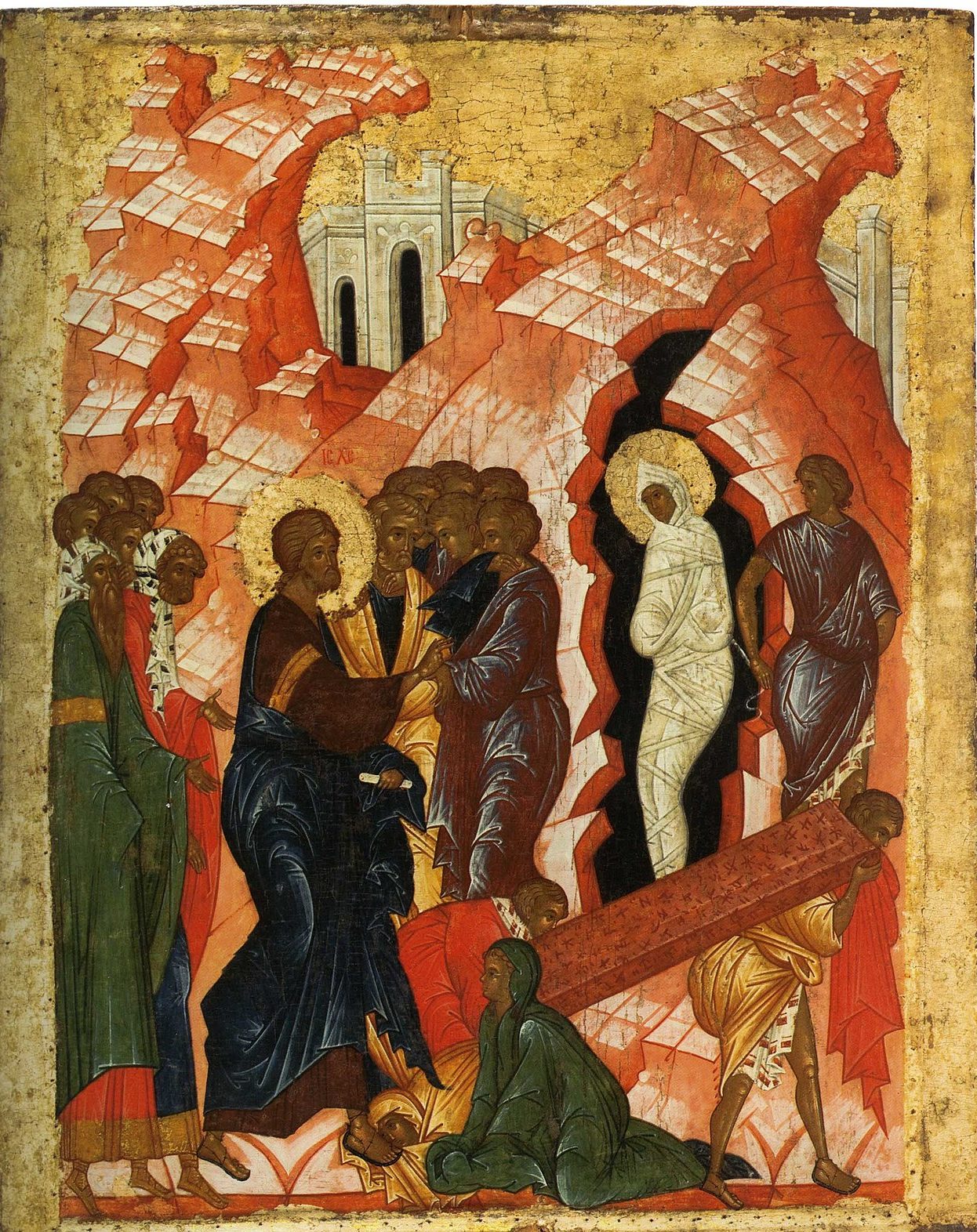
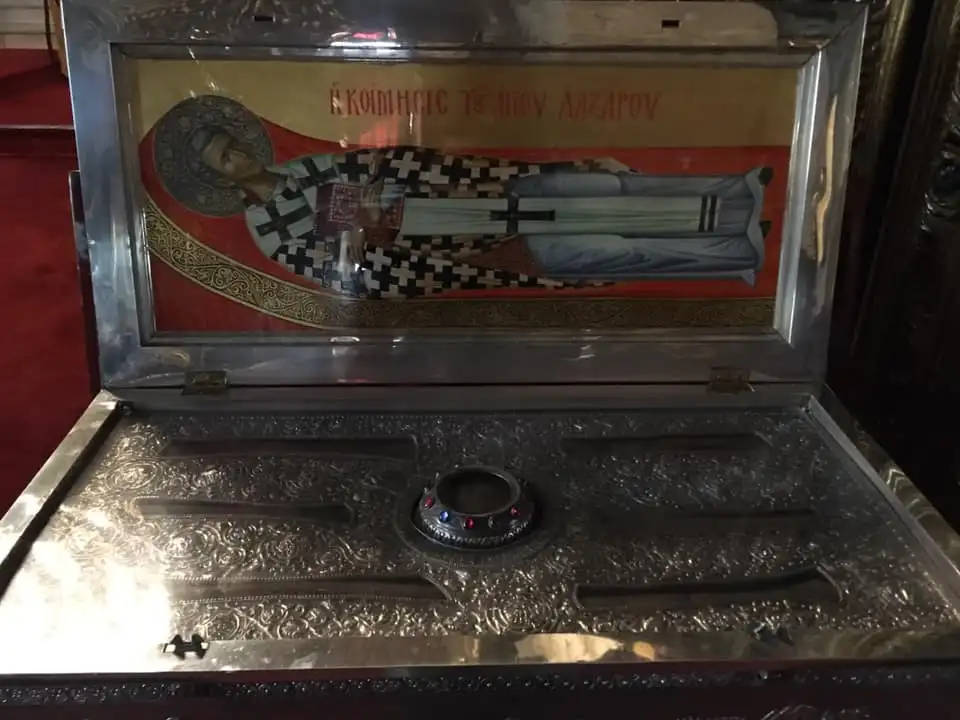
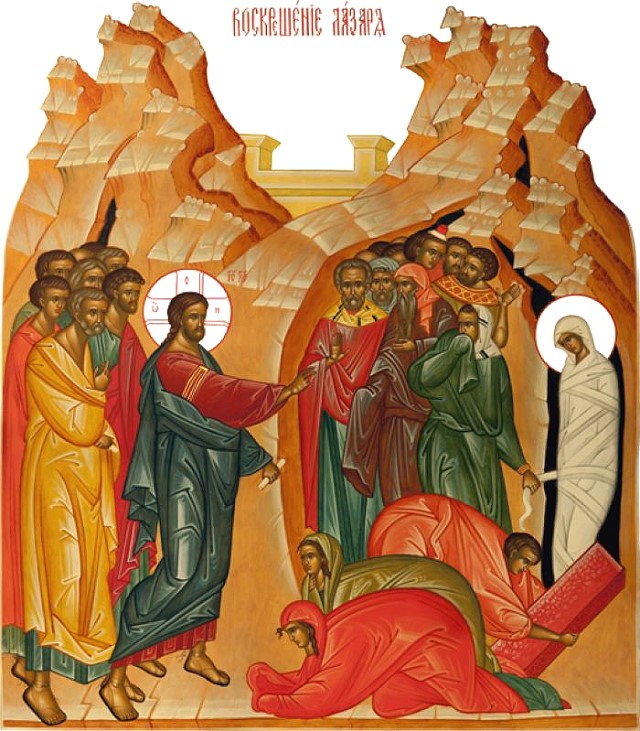
With the Liturgy in Cheltenham tomorrow, a day which belongs to neither Lent nor Holy Week, we celebrate the raising of St Lazarus the Four Days Dead: a signpost to the Saviour’s own Resurrection.
The wonder of the raising of Lazarus sets the tone of excitement for the Lord’s Entry into Jerusalem, going to His voluntary passion on the colt of a ass.
This day of rejoicing, points to the coming joy beyond the dark days of the Lord’s passion, the Cross and Golgotha, to the Harrowing of Hell, in which the Victor and Vanquisher of death will not command Lazarus, but the souls of the Old Testament saints to come forth.
Though Lazarus was still destined to fall asleep in the Lord, and his rising was a mere foretaste of the resurrection of the dead, it beckons us in our celebrations to the joy of the Paschal dawn in which Christ comes forth from the tomb as Victor for all eternity.
Turning to St Lazarus, we ask his prayers before the throne of the Risen and Victorious Saviour, for strength and endurance in the holy days ahead.
Holy Father, Lazarus the Four Days Dead, pray to God for us!
Ode I, Irmos: Let us sing to the Lord, Who led His people through the Red Sea: for He alone is gloriously glorified.
Glory to Thee, our God, glory to Thee.
With Thy divine command Thou hast raised dead Lazarus, in Thy love for mankind; for Thou art the Fashioner and Guardian of Life.
Glory to Thee, our God, glory to Thee.
O immortal Lord, with Thy word Thou hast raised Lazarus, four days dead, and by Thy power Thou hast destroyed the dark kingdom of hell.
Glory to Thee, our God, glory to Thee.
Thou hast given to all, O Master, a proof of Thy transcendent Godhead, raising Lazarus from the dead on the fourth day.
Glory to Thee, our God, glory to Thee.
Today Bethany proclaims beforehand the Resurrection of Christ the giver of Life, and it rejoices at the rising of Lazarus.
Glory to Thee, our God, glory to Thee.
In the beginning Thou hast brought all creation out of nothing, and Thou knowest the secrets of our hearts; and now as Master Thou dost foretell to Thy disciples the falling asleep of Lazarus.
Glory to Thee, our God, glory to Thee.
O Christ, Thou hast become man, taking human nature from the Virgin, and as man Thou hast asked where Lazarus was buried, although as God Thou wast not ignorant of this.
Glory be to the Father and to the Son and to the Holy Spirit.
O Word, giving us an assurance of Thine own Resurrection, Thou hast raised Thy friend as if from sleep, though he had lain four days in the tomb and already stank.
Both now and ever, and unto the ages of ages. Amen.
The host of angels and of mortal men praise thee, O Virgin Mother, without ceasing. For thou hast carried their creator as a babe in thine arms.
Ode III, Irmos: Thou art the support of those who flee unto Thee, O Lord, Thou art the light of those in darkness, and my spirit doth hymn Thee.
Glory to Thee, our God, glory to Thee.
Displaying Thy two energies, O Saviour, Thou hast made manifest Thy two natures: for Thou art both God and man.
Glory to Thee, our God, glory to Thee.
Though Thou art the Abyss of knowledge, Thou dost ask where they have laid the body of Lazarus. For it was Thy purpose, O Giver of Life, to raise him from the dead.
Glory to Thee, our God, glory to Thee.
Going from one place to another, Thou hast as mortal man, appeared circumscribed; but, as God uncircumscribed, Thou fillest all things.
Glory to Thee, our God, glory to Thee.
At Thy divine word, Thou hast raised Lazarus, O Christ, I pray Thee, raise me also, dead through my many sins.
Glory to Thee, our God, glory to Thee.
O Lord who workest miracles, standing in Bethany by the tomb of Lazarus, Thou hast shed tears for him in accordance with the law of nature, confirming the full reality of the flesh which Thou hast taken, O Jesus my God.
Glory to Thee, our God, glory to Thee.
Straightway Thou hast made the sorrow of Mary and Martha to cease, O Saviour, showing Thy sovereign authority. For, as Thou hast said, Thou art in truth the Resurrection and the Life and the Lord of all.
Glory be to the Father and to the Son and to the Holy Spirit.
O Lord, from the ranks of the dead and the darkness of hell thou hast snatched Thy friend Lazarus, bound in his grave-clothes; and by Thine all-powerful word Thou hast broken open the gates of the kingdom of death.
Both now and ever, and unto the ages of ages. Amen.
Taking up Thy dwelling in a Virgin, O Lord, Thou hast appeared to men incarnate, enabling them to see Thee with their eyes; Thou hast made her in very truth the Theotokos and the help of the faithful, O Thou who alone lovest mankind.
Lord, have mercy. Lord, have mercy. Lord, have mercy.
Sessional hymn, Tone 4: The sisters of Lazarus stood beside Christ and, lamenting with bitter tears, they said to Him: “O Lord, Lazarus is dead.” And though as God He knew the place of burial, yet He asked them, “Where have ye laid him?” Coming to the tomb, He called Lazarus that was four days dead; and he arose and worshipped the Lord who had raised him.
Glory be to the Father, and to the Son, and to the Holy Spirit; both now and ever, and unto the ages of ages. Amen.
Sessional hymn, Tone 8: Foreknowing all things as Creator, Thou hast warned the disciples at Bethany saying: “Our friend Lazarus has fallen asleep today.” And, though Thou was not ignorant, Thou hast asked: “Where have ye laid him?” Weeping as a man, Thou hast prayed to the Father; Thou hast called Thy friend Lazarus from hell, O Lord, and raised him when he had been four days dead. Therefore, we cry to Thee: Accept, O Christ our God, the praise we dare to offer, and count us all worthy of Thy glory.
Ode IV, Irmos: I have heard, O Lord, of the mystery of Thy dispensation, and I considered Thy works, and I have glorified Thy Godhead.
Glory to Thee, our God, glory to Thee.
Thou hast prayed to the Father, not because Thou art in need of any help, but to fulfill the mystery of Thine incarnation; and so, almighty Lord, Thou hast raised up a corpse that was four days dead.
Glory to Thee, our God, glory to Thee.
Coeternal with the Father, the Word that was revealed from the beginning as God, now offers prayers as man, though it is He that receives the prayers of all.
Glory to Thee, our God, glory to Thee.
O Saviour, Thy voice destroyed all the power of death, and the foundations of hell were shaken by Thy divine might.
O most holy Theotokos, save us.
Let us sing the praises of the Virgin, for she remained a virgin after bearing child, and she gave birth to Christ our God, who has delivered the world from error.
Glory to Thee, our God, glory to Thee.
As Shepherd, O Saviour and Creator, Thou hast snatched from the fierce and all-devouring wolf a man that had been four days dead; and through him, in Thy power as Lord, Thou hast revealed beforehand the universal glory of Thy Resurrection on the third day.
Glory to Thee, our God, glory to Thee.
Beholding Thee, O Christ the Life, the companions of Martha cried aloud: “If Thou hadst been here, O Lord, the Light and Life of all, Lazarus would not have died.” But since Thou art the Life of the dead, in Thy love for mankind Thou hast turned their sorrow into joy.
Glory be to the Father and to the Son and to the Holy Spirit.
The depths are afraid at Thy presence, O Lord, the source of life; all the waters are Thy servants. The gatekeepers tremble before Thee, O Christ, and the bars of hell are broken by Thy power, as Lazarus rises from the dead at Thy command, almighty Saviour who lovest mankind.
Both now and ever, and unto the ages of ages. Amen.
Unwedded Virgin, thou art the glory of the faithful; thou art the advocate and refuge of Christians, their rampart and haven, for, Undefiled, thou dost offer intercession to thy Son, saving from danger those who in faith and love acknowledge thee as the pure Theotokos.
Ode V, Irmos: Wherefore hast Thou turned Thy face from me, O Light never-waning? And why hath a strange darkness covered me, wretch that I am? But turn me, and guide my steps to the light of Thy commandments, I pray.
Glory to Thee, our God, glory to Thee.
In Thy love for mankind, coming to the tomb of Lazarus Thou hast called him and granted him life, for Thou art the immortal life of all mortal men; and so Thou hast as God clearly foretold the future Resurrection.
Glory to Thee, our God, glory to Thee.
His feet bound in the grave-clothes, Lazarus walked out from the tomb. O wonder of wonders! Christ who gave him strength is greater than the power of death which held him back. All things obey Christ’s word, serving Him as God and Master.
Glory to Thee, our God, glory to Thee.
Thou hast raised Lazarus on the fourth day, though his corpse already stank. Raise me up, O Christ, for I am dead in sin and lie in the pit and the dark shadow of death; deliver and save me in Thy compassion.
Glory to Thee, our God, glory to Thee.
Thou hast prayed and given glory to the Father, for Thy power is not opposed to His. To confirm the faith of the multitude that stood round Thee, Thou hast thanked Thy Father, O longsuffering Lord, and then raised Lazarus by Thy command.
Glory to Thee, our God, glory to Thee.
O voice of God! O divine power and might! With that voice, O Saviour, Thou hast shattered the gates of hell and all-devouring death. Deliver me from my passions, as once Thou hast delivered Thy friend Lazarus that was four days dead.
Glory be to the Father and to the Son and to the Holy Spirit.
At the prayers of Lazarus, of Martha and Mary, O loving Lord, make us worthy to behold Thy Cross and Passion, and the joyful Queen of Days, the feast of Thy Resurrection.
Both now and ever, and unto the ages of ages. Amen.
Since, all-pure Virgin, thou hast a mother’s boldness before thy Son, do not forget us and our needs, we pray, for we are thy kinsfolk: thee alone we Christians bring as intercessor, to win the gracious mercy of the Master.
Ode VI, Irmos: O Lord, who hast made Jonah dwell within the whale, deliver me from corruption, as Thou hast delivered him; for I am caught in the snares of the enemy.
Glory to Thee, our God, glory to Thee.
Love led Thee, Master, to Lazarus at Bethany; and as God Thou hast raised him, though his corpse already stank, and hast delivered him from the bonds of hell.
Glory to Thee, our God, glory to Thee.
Martha despaired when she saw Lazarus already four days dead. But Christ, as God, raised him from decay and brought him back to life by His word.
Glory be to the Father and to the Son and to the Holy Spirit.
As true God Thou hast known of the falling asleep of Lazarus and hast announced it beforehand to Thy disciples, giving them a proof, O Master, of the infinite power of Thy divinity.
Both now and ever, and unto the ages of ages. Amen.
Thou who art by nature uncircumscribed wast circumscribed in the flesh; coming to Bethany, O Master, as man Thou dost weep over Lazarus, and by Thy power as God Thou dost raise him on the fourth day from the dead.
Lord, have mercy. Lord, have mercy. Lord, have mercy.
Glory be to the Father, and to the Son, and to the Holy Spirit; both now and ever, and unto the ages of ages. Amen.
Kontakion, Tone 2: Christ, the Joy of all, the Truth, the Light, the Life, the Resurrection of the world, hath, of His goodness, appeared to those on earth, and become the archetype of the Resurrection, granting divine forgiveness unto all.
Ikos: The Creator of the world foretold to His disciples what would come to pass, proving to them that He knows all things as the Maker of all. “Brethren and companions, our friend has fallen asleep”, He said. “Let us go, then, and see a strange burial, and behold the tears of Mary and the tomb of Lazarus. For I shall work a miracle there, as the prelude to My Crucifixion, granting divine forgiveness unto all.”
Ode VII, Irmos: In the furnace the Hebrew children boldly trod the flame underfoot and transformed the fire into dew, crying out: Blessed art Thou, O Lord God, forever!
Glory to Thee, our God, glory to Thee.
Weeping as man in Thy compassion, Thou hast as God raised Lazarus from the tomb; and, delivered from hell, he cried aloud: “Blessed art Thou, O Lord God, forever!”
Glory to Thee, our God, glory to Thee.
At the Master’s word Lazarus came out bound in grave clothes, escaping from the chaos and darkness of hell, and he cried aloud: “Blessed art Thou, O Lord God, forever!”
Glory to Thee, our God, glory to Thee.
Shedding tears over Thy friend, O merciful Lord, Thou hast made the tears of Martha cease, and by Thy voluntary Passion Thou hast wiped away all tears from the face of Thy people. O God of our fathers, blessed art Thou.
Glory be to the Father and to the Son and to the Holy Spirit.
Master of Life and Saviour, Thou hast called the dead man as if he were asleep. With Thy word thou hast burst asunder the belly of hell and raised up Lazarus as he sang: “O God of our fathers, blessed art Thou.”
Both now and ever, and unto the ages of ages. Amen.
O Master, Thou hast raised a dead man bound in grave clothes, a corpse that already stank. I am held fast in the bonds of sin; raise me up and I shall sing: O God of our fathers, blessed art Thou.
Ode VIII, Irmos: When the instruments of music sounded, countless multitudes worshipped the image in Dura; but the three Children, refusing to bow down, praised and glorified the Lord forever.
Glory to Thee, our God, glory to Thee.
As Shepherd, Thou hast gone to seek Thy sheep; rescuing the dead man from the fierce and destructive wolf, in Thy power Thou hast brought him from corruption to new life, and he cried out to Thee: “Praise the Lord and exalt Him above all forever.”
Glory to Thee, our God, glory to Thee.
As mortal man Thou hast asked where Lazarus was buried; as Maker, Thou hast raised him from the dead by Thy royal command. Hell was afraid of him when he cried out to Thee: “Praise the Lord and exalt Him above all forever.”
Glory to Thee, our God, glory to Thee.
As a mortal, Thou dost search for Lazarus; as God, Thou dost raise him by Thy word, though he was four days dead. Therefore we sing Thy praises forever.
Glory be to the Father and to the Son and to the Holy Spirit.
Fulfilling a debt of gratitude for her brother, Mary brought Thee, O Lord, sweet-smelling spices; and she sings Thy praises forever.
Both now and ever, and unto the ages of ages. Amen.
As man Thou dost pray to the Father, as God Thou dost raise Lazarus. Therefore, O Christ, we sing Thy praises for ever.
Ode IX, Irmos: O ye people, with glory let us honour the pure Theotokos, who conceived within her womb the divine fire and yet was not consumed, and let us magnify her with hymns.
Glory to Thee, our God, glory to Thee.
Seeing a four-day corpse walking, the people were struck with wonder at the miracle and cried out to the Deliverer: “We magnify Thee in hymns, O God.”
Glory to Thee, our God, glory to Thee.
Thou hast established men’s faith in Thy glorious Resurrection, O my Saviour, before it came to pass, by freeing Lazarus from hell when he was four days dead; and I magnify Thee in hymns.
Glory to Thee, our God, glory to Thee.
Honouring Thy Father, O Christ, and showing that Thou art not opposed to Him, after praying Thou hast by Thine own authority raised Lazarus that was four days dead.
Glory to Thee, our God, glory to Thee.
O my Christ, Thou hast raised from the tomb Lazarus that was four days dead, and so Thou makest him a truthful witness to Thy Resurrection on the third day.
Glory be to the Father and to the Son and to the Holy Spirit.
Thou dost walk and weep and speak, my Saviour, showing the action of Thy human nature; and, revealing Thy divine nature, Thou dost raise Lazarus.
Both now and ever, and unto the ages of ages. Amen.
In ways surpassing speech, my Master and Saviour, Thou hast brought about my salvation by the free will exercised in each of Thy two natures.
Troparion, Tone 1: In confirming the common Resurrection, O Christ God, Thou didst raise up Lazarus from the dead before Thy Passion. Wherefore, we also, like the children bearing the symbols of victory, cry to Thee the Vanquisher of death: Hosanna in the highest; blessed is He that cometh in the name of the Lord.
“Behold, our restoration hath now been revealed to us! God uniteth Himself to men in manner past recounting! Falsehood is dispelled by the voice of the archangel! For the Virgin receiveth joy, an earthly woman hath become heaven! The world is released from the primal curse! Let creation rejoice and chant aloud: O Lord, our Creator and Deliverer, glory be to Thee!”
Dear brothers and sisters – s prazdnikom!
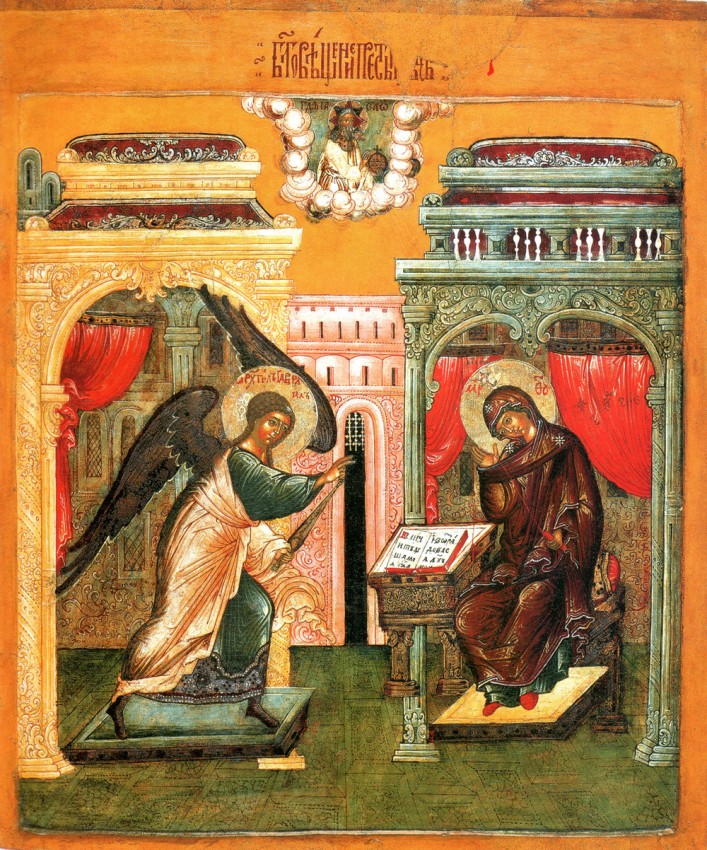
Greetings as we celebrate the joyful feast of the Annunciation.
How wonderful it is that it is in this springtime of unfurling leaves, spring flowers and blossom ready to burst open the gardens hedgerows, that we celebrate the yearly feast of the Annunciation – that great Springtime in the Divine economy of salvation, in which the long winter of man’s exile and estrangement from God was undone by the Divine condescension and Mary’s ‘fiat’: “Behold the handmaid of the Lord; be it unto me according to Thy word.”
The great hymnographer, St John of Damascus wrote,
“Today, from the cold winter, the warm and flowery spring has shown forth, and the golden sun of rejoicing and happiness has dawned for us.
Today, God-planted Eden is re-opened, and God-fashioned Adam, due to His goodness and love for man, enters again to dwell within.”
This incarnational journey from the spiritual winter of exile to the springtime of salvation echoes the beautiful prophetic words from the Song of Solomon,
“The winter is past; the rains are over and gone. Flowers appear on the earth; the season of singing has come, the cooing of doves is heard in our land. The fig tree forms its early fruit; the blossoming vines spread their fragrance. Arise, come, my darling; my beautiful one, come with me.”
As we anticipate the yearly celebration of Christ’s victorious rising from the dead, let us rejoice in the Annunciation, in which our Triune God addresses these prophetic words of Solomon, “Arise, come, my darling; my beautiful one, come with me…” not only to the Mother of God, but to every soul, created, cherished and loved by Him, as the Divine Bridegroom reaches out to humanity through His coming and dwelling among us – and even as we look forward to Pascha/Easter, we are struck that this word “Arise” calls us not only from spiritual slumber to attention and vigilance, but to be sharers and participators in the joy of the resurrection.
So, let us embrace this spiritual-springtime and the promise contained within it, to bask in that golden sun of rejoicing.
We look beyond the dawn memorialised by this day to its culmination of in the glory of the resurrection of the Saviour, the Risen Sun of Righteousness, remembered in this feast as that tiny physical Presence within the womb of the Mother of God, yet the One Who not only re-opened paradise, but went to search for Adam and Eve in the very depths of Hades. Setting them free by His victory on the Tree of the Cross and His third-day resurrection, He was able to say to each of them – to the Forerunner, and to every righteous soul of the Old Covenant – “Arise, come, my darling; my beautiful one, come with me.”
Let us look to Christ the Bridegroom with longing, who in His great love came in the Annunciation and Incarnation to seek us in our own dwelling-place as the Word who “became flesh and dwelt among us, and we beheld His glory, the glory as of the only begotten of the Father, full of grace and truth.”
May God bless you and may this great feast be filled with rejoicing, and guide and hasten us towards the Lord’s glorious resurrection.
We are publishing the festal canon – a poetic dialogue between the Mother of God and the Archangel – in simple form (without the Lenten canons from the Triodion) so that it may be prayed wherever parishioners find themselves on this wondeful feast.
May God bless you all.
Ode I, Irmos: I shall open my mouth, and the Spirit will inspire it, and I shall utter the words of my song to the Queen and Mother: I shall be seen radiantly keeping feast and joyfully praising her wonders.
Most Holy Theotokos, save us.
Let thy forefather David sing to thee, O Lady, striking upon the harp of the Spirit: “Hearken, O Daughter, to the glad voice of the Angel, for he discloses to thee joy past telling.”
Most Holy Theotokos, save us.
The Angel: In gladness I cry to thee: incline thine ear and give heed unto me, as I tell of God’s conception without seed. For thou, O Most pure, hast found grace before the Lord such as no other woman ever found.
Glory be to the Father, and to the Son, and to the Holy Spirit.
The Theotokos: O angel, help me to understand the meaning of thy words. How shall what thou sayest come to pass? Tell me clearly, how shall I conceive, who am a virgin maid? And how shall I become the Mother of my Maker?
Now and ever, and unto the ages of ages. Amen.
The Angel: Thou dost think, so it seems, that I utter words deceitfully; and I rejoice to see thy prudence. But take courage, O Lady: for when God wills, strange wonders are easily accomplished.
Ode III, Irmos: O Mother of God, thou living and plentiful fount, give strength to those united in spiritual fellowship, who sing hymns of praise to thee: and in thy divine glory vouchsafe unto them crowns of glory.
Most Holy Theotokos, save us.
The Theotokos: There is no more a prince from Judah’s line, but the time is at hand in which Christ, the hope of the Gentiles, shall appear. But do thou make plain to me how I being a virgin, shall bear him?
Most Holy Theotokos, save us.
The Angel: O Virgin, thou dost seek to know from me the manner of thy conceiving, but this is beyond all interpretation. The Holy Spirit shall overshadow thee in His creative power and shall make this come to pass.
Glory be to the Father, and to the Son, and to the Holy Spirit.
The Theotokos: My mother Eve, accepting the suggestion of the serpent, was banished from divine delight: and therefore I fear thy strange salutation, for I take heed lest I slip.
Now and ever, and unto the ages of ages. Amen.
The Angel: I am sent as the envoy of God to disclose to thee the divine will. Why art thou, O undefiled, afraid of me, who rather am afraid of thee? Why, O Lady, dost thou stand in awe of me, who stand in reverent awe of thee?
Lord, have mercy.(Thrice)
Sessional Hymn, Tone VIII, Spec. Mel. “Of the shepherds’ pipes …”: The Word of God is now come down upon earth. The Angel stood before the Virgin and cried aloud: “Rejoice, blessed Lady, who alone among women hast preserved the seal of thy virginity, while yet receiving in thy womb the pre-eternal Word and Lord, that He as God may save mankind from error.”
Glory be to the Father, and to the Son, and to the Holy Spirit; now and ever, and unto the ages of ages. Amen.
Another Sessional Hymn, same tone: Spec. Mel. “That which was commanded …”: Gabriel, the supreme commander, was sent from heaven by God; and he quickly presented himself before the animate city, manifestly saying to her: “Thou shalt receive the Creator in thy womb, O Virgin, and shalt immutably give birth to him in the flesh! Wherefore, I am sent to announce to thee thy strange birthgiving, O pure one, and stand here, crying aloud to thee: Rejoice, O bride unwedded!”
Ode IV, Irmos: He who sitteth in glory upon the throne of the Godhead, Jesus the true God, is come in a swift cloud and with His sinless hands he hath saved those who cry: Glory to Thy power, O Christ.
Most Holy Theotokos, save us.
The Theotokos: I have learnt from the Prophet, who foretold in times of old the coming of Emmanuel, that a certain holy Virgin should bear a child. But I long to know how the nature of mortal men shall undergo union with the Godhead.
Most Holy Theotokos, save us.
The Angel: The bush that burnt with fire and yet remained unconsumed, disclosed the secret mystery that shall come to pass in thee, O pure Maiden, full of grace. For after childbirth thou shalt remain ever-Virgin.
Glory be to the Father, and to the Son, and to the Holy Spirit.
The Theotokos: O Gabriel, herald of the truth, shining with the radiance of Almighty God, tell me truly: how shall I, my purity remaining untouched, bear in the flesh the Word that has no body.
Now and ever, and unto the ages of ages. Amen.
The Angel: I stand before thee in fear, as a servant before his mistress, and in awe I am afraid to look at thee now, O Maid. In His good pleasure shall the Word of God descend upon Thee, as dew upon the fleece.
Ode V, Irmos: The whole world was amazed at thy divine glory: for thou, O Virgin who hast not known wedlock, hast held in thy womb the God of all and hast given birth to an eternal Son, who rewards with salvation all who sing thy praises.
Most Holy Theotokos, save us.
The Theotokos: I cannot understand the meaning of thy words. For there have often been miracles, wonders worked by the might of God, symbols and figures contained in the law. But never has a virgin borne child without knowing a man.
Most Holy Theotokos, save us.
The Angel: Thou art amazed, O all-blameless Virgin; and amazing indeed is the wonder that comes to pass in thee: for thou alone shalt receive in thy womb the King of all who is to take flesh. It is thou who art prefigured by the utterances and dark sayings of the prophets and by the symbols of the law.
Glory be to the Father, and to the Son, and to the Holy Spirit.
The Theotokos: How can He whom nothing can contain, upon whom none can gaze, dwell in the womb of a virgin who He Himself has formed? And how shall I conceive God the Word, who with the Father and the Spirit has no beginning?
Now and ever, and unto the ages of ages. Amen.
The Angel: He who promised to thy forefather David that of the fruit of his body He would set upon the throne of his kingdom, He it is that has chosen thee, the only excellency of Jacob, as His spiritual dwelling place.
Ode VI, Irmos: Prefiguring Thy three-day burial, the prophet Jonah cried out in the belly of the whale: ‘Deliver me from corruption, O Jesus, King and Lord of hosts.’
Most Holy Theotokos, save us.
The Theotokos: Receiving thy glad tidings, O Gabriel, I am filled with divine joy. For thou dost speak to me of joy, a joy without end.
Most Holy Theotokos, save us.
The Angel: Divine joy is given to thee, O Mother of God. All creation cries unto thee: “Rejoice, O Bride of God.” For thou alone, O pure Virgin, wast foreordained to be the Mother of the Son of God.
Glory be to the Father, and to the Son, and to the Holy Spirit.
The Theotokos: May the condemnation of Eve be now brought to naught through me; and through me may her debt be repaid this day. Through me may the ancient due be rendered up in full.
Now and ever, and unto the ages of ages. Amen.
The Angel: God promised to our forefather Abraham that in his seed the Gentiles would be blest, O pure Lady; and through thee today the promise receives its fulfilment.
Lord, have mercy.(Thrice)
Glory be to the Father, and to the Son, and to the Holy Spirit; now and ever, and unto the ages of ages. Amen.
Kontakion, in Tone VIII: To Thee, the Champion Leader, we Thy servants dedicate / a feast of victory and of thanksgiving / as ones rescued out of sufferings, O Theotokos: / but as Thou art one with might which is invincible, / from all dangers that can be do Thou deliver us, / that we may cry to Thee: // Rejoice, Thou Bride Unwedded!
Ikos: An archangel was sent from Heaven to say to the Theotokos: Rejoice! And beholding Thee, O Lord, taking bodily form, he was amazed and with his bodiless voice he stood crying to Her such things as these:
Rejoice, Thou through whom joy will shine forth: Rejoice, Thou through whom the curse will cease! Rejoice, recall of fallen Adam: Rejoice, redemption of the tears of Eve!Rejoice, height inaccessible to human thoughts: Rejoice, depth undiscernible even for the eyes of angels! Rejoice, for Thou art the throne of the King: Rejoice, for Thou bearest Him Who beareth all! Rejoice, star that causest the Sun to appear: Rejoice, womb of the Divine Incarnation! Rejoice, Thou through whom creation is renewed: Rejoice, Thou through whom we worship the Creator! Rejoice, Thou Bride Unwedded!
Ode VII, Irmos: The holy children bravely trampled upon the threatening fire, / refusing to worship created things in place of the Creator, / and they sang in joy: // ‘Blessed art Thou and praised above all, O Lord God of our Fathers.’
Most Holy Theotokos, save us.
The Theotokos: Thou dost bring me good tidings of divine joy, that the immaterial Light, in His abundant compassion, will be united to a material body; and now thou criest out to me: “O All-pure, blessed is the fruit of thy womb.”
Most Holy Theotokos, save us.
The Angel: Rejoice, O Lady, rejoice, O most pure Virgin; rejoice, thou vessel wherein God is contained, rejoice, thou candlestick of the Light, the restoration of Adam and the deliverance of Eve, holy Mountain, shining Sanctuary, and Bridal Chamber of immortality.
Glory be to the Father, and to the Son, and to the Holy Spirit.
The Theotokos: The descent of the Holy Spirit has purified my soul and sanctified my body: it has made of me a Temple that contains God, a Tabernacle divinely adorned, a living Sanctuary, and the pure Mother of Life.
Now and ever, and unto the ages of ages. Amen.
The Angel: I see thee as a Lamp with many lights and as a Bridal Chamber made by God. As an Ark of gold, O spotless Maiden, receive now the Giver of the Law, who through thee has been pleased to deliver the corrupt nature of mankind.
Ode VIII, Irmos: Hearken, O pure Virgin Maid: / Let Gabriel tell thee the counsel of the Most High that is ancient and true. / Make ready to receive God: / for through thee the Incomprehensible comes to dwell with mortal men. / Therefore I cry rejoicing: // O all ye works of the Lord, bless ye the Lord.
Most Holy Theotokos, save us.
The “All mortal thought is overwhelmed,” answered the Virgin, “as it ponders the strange wonders of which thou tellest me. I am filled with joy at thy words, yet am afraid: I fear lest thou deceive me, as Eve was deceived, and lead me far from God. Yet lo, thou criest out: O all ye works of the Lord, bless ye the Lord.”
Most Holy Theotokos, save us.
The Angel: “See thy difficulty is resolved”, said Gabriel to this. “Thou hast well said that this matter is hard to grasp. Obey, then, the words of thine own lips: doubt not as though it were deceitful, but believe in this thing as very truth. For I cry rejoicing: O all ye works of the Lord, bless ye the Lord.”
The Theotokos: “Childbirth comes from mutual love: such is the law that God has given to men”, said again she who is without reproach. “I know not at all the pleasure of marriage: how then dost thou say that I shall bear child? I fear lest thou speak in guile. Yet lo, thou criest out: O all ye works of the Lord, bless ye the Lord.”
We bless, Father, Son, and Holy Spirit, the Lord.
The Angel: “O holy Virgin,” replied the Angel, “thou speakest to me of the customary manner whereby mortal men are born. But I tell thee of the birth of the true God. Beyond words and understanding, in ways that He alone knows, He shall take flesh of thee. Therefore, I cry rejoicing: O all ye works of the Lord, bless ye the Lord.”
Now and ever, and unto the ages of ages. Amen.
The Theotokos: “Thou showest thyself to me as a herald of the truth,” the Virgin said, “for thou hast come as a harbinger of common joy. I have therefore cleansed soul and body. Be it unto me according to thy word, that God may dwell in me, to Whom I cry out with thee: “Bless the Lord, all ye works of the Lord, and supremely exalt Him throughout all ages!”
Ode IX.
Refrain: Proclaim, O earth, good tidings of great joy; / ye heavens, praise the glory of God.
Irmos: Let no profane hand touch the living Ark of God, / but let the lips of the faithful, chanting unceasingly / the words of the angel to the Theotokos, with joy cry out: // Rejoice, thou who art full of grace, the Lord is with thee.
Refrain:Proclaim, O earth, good tidings of great joy; / ye heavens, praise the glory of God.
Having conceived God in ways past understanding, O Maiden, thou hast escaped from the ordinances of nature. For though by nature mortal, thou wast not subject to the established laws of motherhood. Therefore, as is meet, dost thou hear the salutation: “Rejoice, thou who art full of grace: the Lord is with thee.”
Refrain:Proclaim, O earth, good tidings of great joy; / ye heavens, praise the glory of God.
How dost thou give milk, O pure Virgin? This the tongue of mortal man cannot make plain. For thou showest forth a thing unknown to nature, that utterly surpasses the usual laws of birth. Therefore, as is meet, dost Thou hear the salutation: “Rejoice, thou who art full of grace: the Lord is with thee.
Refrain:Proclaim, O earth, good tidings of great joy; / ye heavens, praise the glory of God.
The Holy Scriptures speak of thee mystically, O Mother of the Most High. For Jacob saw in days of old the ladder that prefigured thee, and said: “This is the stair on which God shall tread.” Therefore, as is meet, dost thou hear the salutation: “Rejoice, thou who art full of grace: the Lord is with thee.”
Glory be to the Father, and to the Son, and to the Holy Spirit.
The bush and the fire showed a strange marvel to Moses, the initiate in sacred things. Seeking its fulfilment in the course of time, he said: “I shall observe it brought to pass in the pure Virgin. To her as Theotokos shall the salutation come: Rejoice, thou who art full of grace: the Lord is with thee.”
Now and ever, and unto the ages of ages. Amen.
Daniel called thee a spiritual mountain; Isaiah, the Mother of God; Gideon saw thee as a fleece and David called thee sanctuary; another called thee gate. And Gabriel in his turn cries out to thee: “Rejoice, thou who art full of grace, the Lord is with thee.”
Troparion, Tone IV: Today is the fountainhead of our salvation / and the manifestation of the mystery which was from eternity. / The Son of God becometh the Virgin’s Son, / and Gabriel proclaimeth the good tidings of grace; / wherefore, we also cry to the Theotokos with him: / Rejoice, thou who art full of grace, // the Lord is with thee.
The Chapel of St David and St Nicholas / часовня святых Давида и Николая:11 New Rd, Llanelli, Carmartheshire SA14 8LS
Благовещение Пресвятой Богородицы: 10:00 – Часы 3, 6, 9, Изобразительны, Вечерня с Литургией Св. Иоанна Златоустого
The Annunciation of the Most Holy Mother of God: 10:00 – 3rd, 6th and 9th Hours, Typika, Vesperal Liturgy of St John Chrysostom
Dear brothers and sisters,
May I remind you that the Liturgy for Annunciation will be in Llanelli, and NOT in Cardiff, as the convent chapel Nazareth House will in use for Latin Good Friday.
We will chant the Hours at 10:00, followed by the Vesperal Liturgy of St John Chrysostom.
A bring and share lunch will follow. Remember, this is a fish day.
The following day, Lazarus Saturday, we will celebrate the Divine Liturgy in Cheltenham, with the Hours and Liturgy celebrated from 10:00 in Prestbury United Reformed Church, 5 Deep St, Cheltenham GL52 3AW.
Confessions will be heard from 09:15, and a bring and share lunch will follow – as usual. The variables may be found at:
Just at the time in which it was relevant, I noticed my little book of homilies of Fr Daniel Sysoev, wedged into a gap between stacks of books in my cell – and it opened to a little homily on spiritual kinship.
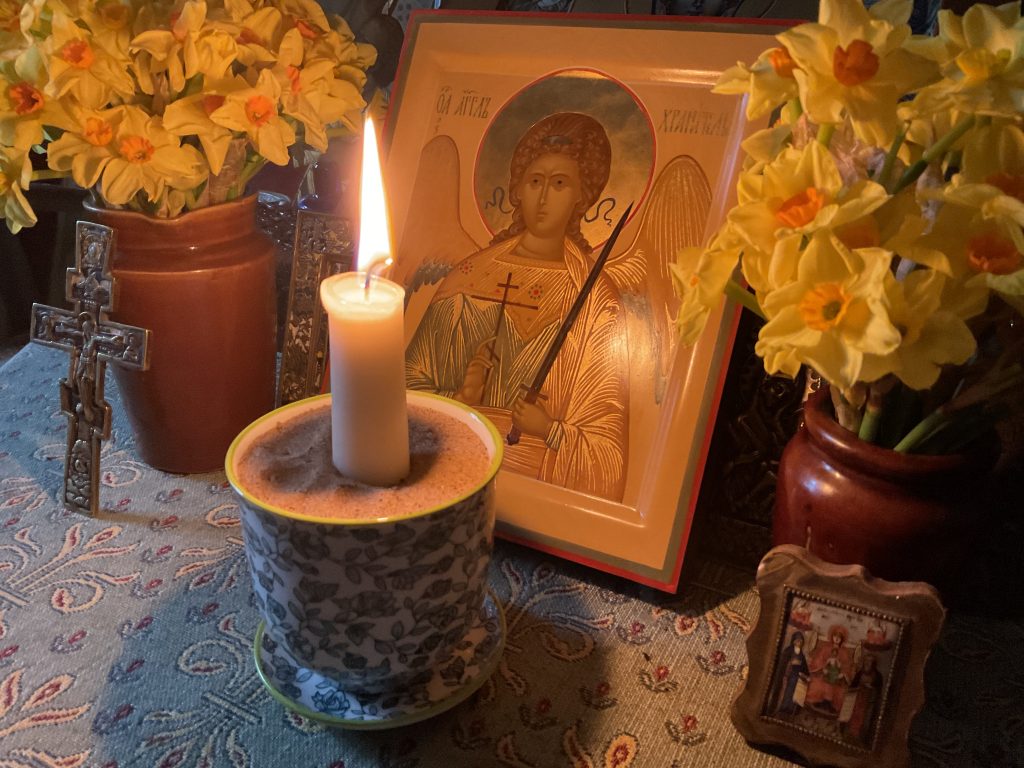
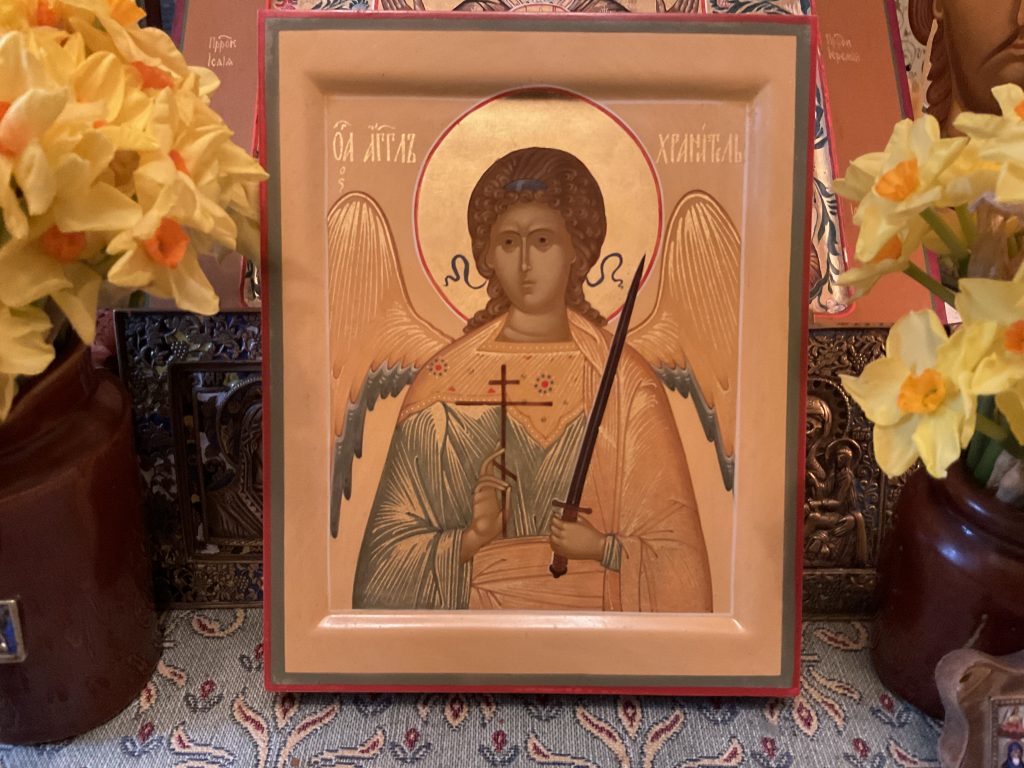
In confession, I constantly encourage the faithful to labour to build their relationship and kinship with their guardian angel and the saint whose name they bear. Both are heavenly protectors who wish to be spiritual kin, and not ritual static figures in Orthodox spiritual identity.
As even a cursory glance at the canons and prayer to the Guardian Angel makes clear, our angelic companion has REAL influence over not only our actions, but also our minds, with all of their complications and problems, especially when we are afflicted by mental trials and temptations.
Just as God respects our freedom and will, and does not force or coerce us in the events and actions of life, neither do our guardian angels, but rather ever-vigilantly await our cries and calls for help, wanting us to align our will with that of God, who created both them and us. It is in this alignment and obedience to the Lord, and in knowing and pursuing our need for angelic assistance – the gift of God – that we are able to build bonds of kinship, regardless of time and space, physicality and immateriality.
Our Guardian Angel wants to be part of our life; to share in each hour day, as a sign of God’s love and care for us. But… we must want this for it to become an actualised reality.
Fr Daniel – a martyr for the Faith – wrote,
“The angels of God can be people’s friends, and, as we know, we share a friendship with our guardian angel, be it only to a small degree. I hope that we will all feel warmly toward our guardian angels, that we may try to greet them and pray to them, and that they will look after us. If we try to do good things with their help, it will give rise to that friendship that can blossom beyond the limits of time… Each person must find spiritual friendship which transcends both time and the difference between beings, between people and angels, so that we may enkindled together and glorify the Trinity, from whom we draw this strength.”
So… make sure that WITHOUT FAIL, you pray to your guardian angel EVERY day.
If you have time, don’t simply turn to the Canon to the Holy Guardian Angel when preparing for Holy Communion, but as often is possible.
If you have time to pray it every day, do so… and let each of us be mindful that we mistakenly turn to all manner of people first, in need, emergency and trouble, rather than turning to our guardian angel.
We need to correct ourselves and start reacting spiritually to the trials of life.
Our guardian angel is waiting to hear us – waiting to help in every trial and adversity.
Morning Prayer:
O Holy Angel, who standest by my wretched soul and my passionate life: do not abandon me, a sinner, neither depart from me because of my lack of self-control. Leave no room for the evil demon to gain control of me through the violence of this mortal body. Strengthen my weak and feeble hand, and instruct me in the path of salvation. O holy Angel of God, the guardian and protector of my wretched soul and body: forgive all the sorrows I have caused you, every day of my life. If I have sinned in this past night, protect me during this day. Keep me from every adverse temptation, that I may not anger God by any sin. Pray to the Lord for me, that He may establish me in His fear and make me, His servant, worthy of His goodness. Amen.
Evening Prayer:
O Angel of Christ, my holy guardian and protector of my soul and body, forgive me all wherein I have sinned this day, and deliver me from all opposing evil of mine enemy lest I anger my God by any sin. Pray for me, a sinful and unworthy servant, It that thou mayest show me forth worthy of the kindness and mercy of the All-holy Trinity, and of the Mother of my Lord Jesus Christ, and of all the saints. Amen.
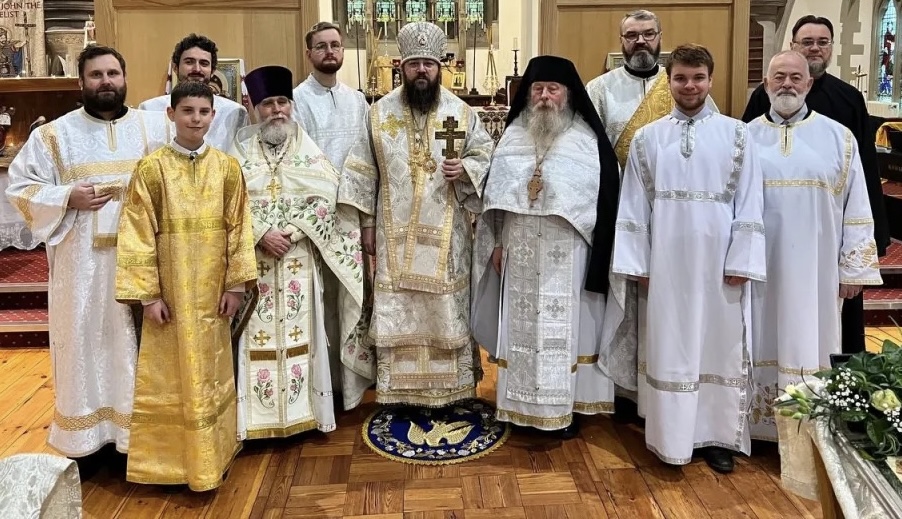
Our wonderful, growing and busy Cardiff parish of the Russian Orthodox Church Outside of Russia was founded in Bright Week 2011, so as we approach Pascha, we are coming to the end of our twelfth year!
So, our community will soon be a teenager, though hopefully without the more-challenging traits of teenage life.
What change has occurred during these twelve years, from the starting point of only having a monthly Saturday Liturgy celebrated by one of the cathedral clergy; the congregation almost exclusively 100% Slav; and the services only using English for the creed and Lord’s Prayer.
When we moved to Nazareth House and services became weekly, we saw an immediate change, and discovered the difference between those who thirsted for spiritual life and seized every chance for prayer, worship and the Holy Mysteries, and those who enjoyed the monthly Liturgies and sociable meal as an opportunity for Russians, Moldovans and Ukrainians to come together.
Our numbers initially fell, as the parish identity evolved with the changes in clergy and the initial blessing of services three or four times a week, in Nazareth House and Newman Hall.
And now…
Including our assistant priest, Archpriest Luke, we now have four parish clergy, services at least three times a week across our South Wales mission, and have made a spiritual impact on local people exploring Holy Orthodoxy – as attested to by our baptisms – with Patrick, Brigid and Mary baptised a little over a week ago; the enrolment of another catechumen last Sunday; two or three more baptisms later in the year; and the constant enquiries and arrival of students and other new people who feel welcome and at home in our friendly traditional community.
All of this is despite the fact that we still have no place of our own in the city; moving around due to covid (and even administered the Holy Mysteries in Cardiff after Liturgy in Llanelli); having to set up and put away every time we have a service; and whilst the clergy have to travel to and fro across South Wales, also serving in other places, with only the rector as a salaried priest.
Father Luke, of course, is retired from secular employment, but Deacon Mark and Hierodeacon Avraamy show great dedication, receiving no income from the parish!
Weekly services now see parishioners travel from Gloucestershire, Somerset and Wiltshire each week, as well as those who live on this side of the River Severn, and our services are now in English with a little bit of Welsh (hopefully to grow) as well as Church Slavonic.
We have worshipped in the Greek Church, Nazareth House, Llanelli during lockdown Newman Hall, St John’s, St Mary Butetown, and again in Nazareth House. And… despite nomadic life, the parish flourishes and grows!
Our congregation is still relatively small, usually having thirty-five to forty-five adults each Sunday, but given the vast geographical area in which parishioners live, we seldom have everyone in church at the same time.
We are heartened that those who come – with some more occasional friends of the parish driving for the midlands and west country – seeking maximalism and faithfulness to Sacred Tradition, and are not interested in diluted, liberal, renovationist alternatives to the fulness of the Church’s teaching and praxis.
Our Slav parishioners have shown great warmth, generosity and openness in embracing British people who have become such a dedicated part of our parish, as well as in their support of the three British clergy, and show the missionary spirit of ROCOR – particularly in this multi-national diocese.
We look forward to the next baptisms, to the task of teaching and nurturing those totally new to Orthodoxy, of Fr Avraamy’s hopefully permannent transferal to our diocese, to developing English and Welsh in our services – and above all to finding a building as an Orthodox temple, when God sees fit. Perhaps the parish’s teenage years will see this great and much needed development in our Welsh capital city!
Sunday numbers were a bit low in Cardiff, with the beginning of the Easter school holiday and illness impacting on parish attendance.
However, we still had thirty-five adults, including half a dozen crossing the border from England, as well as a few children.
It was a great joy to have Father Hierodeacon Avraamy back with us, after his assistance in the cathedral last weekend, and I very much appreciated the return to our now ‘normal’ celebration with two deacons!
Despite the slightly later end to Mass, our morning confessions progressed at a goodly pace, and it was possible to accommodate eight penitents during the hours.
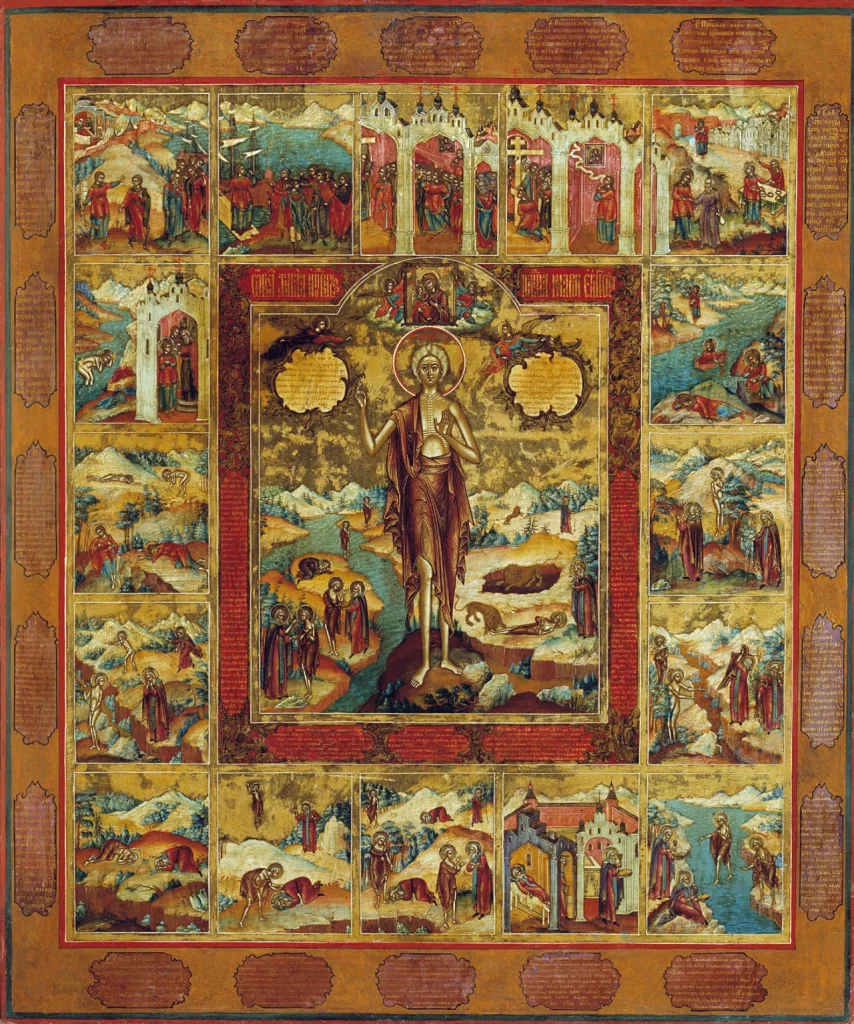
It was a busy week of confessions, with Wednesday and Thursday dedicated to them, and on Wednesday we also chanted a moleben for the Brotherhood of the Holy Kiev Caves Lavra, as well as the four hour long matins with the Great Canon and life of St Mary of Egypt, whose Sunday was celebrated today.
Yesterday, was the penultimate Liturgy for the newly-baptised Mary (Germaine), soon to move to Pamplona with husband José, and we treated the day as an anticipated name-day for her, as it was the Lenten Sunday dedicated to her ‘angel’ – St Mary of Egypt.
It was a quiet and prayerful Liturgy, with the choir continuing to sing the prolonged Lenten melodies for the Liturgy of St Basil, with its longer priestly prayers. We are very grateful to our singers for their labours, especially as they rehearse for Pascha – with their singing sounding wonderful as we socialised at the back of the church.
The number of confessions for the week was reflected in the goodly number of those receiving the Holy Mysteries, and in a repeat of last week, it was wonderful to see those who had communed assembled on the left kliros after communion.
Worshippers enjoyed socialising over a ‘picnic’ after the service, and after spending some pastoral time with a few parishioners, it was my great joy to admit student, Joe, as a catechumen – so that his friend and fellow student, Kyle, is no longer the only one for whom we are praying in the Litany of the Catechemens! We look forward to the day when they will enter the fulness of Orthodoxy, through the Mystery of Holy Baptism.
Our three clergy and a group of Bridge-crossing parishioners relaxed in our nearby café after finishing the packing away and car-loading, and it was a welcome change for all three clergy to be part of the weekly café visit. I look forward to this social relaxation every week: a valuable time with our students and young people, as well as those needing coffee before their return to England.
The coming week is, of course, Holy Week for the Nazareth House community, so the chapel is very much in use at the end of the week, necessitating the hearing of confessions before 17:00 on Thursday, as the Mass of Maundy Thursday will be celebrated at 18:00. It will also be possible for us to hear confessions (if necessary) in Deacon Mark’s office in Morganstown at Saturday tea-time, on our return journey from celebrating Liturgy in Cheltenham for Lazarus Saturday.
Will those requiring confession please email me by noon on Wednesday?
Good Friday services in Nazareth House preclude the Orthodox celebration of the feast of the Annunciation, so our Divine Liturgy will now be celebrated in Llanelli in the Chapel of St David and St Nicholas at 10:30. I will post details separately.
Our Lazarus Saturday Liturgy will be celebrated in Cheltenham, in Prestbury United Reformed Church, where confessions will be heard from 09:15. The Hours will be chanted at 10:00 and the Liturgy will be celebrated at 10:30. We eagerly look forward to the celebration of this wonderful feast before Holy Week.
The Catholic Easter Vigil, next Saturday, will make it impossible for us to set up in the evening – hence confessions in Morganstown – and the Easter Sunday Mass will not commence until 10:00. Therefore, we will not have access to the chapel until around 10:35/10:40.
The Hours will be read during the proskomedia, and we will begin our celebration of the Palm Sunday Liturgy – the Entry of the Lord into Jerusalem – as close to 11:00 as possible. There will be very little chance to hear confessions before the Liturgy, so it may be necessary to confess and commune parishioners AFTER the Liturgy. This is unfortunate, but unavoidable.
Finally, for those who do not use Facebook, yesterday, we sadly announced the repose of Eileen, mother of our dear friend Father Sebastian of the Oratory of St Philip Neri, and ask you to remember her in your prayers, together with the newly departed Ronald, father of Father Alexander.
Our deepest sympathy is extended to Father Sebastian and his sisters, Alison and Helen, and – of course – to Father Alexander. May the Lord remember the souls of the newly-departed in His Kingdom. Memory Eternal!
I hope that, if your spiritual labours have flagged during the latter part of the Great Fast, the week ahead may be one of refocussing and regaining momentum before Holy Week!
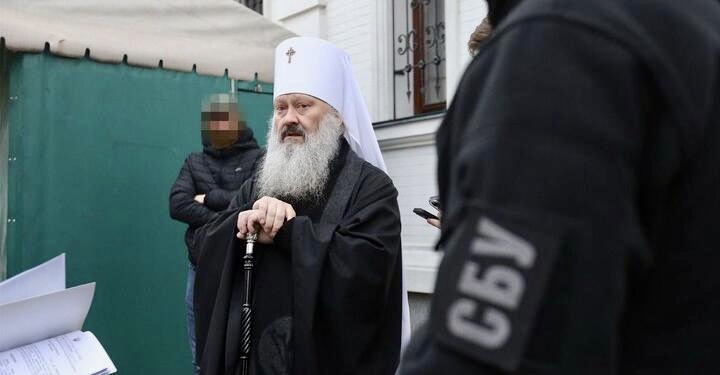
Please continue to keep Metropolitan Pavel, the Abbot of the Holy Dormition Kiev-Caves Lavra, and all of its persecuted Brotherhood in your prayers.
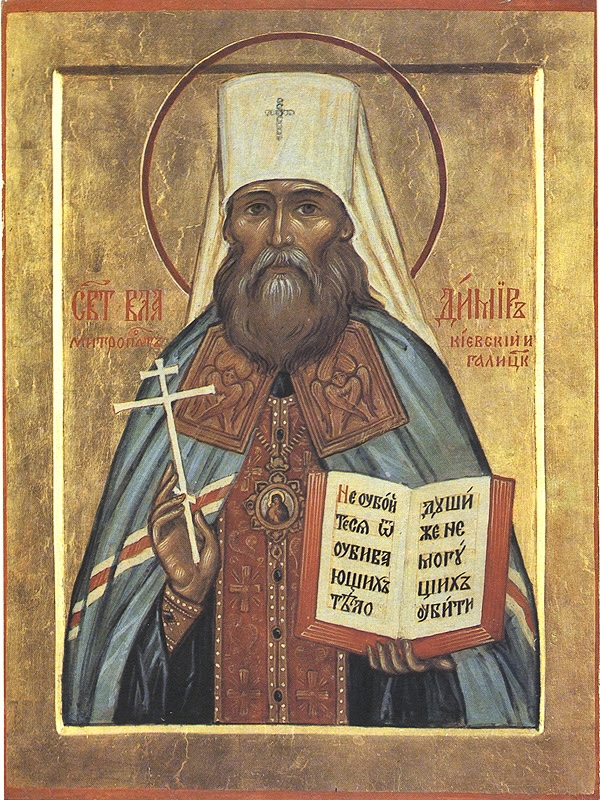
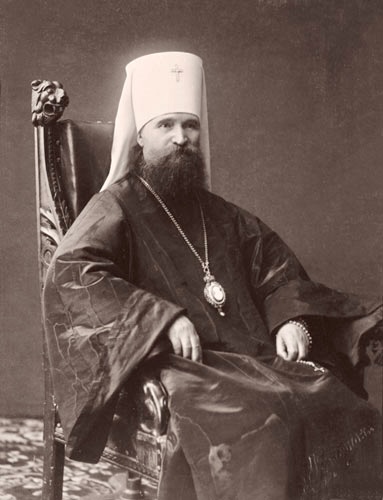
At this time of suffering and persecution for the Ukrainian Orthodox Church, let us not forget that Metropolitan Onuphry’s predecessor, St Vladimir (Metropolitan of Kiev and Galich 1915 to 1918) was the first Hieromartyr of the Soviet yoke.
Let us turn to him in prayer for the suffering Ukrainian Orthodox Church, for his successor, Metropolitan Onuphry, and for the Abbot and Brotherhood of the Kiev Caves Lavra.
The holy Metropolitan Vladimir of Kiev was the first bishop to be tortured and slain by the Communists at the time of the Russian Revolution.
Basil Nikephorovich Bogoyavlensky was born in the province of Tambov of pious parents on January 1, 1848. His father, a priest, was later murdered. The young Basil graduated from the Theological Academy in Kiev in 1874, and taught in the Tambov seminary for seven years before he was ordained to the holy priesthood.
His wife died in 1886, and their only child died shortly thereafter. The bereaved widower entered the Kozlov monastery in Tambov and was given the name Vladimir. In 1888 he was consecrated bishop of Staraya Rus, and served as a vicar bishop of the Novgorod diocese. In 1891 he was assigned to the diocese of Samara. In those days people of his diocese suffered from a cholera epidemic and a crop failure. Bishop Vladimir devoted himself to caring for the sick and suffering, inspiring others to follow his example.
In 1892 he became Archbishop of Kartalin and Kahetin, then in 1898 he was chosen as Metropolitan of Moscow and Kolomna. He served fifteen years in this position.
Metropolitan Vladimir was distinguished by his compassion for the poor, and for widows and orphans. He also tried to help alcoholics and those who had abandoned the Church. The Metropolitan was also interested in the education of children in school, especially those who were studying in the theological schools.
In 1912, after the death of Metropolitan Anthony, he was appointed Metropolitan of Petrograd, administering that diocese until 1915. Because he disapproved of Rasputin, Metropolitan Vladimir fell out of favor with the Tsar, and so he was transferred to Kiev. On November 5, 1917 it was he who announced that Saint Tikhon (April 7) had been elected as Patriarch of Moscow.
The “Ukrainian Congress” was also calling for an autonomous Ukraine and for the creation of a Ukrainian Church independent from the Church of Russia. Metropolitan Vladimir suffered and grieved because of this question, warning that such a division in the Church would allow its enemies to be victorious. However, at the end of 1917, a Ukrainian Dominion was formed, and also a separate Ukrainian church administration (“rada”) led by the retired Archbishop Alexis Dorodnitzin. This uncanonical group forbade the commemoration of Patriarch Tikhon during church services, and demanded that Metropolitan Vladimir leave Kiev.
In January 1918 the civil war came to Kiev, and the two forces vied for control of the city. Many churches and monasteries were damaged by the cannon fire. The Bolsheviks seized the Kiev Caves Lavra on January 23, and soldiers broke into the churches. Monks were taken out into the courtyard to be stripped and beaten. At six thirty on the night of January 25, five armed soldiers and a sailor came looking for Metropolitan Vladimir. The seventy-year-old hierarch was tortured and choked in his bedroom with the chain of his cross. The ruffians tortured the Metropolitan and demanded money.
When they emerged, the Metropolitan’s cell attendant approached and asked for a blessing.The sailor pushed him aside and told him, “Enough bowing to these blood-drinkers. No more of it.” After blessing and kissing him, the Metropolitan said, “Good-bye, Philip.” Then he walked calmly with his executioners, just as if he were on his way to serve the Liturgy.
Metropolitan Vladimir was driven from the monastery to the place of execution. As they got out of the car, the holy martyr asked, “Do you intend to shoot me here?”
“Why not?” they replied.
After praying for a short time and asking forgiveness for his sins, Metropolitan Vladimir blessed the executioners, saying, “May God forgive you.” Then several rifle shots were heard.
In the morning, some women came to the gates of the Lavra and told the monks where the Metropolitan’s body could be found. He was lying on his back, with bullet wounds near his right eye and by his right collarbone. There were also several cuts and gashes on the body, including a very deep chest wound. The hieromartyr was carried into the Lavra church of Saint Michael, where he had spent his last days at prayer.
In Moscow, the All-Russian Church Council was in session when word came of Metropolitan Vladimir’s death. Patriarch Tikhon and his clergy performed a Memorial Service for the New Martyr Vladimir. A commission was formed to investigate the circumstances of Metropolitan Vladimir’s murder, but it was unable to carry out its duties because of the Revolution.The Council decided that January 25, the day of his death, would be set aside for the annual commemoration of all of Russia’s martyrs and confessors killed by the Soviets.
The holy New Martyr Vladimir of Kiev was glorified by the Orthodox Church of Russia in 1992. On the Sunday closest to January 25 (the day of Metropolitan Vladimir’s martyrdom) we also observe the Synaxis of Russia’s New Martyrs and Confessors.
The speech of His Eminence, Metropolitan Pavel – Abbot of the Holy Dormition Kiev Caves Lavra on 29th March: the day on which the persecuting government set for the withdrawal or eviction of the sacred brotherhood who rebuilt the monastery from ruins and rubble.
Persecution is a daily reality, and the age of the martyrs and confessors has returned.
“ We, dear brothers and sisters, are at the baptismal font of Holy Rus, a 1000 year old place, where we still are in communion with those who inhabit Heaven, with the testimony of their Holy Relics abiding in this greatest holy place.
The first martyrs here were Ioann and Fyodor, his father, the Varangian Christians who were sacrificed to the idols. Then martyrs Theodor, Lukian, Vasiliy and others who are resting in this sacred place. The last martyr – hieromartyr Vladimir who was fighting the godless authorities, renovationism and all those passions and sins devouring our Fatherland.
Today unfortunately history is repeated. Instead of uniting people around defending the country we (the country) are killing our own, driving them out of our sacred places, OUR holy places, built by OUR people, built by ourselves. I testify of that as a person who knows, who built many churches. We are interceding before all the saints so they would not abandon us, and the faithful.
“Again Herodias is raving, again she is dancing and again she is trying to have John the Baptist beheaded by Herod. Again Jezebel is going around trying to seize the vineyard of Naboth and chase Elijah into the hills”- for this sermon the Holy Hierarch was sent into exile.
Today these kinds of things are happening in our country. Today we received correspondence from the director of the “ museum” signed by the minister of culture informing us we are being evicted from this place of 1000 years of prayer. I want to warn the President and all his gang- our tears will not fall onto the ground but they will fall on your head to your woe.
Today you think that having climbed to power on our backs and with our blessing you can treat us like this. God will not forgive you or your kin for this evil act – today two hundred and twenty monks are being made homeless; because you could not receive Metropolitan Onufriy with the Synod to hear him out; you could not control your Minister of Culture consumed by the spirit of godlessness an demonic hate towards us. Therefore, he acts with your permission. Woe to you!
We informed the above mentioned authorities that we will not leave the Lavra until the decision of the Court. We have turned to all the Ukrainian courts with all our documents, but now the third judge has declined our case, because the pressure on the judges to expel us from the Lavra is too great.
Today we are appealing to the United Nations, to UNESCO and other human rights organisations. We are appealing to the other churches to pray for us so truth would win.
We know that Truth is crucified in the world. When the Hieromartyr Petro Polyansky was judged by a “ troika” tribunal, one of the three said: “ Ours is the truth, we are finishing with you, priests, we have won” to which Fr Petro replied-“ You are right, yours is the TIME, the time of lies, untruth and deceit.
There is also another Judgement- the Judgement of Christ. You will not win that trial because Christ the Judge and Defender never makes mistakes.
Mr President and you Cabinet – woe to you! We are not the enemies of Ukraine. We are not bandits or “ the fifth column”, we are citizens of our country. You came to us in your election campaign, you asked for the blessing from Metropolitan Onufriy to win this election. And today, as president, you could not even receive and hear out the elderly hierarch who represents millions of your citizens.
We have seen the lawlessness that has happened in Ivano-Frankivsk Region. In the city the last cathedral has been taken away. The cathedral which the Lavra rebuilt. Tear gas with pepper spray….they shut the doors and smoked people out like rats…have a look at the videos- get closer to your people.
We saw what the state police has been doing in the region of Vinnitsa- a priest serving the sacrament of anointing with oil, was beaten by the police, and dragged through the church. Those who take the sword will perish by the sword.
A word about us to the international community- we preach love, overcoming of hatred, patience, we support the human rights…so what is this eviction about? How can we trust or believe our authorities? We ask and demand justice but not only for ourselves, but for our Holy Church ( the people)
I address the police. You are coming for us on the 30th, but be mindful people. Do not carry out instructions of the mad tormentors. The synod of so-called Orthodox Church of Ukraine already said they will be serving the Feast of the Annunciation in the Lower church in the Lavra. They also had the plan of taking the Pochaev Lavra approved. And now, dear brothers and sisters, look at this so called New Church in Ukraine, which deprives people of the real sacraments, which acts by bullying, which takes away salvation from people. Whose supporters take away churches by force and then don’t attend. There is a saying “Сам не гам- та иншому не дам» describing this.
The tears of the monks will also fall on someone else – Patriarch Bartholomew, who is doing lawlessness in Ukraine today. I don’t understand the man- he is 80 years old, soon he will be standing at the judgement seat of Christ…does he think himself immortal.
Having lost a lot of his folk he is today stealing sheep from someone else’s yard. Woe to you and shame on you, because all that is happening today is with your miserable and deceitful blessing.
I am addressing you, dear brothers and sisters with a plea, please come to the services to support us all as the journalists of the Rada told us that disorder may happen on the 30th and the 31st of March.
We call on you not to respond to haters with hate. We ask you to be faithful to the Holy Mother Church. We know that even if we have to leave we will come back. Khrushchev promised that by 1970 he will show the last priest on TV but how mistaken he was.
The Church was resurrected and he is probably enduring the torments of hell. On the 10th of March 1961 the Lavra was shut by him. In 1988 in the Soviet Union the Lavra opened again and the faithful monks returned, making more disciples. Sixty two years later, the grandchildren of the persecutors of the Church come again to shut us down. The desires of the world and the passions are winning over you. Think of it now, because you will have to give answer for everything.
Dear pilgrims, brothers and sisters, who came to us for spiritual renewal and the blessing from the saints- again, we are enduring times of persecution, by the people who are casting out the Mother of God herself, who said to the Greek architects “ I want to dwell in the city of Kiev”.
She provided the funds for the building of the Holy Dormition cathedral and She appeared in an uncreated icon of the Dormition of the Mother of God.
The presence of the Mother of God is the highest treasure for the monastics. The Monk Alipiy, with the other iconographers, frescoed the wonderful church. The church was desolated and deconsecrated several times and destroyed by the bolsheviks. It was fully rebuilt by the brethren and the small donation from the government in 2000. With many tears of people who prayed and donated so they would see the church rebuilt before they died.
Since then, the brothers have invested everything into the interior decor, the royal doors, the icons over the last 22 years.
This church was taken away from us. You saw the darkened crosses since it happened, you saw darkened icons…people are probably working on the destruction of the Holy places.
Why do I say this? Because I read and hear threats in the internet, on the news…yesterday I went to the passport office because my passport is lost or has been stolen, but the news has started spreading lies that I am emigrating, abandoning my brethren. This is how slander works.
I will not leave unless I have to bury everyone of you.
Today I am addressing all countries which have protection of human rights observed, I am addressing the faithful, of whom some say this is coming to us for our sins. Maybe it is better for all of us to look deeper into our hearts and look closely at our own lives and our sins?
The minister of culture said in public this is for the sins for the Ukrainian Church. If you decided to pronounce a verdict on us without an epitrachil, maybe you can ask yourself if your wife could have died because of your sins? Maybe you can take the plank out of your eye instead of seeing the specks in the eyes of our brothers, martyrs and confessors?
We never thought that in the 21st century we would be oppressed by our own people. But if we read the elders who prophesied in Stalin’s times about the times of Khrushchev, about our times, we are awe-struck at how they saw what would happen?
Dear Rulers, what has the Church done to you? Or maybe you are running away from your conscience? None of us is going to avoid the judgement of God, not a single person.
Again, dear Brothers and Sisters, please, I beg you, pray for us, for me, because I as an abbot have a very heavy heart.
Yesterday the security services had their meeting with me and they I said, “I am not compromising.” If I have to give my life for Christ, for the Church, then I have to. There can be no compromises with God. And you are temporary. Like dew in the sun you will evaporate. Again and again I say, those who raise the sword shall perish by it.
I am addressing those people who slander us. We do not have the Moscow Church here. Our church is Christ’s Church. We do not sing songs or poems hate against anyone, we exist to praise Christ and his Mother. We wish everyone peace and health, at the time when the enemies are attacking our country from all sides.
Instead of being grateful for the prayer that is ascending to God, here you are killing our priests! Some of you said- when we are finished dealing with the Lavra we will sort out the womens monastery of the Protection of the Mother of God.
“Evil will slay the wicked; the foes of the righteous will be condemned” ( Psalm 33)
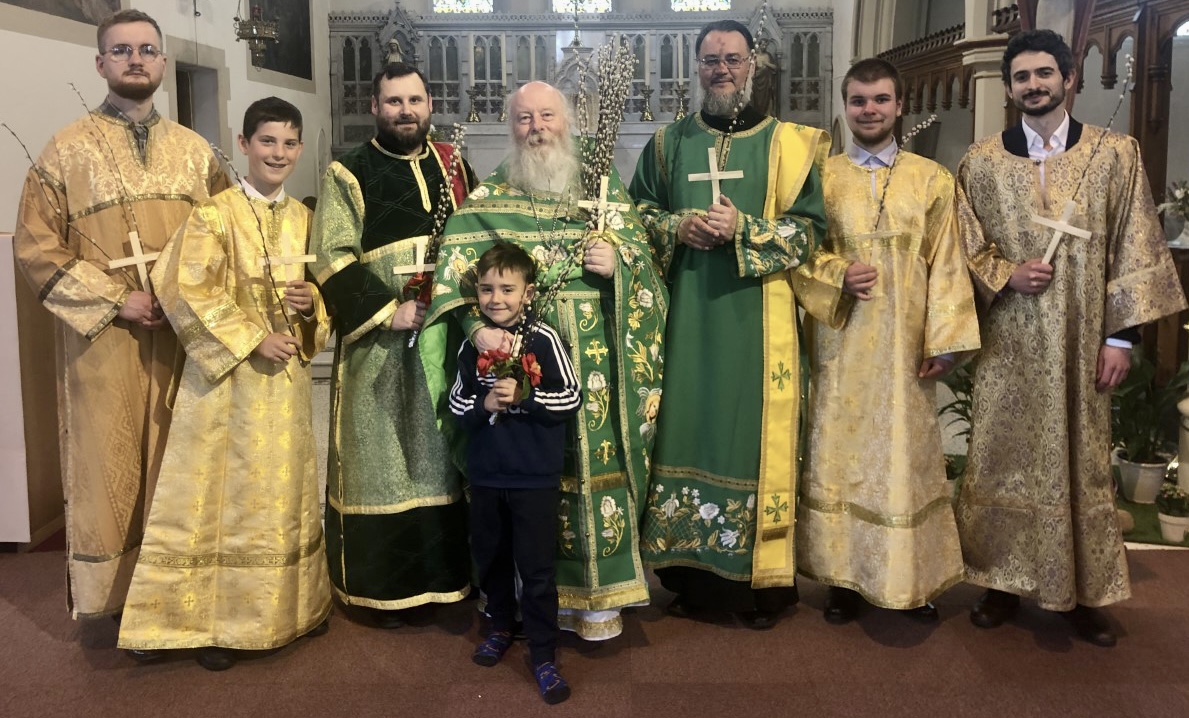


 Just at the time in which it was relevant, I noticed my little book of homilies of Fr Daniel Sysoev, wedged into a gap between stacks of books in my cell – and it opened to a little homily on spiritual kinship.
 Morning Prayer:
  Our wonderful, growing and busy Cardiff parish of the Russian Orthodox Church Outside of Russia was founded in Bright Week 2011, so as we approach Pascha, we are coming to the end of our twelfth year!
 It was a busy week of confessions, with Wednesday and Thursday dedicated to them, and on Wednesday we also chanted a moleben for the Brotherhood of the Holy Kiev Caves Lavra, as well as the four hour long matins with the Great Canon and life of St Mary of Egypt, whose Sunday was celebrated today.