Thank you to everyone who has supported the shared life of our community over the past week, and to both parishioners, friends and benefactors of the parish, who have been generous in so many different ways.
In the absence of both Olga and Masha, we are grateful to our young men, who in Joe’s case defied a sore and croaky throat to sing parts of the Liturgy, including a lovely Athonite setting of the first antiphon. Thanks also to Father Hierodeacon Avraamy for chanting on the kliros and lending his support. We look forward to our gentlemen contributing more traditional Russian and Byzantine chants to our Liturgy, and broadening our musical tradition.
For a second week, both the “digital collection plate” (card reader) and remote-giving greatly increased our weekly offering, and Father Mark reports that this week’s total electronic payments were £1,735, which we most definitely don’t expect to happen too often, but which does show the benefits of multiple options for donating to the parish.
From next week Joanna will be organising volunteers to take the candle and prosphora offerings and look after the candle tray, and we will hopefully expand this to reinstate our parish lavka/kiosk, once we have acquired suitable items.
Joanna has written to Vladyka Irenei, updating him about our bid offer on the building in Taff’s Well, and I will personally update him on the progress of the gofundme page, hoping that together with other proactive individuals, he will promote our fundraising, regardless of the outcome with the chapel.
Thanks to our parish youth, for their ongoing labours around fundraising and social media. It’s very good to see them involved and dedicated to parish life.
Branka has asked me to announce that on forthcoming ordinary Sundays, refreshments after Liturgy will be limited to cake and hot drinks, given the time it is taking to wash up and clean, which usually sees us leaving later than our planned exit.
Though we previously asked offerings to be limited to finger-food for ease of clearing up and cleaning, this went unheeded, making a fair amount of work for a relatively small handful of people, so as of next week, let’s please stick to this simplified trapeza, and look forward to feast days for shared meals together. We will be strict in keeping to this plan for ease of clearing and cleaning St Philip’s, and to make this easier, may we also ask that parishioners take any used cups, plates etc., to the kitchen hatch when they have finished, so that our sisters are spared the task of having to go round church picking things up. Thank you.
We are grateful to those who pack things away after Liturgy, but I would like to clarify an important point. Can we please not remove principal icons from the stands until the end of the thanksgiving prayers and the priest’s dismissal? Our worship has not finished until that point, and the dismissal is given on the “solea” (liturgical are between he screen and the nave), which must remain complete until then. By all means, pack away the peripheral icons, but please wait until the last “amen” before removing the icons from the stands.
As announced, this week should hopefully see our usual meeting to pray Small Compline and an akathist to the Mother of God in Nazareth House at 18:00, with confessions before and after the service.
We shall chant vespers for the eve of the feast of St Vyacheslav (Wenceslaus) on Friday at 15:00, and given my journey to Warminster after the service, it would be a great help to hear confessions beforehand, if possible.
On Saturday, we will continue the feast, and also honour St Chariton the Confessor, with the celebration of our monthly Warminster Liturgy for parishioners living in Wessex, the service in the Chapel of St Lawrence at 10:30. Confessions will be heard before the service, and we will have our customary bring-and-share lunch afterwards.
On Sunday, we will have the joy of celebrating the feast of the Uncovering of the Relics of St. John of Shanghai and San Francisco (1993), and the variables for Liturgy may be found here:
As announced on WhatsApp, through the generosity of the Oratorian Fathers, we will have the blessing of celebrating the feast of the Protecting Veil (Pokrov) on the Oratory Church on Tuesday 14 October (1st Old Style) and will commence the Hours and Liturgy at 10:45. It will be a joy to celebrate this wonderful feast of the maternal protection, and loving care of the Theotokos, and we will share refreshments in the lower sacristy after the Liturgy.
We ask your prayers for Olga, Valentina and Svetlana on their holiday travels; for the sick servants of God Pavel and Brigid; for Liza as she has a hospital visit and procedure tomorrow (Monday); and for the newly departed servants of God, Protodeacon Peter and Natalia of our Geneva parish.
Don’t forget that we across the miles we pray together for the future mission-base for our parish at 20:00 each evening.
Greetings as we continue to celebrate the afterfeast of the Exultation of the Life-Giving Cross, having been greatly blessed by the presence of one of the Oratories relics of the Life-Giving Cross at Liturgy, having already taken the relic to Lazarica for the festal Liturgy on Saturday. Profound thanks to the Father and Brothers of the Oratory.
Today is the name-day of our very dear departed sister, Lyudmila, who touched us all in so many different ways, with her treats, her dry humour, her gentle warmth and prayerfulness, but above all in her deep humility and faith as she suffered her illness with unshakeable hope and trust in God. Please remember her and pray for her today. May her memory be eternal! Вечная память!
Celebrating newness of life, before we began yesterday’s Liturgy, we had the joy of the naming of two-week old Ezra, with the Church’s prayer asking God’s blessing, as we look forward to his baptism and reception of the Holy Mysteries.
“O Lord our God, we pray unto Thee, and we beseech Thee, that the light of Thy countenance may be shown upon Thy servant, Ezra, and that the cross of Thine only-begotten Son may be graven in his heart and in his thoughts, that he may flee from the vanity of the world and from every evil snare of the enemy, and may follow after Thy commandments. And grant, O Lord, that Thy Holy Name may remain unrejected by him and that he may be united, in due time, to Thy holy Church, and that the terrible Mysteries of Thy Christ may be administered unto him, that having lived according to Thy commandments and preserved without flaw the Seal he may receive the bliss of the elect in Thy kingdom; through the grace and love toward mankind of Thine only-begotten Son, with whom Thou art blessed, together with Thine all-holy and good and life-giving Spirit, now and ever and unto ages of ages. Amen.”
It reminded me of the arrival of Yuriy, who was baptised in his third week and has been at the heart of our parish ever since, and we know that Joseph will ensure, that like Yuriy, Ezra not only grows up in Faith, but as a child comfortable in the familiarity and sacred pattern of Church and parish life, surrounded by icons, candles, the smell of incense and sacred chant. Of course, Ezra has been used to the chant of the Liturgy throughout his life until now, but experienced ‘from the outside’ for the first time, yesterday. May God bless Ezra and his mum and dad. Many years to them!
This week will see our usual services…
Thursday 2 October at 18:00: Small Compline and akathist in Nazareth House, Colum Rd, Cardiff CF10 3UN . Confessions before and after the service.
Friday 3 October at 15:00: Vespers for the Eve of the Feast of St Dimitri of Rostov in the Oratory Church, Swinton St, Cardiff CF24 2NT. Confessions before and after the service.
Sunday 5 October at 09:00: The Hours and Divine Liturgy, followed by a bring-and-share lunch in St Philips Church, Tweedsmuir Rd, Tremorfa, Cardiff CF24 2QZ. Confessions before the service.
It has been a joy to welcome so many visitors over the past months, and this is a period of constant enquiries, questions and long spiritual conversations with people (usually young ones!) exploring Faith and spiritual life. The warmth of our parishioners cushions what can be a daunting experience for those coming to an Orthodox service for the first time. Let’s please ensure everyone is greeted and welcomed, and encouraged to come into the Liturgy and NOT stand to side of the sanctuary.
The last point is one that I ask existing parishioners to take on board. Standing, seeing the Liturgy from the side of an unscreened sanctuary is not the place to be in our Liturgy, but rather before the icons and Holy Table. Please enter the church, even if late, and face the Holy Table from the body of the church. We cannot change where the entrance is, but we can ensure we enter and stand together for worship. At many Liturgies there are more people at the side of the altar than before the icons, which is actually very distracting for the clergy in the sanctuary. As the weeks goes on, we will be screening the side of the sanctuary, when we are able to do so.
As you are aware our building campaign is now under way, having been launched on Friday evening, and has thus far received £8100 in donations directly into our bank account via personal bank transfer and £1, 685 from the gofundme page. Thanks to our young people for their work on this, and on social media. We really appreciate their labours.
The card machine which we are trialing till the end of the year was in place for yesterday’s Liturgy and received positive feedback from the faithful who used it, the total electronic donations of £190 being split as follows: £65 General Collection, £40 Building Fund, £70 Stipend Fund, £15 Candle Purchases, £50 of the donations were gift aided giving an additional £12.50. All in all this saw total donations of £350.50.
The now affordable post-school vacation holiday season continues, and we ask prayers for our regent Olga and Valentina Nikolaevna as they travel to Rhodes, and also for Sasha and his family, presently in Lithuania, and for matushka Alla on her visit to Russia. We continue to pray for Masha and Neil with the complication of their new house, that God may give them strength and resielince in creating a wonderful home with a chapel in the garden.
As we approach October, I would like to know if there will be singers and readers for the feast of Pokrov (the Protecting Veil) on Tuesday 14 October, as we would like to celebrate the feast with a Liturgy. Please let me know if you are able to assist.
Our next Wessex Liturgy will be on Saturday 11 October, the feast of St Chariton the Confessor of Palestine, and we will celebrate our Liturgy in the chapel of St Lawrence, in Warminster, at 10.30.
Our next Cheltenham Liturgy will be the following Saturday, 18 October, and will be dedicated to the Protecting Veil of the Mother of God, as we do for our Gloucestershire October Liturgy each year.
With thanks for every labour, every offering to the life of our community, and every prayer, and may God bless you all.
It has been a joy to celebrate the forefeast, feast and afterfeast of the Nativity of the Mother of God across our Cardiff mission area over the last three days, with Saturday’s pre-festal Liturgy in Cheltenham, the festal Liturgy in Cardiff yesterday, and Compline in Warminster today, after a visit to Shaftesbury Abbey, the resting place of the relics of King Edward the Martyr until their rediscovery in 1931.
It was a pleasure to see parishioners that we had not seen for a while at yesterday’s Liturgy for the feast of the Nativity of the Mother of God, and to welcome our recent arrivals to our joyful celebration of God’s foundation of the Incarnation in the birth of the Mother of the long-awaited Messiah and Saviour of the World. Many thanks to all who made it such a joyful celebration.
Thanks to our Cheltenham ladies for the flowers which have travelled with us from Cheltenham to Wales to Wiltshire, having adorned our icons at the services over the last few days, and which are now lending welcome colour to our Wessex home, in the Chapel of St Lawrence in Warminster.
Our supper and compline service in the chapel allowed us to honour St Joachim and Anna, and to congratulate Jessica Anne on her name day, wishing her “Many Years!”
Following a building committee meeting on Sunday 1/14 September, last week was one of behind-the-scenes activity with work being done on a parish gofundme page to raise money for our building fund, and this should be up and running in the next few days.
This week will see our usual pattern of worship, with small compline in Nazareth House on Thursday at 18:00, and a moleben to St Andrew (before his relics) in the Oratory on Friday at 15:00. Confessions will be heard before and after the service.
Further to Father Mark the Younger’s brief finance report on Sunday, may we encourage parishioners who are UK tax payers to register for Gift Aid, allowing the parish to claim back tax and increase donations at no cost to the donor. Please consider this, as for every £1 donated, we could receives an additional 25p, making a vast difference to parish finances. Please talk to Father Mark if you are interested and able to help in this way.
On the feast of the Exultation of the Cross, on Saturday, my intention is still to celebrate the feast in Lazarica, with the hope that some parishioners may join me in Birmingham. As previously requested, if you can go and are able to offer a place in your vehicle please let us know, to give others the opportunity to celebrate the feast.
As Saturday is a feast of the Cross, it is a Fast day, allowing wine and oil.
We look forward to the veneration of the Cross in St Philip’s on Sunday, the second day of the feast, when we also celebrate the Holy Great-martyr Nikita the Goth and the 0Uncovering of the relics of the Holy Protomartyr and Archdeacon Stephen.
Further to various conversations following confessions, may I stress that as Orthodox Christians, we live CALENDRICALLY.
This means not only keeping fasts and feasts, but knowing and celebrating the saints’ commemorations, day by day.
Reading at the calendar should be part of our daily spiritual routine, and we should remember that an even greater danger than New Calendrism (itself an undermining of sacred, patristic Tradition) is no calendarism, in which carelessness and neglect results in life oblivious to the Church’s commemorations, feasts, fasts, saints and seasons. As we look to the year ahead, please consider buying a physical, paper and print calendar to have in your icon corner.
In your prayers, please pray for the much suffering people of Gaza and for Metropolitan Theodosius of Sebastia; for the suffering servant of God, Metropolitan Tychikos, whose health is deteriorating in the light of his persecution and trials; for Porphyrios, matushka Alla and Joanna on their travels; for Pavel, Natalia, Martyn-John and Brigid among the sick; for the departed servants of God Yury and Inna; for baby Ezra and new parents McKenna and Joseph; and for our community to find and acquire its own temple!
The Martyrs Eudoxius, Zeno, Macarius and their Companions received a martyric death for Christ under the emperor Maximian Galerius, the successor of the emperor Diocletian.
Saint Eudoxius held the high position of a military commander in the imperial armies. He was a Christian, as were his friend Zeno and his house steward Macarius. After the emperor Diocletian issued an edict that Christians who refused to offer sacrifice to idols were to be put to death, many people fled to various lands with their families to avoid torture and death. At this time Saint Eudoxius resigned his high position, and with his wife Saint Basilissa and all their family abandoned their property and went into hiding in the region of Armenian Melitene.
The governor of Melitene sent soldiers to search for Eudoxius. When they found Eudoxius, he was attired in white garb. Not recognising him, the soldiers began to question whether a certain military commander Eudoxius had come into these parts. Not revealing who he was, the saint invited the soldiers into his home, fed them and gave them lodging for the night.
Saint Eudoxius considered his encounter with the soldiers as a sign from the Lord of his impending death by martyrdom. In the morning, he disclosed to his guests that he was the one whom they were seeking. In gratitude for the hospitality, the soldiers offered to conceal from the authorities that they had found Saint Eudoxius. However, the saint would not consent to this.
Setting his affairs in order, he told his wife not to weep for him, but on the contrary to celebrate the day of his martyric death. Donning his military garb, he went with the soldiers to the governor. Saint Basilissa and his friends Saints Zeno and Macarius followed after Saint Eudoxius.
The governor tried to persuade Saint Eudoxius to offer sacrifice to the idols and by this safeguard his life, exalted rank and property. Saint Eudoxius firmly refused, denouncing the folly of anyone who would worship soulless idols. He removed his soldier’s belt, the emblem of his authority, and threw it in the governor’s face.
Soldiers present at this, secret Christians, did the same thing, and they numbered more than a thousand men. The embarrassed governor asked the emperor what he should do. He was ordered to try the ringleaders and set the others free.
After prolonged tortures, they led Saint Eudoxius forth to execution. Following after her husband, Saint Basilissa wept, and his friend Saint Zeno also wept for the martyr. Saint Eudoxius again urged his wife not to mourn him, but rather to rejoice that he was worthy of the crown of martyrdom. He asked that she bury his body in a place called Amimos.
To his weeping friend Saint Zeno Saint Eudoxius predicted that they would enter the Kingdom of Heaven at the same time. Emboldened by these words, Zeno loudly declared himself a Christian, for which he was immediately sentenced to death.
Later, Saint Basilissa took her husband’s body without hindrance, and buried it in the place where he had requested. After this, they arrested the saint and led her before the governor. Desiring to share the fate of her husband, she fearlessly denounced both the governor and his false gods, the idols. The governor, however, saw her intent and would not torture her, but instead sent her away. As she left, the saint said to him that God would see her intention to suffer for her faith and would accept this intent as an accomplished deed.
Seven days later, Saint Eudoxius appeared to his wife in a vision and bade her to inform his friend and house steward Macarius, that both he and Saint Zeno awaited the arrival of Macarius. Macarius immediately went to the governor and declared himself a Christian, for which he was sentenced to death and beheaded. Many Christians also suffered martyrdom during this time.
Canon to the Martyr Eudoxius, in Tone VIII
Ode I, Irmos:Having traversed the water as though it were dry land, and escaped the evil of Egypt, the Israelite cried aloud: Let us chant unto our Deliverer and God!
Holy Martyr Eudoxius, pray to God for us.
O ye who desire to proclaim the glories of the martyrs, come, let us all praise Eudoxius, great among martyrs, holding festival with cymbals as did David.
Holy Martyr Eudoxius, pray to God for us.
Throughout the whole world went the impious command not to worship the living God, but idols. But thou, O martyr, didst worship thy God, the God of heaven.
Glory be to the Father, and to the Son, and to the Holy Spirit.
O martyr Eudoxius, thou glory of the pious, true to thy name, amidst the unjust judges that wounded thee didst thou confess Christ God Who is unoriginate.
Now & ever, and unto the ages of ages. Amen.
O Mother who knewest not a husband, the ranks of angels and men unceasingly praise thee, for thou didst bear their Creator in thine arms as a babe.
Ode III, Irmos:O Christ, Who in the beginning established the heavens in wisdom and founded the earth upon the waters, make me steadfast upon the rock of Thy commandments; for none is holy as Thee, O Thou Who lovest mankind.
Holy Martyr Eudoxius, pray to God for us.
Like a lamb wast thou led to the slaughter, O martyr Eudoxius, neither protesting, nor crying out, O most blessed one, emulating the life of Christ thy Teacher. Wherefore, thou hast received unending glory.
Holy Martyr Eudoxius, pray to God for us.
To those who served idols thou didst cry out, O martyr: My God liveth forever, but your gods are the works of men’s hands; falling, they cannot rise up, for they are inanimate, graven images!
Glory be to the Father, and to the Son, and to the Holy Spirit.
The arts of the enemy hast thou cast down, establishing thy mind upon the rock of the Church of Christ. Wherefore, thou didst cry out: This corruptible life do I leave for life everlasting!
Now & ever, and unto the ages of ages. Amen.
God the Word, equally enthroned and everlasting with the Father, wishing to restore the first of our race, took Adam’s hypostasis of thee, O pure one, finding thee to be the most holy of all women, O Mother of God.
Ode IV, Irmos:I have heard, O Lord, the mystery of Thy dispensation; I have understood Thy works, and have glorified Thy divinity.
Holy Martyr Eudoxius, pray to God for us.
Thou didst denounce the deception of those who sought to force thee to renounce everlasting life and to love a life of vanity.
Holy Martyr Eudoxius, pray to God for us.
Wounded, thou didst rejoice in the Word Who was slain in the flesh for our sake, and thou didst cry out to thy tormentors: My sufferings are undeserved!
Glory be to the Father, and to the Son, and to the Holy Spirit.
The gods whom ye serve have mouths, yet cannot speak! thou didst exclaim, O Eudoxius. “Let those who fashion them be like unto them!”
Now & ever, and unto the ages of ages. Amen.
As Thou art sinless, O Unknowable One, grant us purification, and calm Thou the world, O God, through the prayers of her who gave Thee birth.
Ode V, Irmos:Enlighten us with Thy commandments, O Lord, and with Thine upraised arm grant us Thy peace, O Thou Who lovest mankind.
Holy Martyr Eudoxius, pray to God for us.
“Thou art my strength!” thou didst cry out, O Eudoxius. O Christ God Who suffered in the flesh, make me steadfast, for, lo! I suffer in torment.
Holy Martyr Eudoxius, pray to God for us.
“Thou art a treasury of entreaties, O Christ God! Disdain me not!” didst thou cry amid the tortures, O Eudoxius, stout of heart.
Glory be to the Father, and to the Son, and to the Holy Spirit.
Fearing neither the sword nor the fire, Eudoxius cried out to the tormentor: “Behold, I have the mighty strength of the God I serve!”
Now & ever, and unto the ages of ages. Amen.
Heal thou the weakness of my passions, O pure one, making me worthy of thy visitation, and by thine entreaties grant me health.
Ode VI, Irmos:Cleanse me, O Savior, for many are my transgressions; and lead me up from the abyss of evils, I pray, for to Thee have I cried, and Thou hast hearkened to me, O God of my salvation.
Holy Martyr Eudoxius, pray to God for us.
“Neither the sword, nor fire shall separate me from the love of Christ; and I hold your threats to be like the pratings of children!” thou didst cry out with faith to those who sought to compel thee to sacrifice.
Holy Martyr Eudoxius, pray to God for us.
“I fear that tormenting fire which cannot be quenched, and I desire life which cannot be taken away!” thou didst cry out to the tormentor, O Eudoxius. Behold, O thou that woundest my body, I shall not serve thine idols!
Glory be to the Father, and to the Son, and to the Holy Spirit.
“The gods whom thou dost worship are gold and silver. They have mouths, but speak not; ears have they, yet hear not; legs they have, but cannot walk. But my God is the Creator of all!” thou didst exclaim.
Now & ever, and unto the ages of ages. Amen.
By thy prayers may we be delivered from grievous transgressions, O pure Theotokos, and may we acquire the radiance of the Son of God Who was ineffably incarnate of thee, O all-holy one.
Lord, have mercy. Lord, have mercy. Lord, have mercy.
Glory be to the Father, and to the Son, and to the Holy Spirit; now & ever, and unto the ages of ages. Amen.
Sessional Hymn, Tone VIII, Spec. Mel. “Of the Wisdom…”: Having amassed heavenly riches, thou didst scatter them, offering them to the poor; and thy bread didst thou give unto the hungry. Wherefore, having acquired incorruptible life, thou didst shine forth in thy confession of Christ. Therefore, taking courage and suffering lawfully, thou hast received from God a crown for thy labors, O passion-bearer Eudoxius. Entreat Christ God, that He grant remission of sins unto those who with love honor thy holy memory.
Ode VII, Irmos:Once, in Babylon, the youths who had come forth from Judæa trod down the flame of the furnace with their faith in the Trinity, chanting: O God of our fathers, blessed art Thou!
Holy Martyr Eudoxius, pray to God for us.
Emulating the patience of the three youths, O most wise Eudoxius, thou didst not bend thy knee to the false image, but didst cry aloud with fervent faith: O God of our fathers, blessed art Thou!
Holy Martyr Eudoxius, pray to God for us.
Acquiring the invincible aid of grace, O martyr Eudoxius, thou didst firmly cast down the legions of the enemy, and having vanquished them thou didst cry aloud: O God of our fathers, blessed art Thou!
Glory be to the Father, and to the Son, and to the Holy Spirit.
Aflame with the love of divine desire, O martyr Eudoxius, thou didst openly abominate transitory attachments, and, receiving thy reward, thou didst cry out: O God of our fathers, blessed art Thou!
Now & ever, and unto the ages of ages. Amen.
Our all-good God, wishing to restore him who had fallen through deception, is incarnate and born of the Virgin and doth deify mankind.
Ode VIII, Irmos:Madly did the Chaldæan tyrant heat the furnace sevenfold for the pious ones; but, beholding them saved by a higher Power, he cried out to the Creator and Deliverer: Ye children, bless; ye priests, hymn; ye people, exalt Him supremely for all ages!
Holy Martyr Eudoxius, pray to God for us.
Thou didst sail across an abyss of wounds and didst attain unto the harbor of life, O Eudoxius; and, receiving a crown of patience, with the angels thou dost unceasingly cry: Ye children, bless; ye priests, hymn; ye people, exalt Him supremely for all ages!
Holy Martyr Eudoxius, pray to God for us.
To a place of rest hath Christ brought thee out who passed through fire and water, O blessed one; and rejoicing therein with the angels, O wise martyr, unceasingly thou dost chant a hymn to the Trinity: Ye children, bless; ye priests, hymn; ye people, exalt Him supremely for all ages!
Glory be to the Father, and to the Son, and to the Holy Spirit.
Thou didst destroy the noetic serpent with the help of the King of heaven, O glorious one; and receiving a crown of victory and patience, unceasingly thou dost cry out with the immaterial ones: Ye children, bless; ye priests, hymn; ye people, exalt Him supremely for all ages!
Now & ever, and unto the ages of ages. Amen.
The thrice-radiant Godhead which shineth forth in a single ray with one nature in three Hypostases: the unoriginate Father, the Word of one essence with the Father, and the consubstantial Spirit Who reigneth with them, ye children, bless; ye priests, hymn; ye people, exalt supremely for all ages!
Ode IX, Irmos:Heaven was stricken with awe, and the ends of the earth were amazed, that God hath appeared in the flesh, and that thy womb became more spacious than the heavens. Wherefore, the ranks of men and angels magnify thee as the Theotokos.
Holy Martyr Eudoxius, pray to God for us.
The armies of the angels were stricken with awe, and the assemblies of men were amazed that while possessing a corruptible and transitory nature thou didst show the demons to be wretched and weak; and with faith thou didst cry out: I shall serve the Trinity! Holy art Thou, O my Glory!
Holy Martyr Eudoxius, pray to God for us.
Blessed art thou, O martyr Eudoxius, and glorified for all generations, for in nowise sparing thy flesh, thou didst endure torments for Christ’s sake and didst not worship graven images. Wherefore, the ranks of angels, clothed in the raiment of incorruption, have crowned thee.
Glory be to the Father, and to the Son, and to the Holy Spirit.
By thy prayers unto God, O martyr Eudoxius, do thou rescue from every attack of the enemy those who with faith keep the memory of thy sufferings, that he may not boast over us; for, as a martyr, this thou art able to do, having received a reward for thy sufferings from the Most High.
Now & ever, and unto the ages of ages. Amen.
O Virgin Mother of God, thou art revealed as her who gave birth in the flesh unto God the Word, to Whom the Father, in that He is good, gave utterance from His own heart before all the ages, and Who is now known to be higher than all bodies, even though He hath clothed Himself in a body.
In Phrygia, not far from the city of Hieropolis, in a place called Cheretopos, there was a church named for the Archangel Michael, built over a miraculous spring.
This church was built by a certain inhabitant of the city of Laodicia in gratitude to God for healing his mute daughter. The holy Chief Commander Michael appeared to this man in a dream and revealed to him that his daughter would receive the gift of speech after drinking from the water of the spring. The girl actually did receive healing and began to speak. After this miracle, the father and his daughter and all their family were baptized.
At this church of the holy Chief Commander Michael, a certain pious man by the name of Archippus served for sixty years as church custodian. By his preaching and by the example of his saintly life he brought many pagans to faith in Christ. With the general malice of that time towards Christians, and especially against Archippus, the pagans thought to destroy the church in order to prevent people from coming to that holy place of healing, and at the same time kill Archippus.
Toward this end they made a confluence of the Lykokaperos and Kufos Rivers and directed its combined flow against the church. Saint Archippus prayed fervently to the Chief Commander Michael to ward off the danger. Through his prayer the Archangel Michael appeared at the temple, and with a blow of his staff, opened a wide fissure in a rock and commanded the rushing torrents of water to flow into it. The temple remained unharmed. Seeing such an awesome miracle, the pagans fled in terror. Archippus and the Christians gathered in church glorified God and gave thanks to the holy Archangel Michael for the help. The place where the rivers plunged into the fissure received the name “Chonae”, which means “plunging.”
The Chudov (“of the Miracle”) monastery in Moscow is named for this Feast.
Ode I, Irmos:I will open my mouth, and with the Spirit will it be filled; and I shall utter discourse unto the Queen and Mother, and shall appear, keeping splendid festival; and, rejoicing, I will hymn her wonders.
Holy Archangel Michael, pray to God for us.
O supreme commander of the armies of heaven, ever illumined with divine splendors, enlighten my mind, that I may hymn thee, O thou who art the confirmation of those who have recourse unto thee.
Holy Archangel Michael, pray to God for us.
The all-unoriginate Mind showed thee, O most glorious supreme commander, to be the general of the supramundane ranks, a light unto those who are in darkness and a divine adornment of His Church.
Glory be to the Father, and to the Son, and to the Holy Spirit.
Surpassing the heavenly intelligences in spirit, O most eminent Michael, thou wast given to them below as a wall of defense, confirmation, a weapon which slayeth and destroyeth the enemy.
Now & ever, and unto the ages of ages. Amen.
O all-immaculate Virgin, thou splendor of the angels and aid of men, help me who sail the sea and ever venture into the tempest of sin and danger.
Ode III, Irmos: Neither in wisdom, nor in power, nor yet in riches do we boast, but in Thee, O Christ, the hypostatic Wisdom of the Father; for none is holy save Thee, O Thou Who lovest mankind.
Holy Archangel Michael, pray to God for us.
With divine might dost thou encircle all the earth, O most praised chief among the angels, rescuing us that call upon thy divine name from the cruel enemy.
Holy Archangel Michael, pray to God for us.
O supreme commander of God, of aspect most divine, thou hast been a divine herald, an undaunted intercessor for the faithful, a guide to those who are astray and an instructor.
Glory be to the Father, and to the Son, and to the Holy Spirit.
Thou wast a most pure mirror of the splendor of God, radiantly reflecting the manifestation of the honored Spirit, O right wondrous Michael, first among the angels.
Now & ever, and unto the ages of ages. Amen.
He Who by His own will wrought the immaterial intelligences made His abode within thy divine womb as was His desire, O all-immaculate one. The Unseeable is seen in the flesh.
Sessional Hymn, Tone VIII, Spec. Mel. “Of the Wisdom…”: Having become, as is meet, the leader of the ranks of heaven and minister of the glory of God, by the command of thy Creator, thou art a saving mediator, watching over mortals with thine immaterial glory. Wherefore, we all praise thee as is meet, chanting the hymns of thy divine feast today, O supreme commander Michael. Entreat Christ God, that He grant remission of sins to those who lovingly hymn thy divine wonders.
Glory be to the Father, and to the Son, and to the Holy Spirit.
Sessional Hymn, Tone I, Spec. Mel. “The choir of angels…”: The choir of angels, having the divine Michael as its supreme commander, doth with him offer unceasing hymnody unto the Holy Trinity, for the Creator of all by His word brought the fiery ranks out of nonexistence.
Now & ever, and unto the ages of ages. Amen.
Theotokion: O all-holy Virgin, hope of Christians, with the hosts on high do thou unceasingly entreat Him Whom thou didst bear in manner past understanding and recounting, that He grant remission of all our sins and correction of life unto those who with faith and love ever glorify thee.
Stavrotheotokion (replaces the Theotokion on Wednesday and Friday): The unblemished ewe-lamb, beholding her Lamb and Shepherd hanging dead upon the Tree, weeping, declared and maternally exclaimed: O my Son, my God most good, how canst Thou endure Thy descent and Thy voluntary sufferings?
Ode IV, Irmos:Seated in glory upon the throne of the Godhead, Jesus most divine hath come on a light cloud, and with His incorrupt arm hath saved those who cry: Glory to Thy power, O Christ!
Holy Archangel Michael, pray to God for us.
Being Thyself the supreme Intelligence, by Thy will Thou didst create the divine intelligences, and in their midst didst set Michael as a leader illumined with most blessed fellowship and radiant with the noetic ordinances of God.
Holy Archangel Michael, pray to God for us.
O Michael most glorious, thou dost give utterance unto a holy hymn with the thrones, principalities, powers, authorities and sacred dominions, saving us who hymn thee.
Glory be to the Father, and to the Son, and to the Holy Spirit.
We magnify the Creator and Lord of all Who, in His loving-kindness hath given us the luminous supreme commander Michael as a safeguard most great, an unassailable rampart and tower.
Now & ever, and unto the ages of ages. Amen.
Of old the teacher of sacred truths noetically described the mystery of thy birthgiving, O Virgin, beholding thee most clearly in the Spirit as a mountain overshadowed, whence our holy God hath come forth incarnate.
Ode V, Irmos:The ungodly perceive not Thy glory, O Christ; but, waking at dawn out of the night, we hymn Thee, O Only-begotten One Who lovest mankind, Thou effulgence of the glory of the Father’s divinity.
Holy Archangel Michael, pray to God for us.
O bodiless Michael, supreme commander of the angels, thou didst appear leading Israel of old at the command of Him Who hath come forth out of Jacob and appeared unto men in the coarseness of a body.
Holy Archangel Michael, pray to God for us.
Ever deified by immaterial splendors by partaking of the divine, and wondrously amazed, thou dost bestow enlightening radiance upon us, O thou who art first among the angels.
Glory be to the Father, and to the Son, and to the Holy Spirit.
Thy divine temple is adorned with grace, for, entering therein, thou didst show it forth as an abyss of healings and a destroyer of passions, O Michael, first among the angels.
Now & ever, and unto the ages of ages. Amen.
God hath shown thee to be more exalted than the noetic angels, having made His abode in thy womb, O pure and all-immaculate one. Him do thou ever beseech, that He spare those who hymn thee.
Ode VI, Irmos:Prefiguring Thy three-day burial, the Prophet Jonah, praying within the sea monster, cried out: Deliver me from corruption, O Jesus, King of hosts!
Holy Archangel Michael, pray to God for us.
The multitude of the faithful rejoiceth, praising thee, O Michael, and it doth glorify the all-holy Word Who in His goodness hath united men and angels.
Holy Archangel Michael, pray to God for us.
Thou didst save the armies of Israel, revealing thyself and transmitting the commands of God, O supreme commander; and thou didst cast down the enemy and didst utterly destroy them.
Glory be to the Father, and to the Son, and to the Holy Spirit.
Seized with fear and reverence, Joshua, son of Nun, bowed down when he beheld thee, O chief of the angels, asking thine honored and holy name.
Now & ever, and unto the ages of ages. Amen.
Blessed are the people who ever bless thee, O blessed one, who gavest birth unto the blessed God, Who, in His loving-kindness, hath deified mortal man by an ineffable union.
Kontakion, Tone II: O chief commander of God, minister of glory divine, captain of the angels and instructor of men: beg thou great mercy and that which is profitable for us, for thou art the supreme commander of the bodiless hosts.
Ikos:In Thy Scriptures, O immortal One Who lovest mankind, Thou didst say that a multitude of angels rejoiceth in heaven over one man who repenteth. Wherefore, O Sinless One, Who alone knowest the hearts of men, amid our transgressions we ever make bold to beseech Thee to have compassion and to send down compunction upon us, unworthy though we are, granting us forgiveness, O Master, in that Thou art compassionate; for the supreme commander of the bodiless hosts doth entreat Thee in behalf of us all.
Ode VII, Irmos:O all-hymned Lord God of our fathers, Who saved the children of Abraham in the fire, slaying the Chaldæans whom justice rightly overtook: blessed art Thou!
Holy Archangel Michael, pray to God for us.
Beholding, Daniel saw thee, O blessed Gabriel of lightning-bright visage, standing together with Michael, the supreme commander, who commanded thee to cause him to understand the vision which he had seen by the banks of the Ulai.
Holy Archangel Michael, pray to God for us.
Beholding, Daniel saw thee, O blessed Gabriel of lightning-bright visage, standing together with Michael, the supreme commander, who commanded thee to cause him to understand the vision which he had seen by the banks of the Ulai.
Holy Archangel Michael, pray to God for us.
With faith let us shout the praises of the radiant Michael and Gabriel, chiefs among the angels that behold God, our good comforters, intercessors and protectors.
Glory be to the Father, and to the Son, and to the Holy Spirit.
Being comely, most splendid and of godly aspect, in manner surpassing understanding art thou the chief of the immaterial spirits, O most radiant Michael; with them, therefore, pray thou in our behalf.
Now & ever, and unto the ages of ages. Amen.
Beholding the truly ever-existent Word of the great Mind making His abode within thee in a strange and ineffable manner, O Virgin, the Archangel Gabriel cried aloud: Rejoice, O blessed throne of the Most High!
Ode VIII, Irmos:O Almighty Deliverer of all, descending into the midst of the flame Thou didst bedew the pious youths and didst teach them to chant: Bless and hymn the Lord, all ye works!
Holy Archangel Michael, pray to God for us.
O Michael, thou hast been shown to be a commander of the noetic and bodiless hosts, a saving intercessor for men, a divine servant of God, chanting unceasingly: Bless and hymn the Lord, ye works!
Holy Archangel Michael, pray to God for us.
O archangels Gabriel and Michael, two beacons most radiant, enlightening creation with the splendor of the thrice-radiant Godhead: dispel ye the gloom of the wicked.
Glory be to the Father, and to the Son, and to the Holy Spirit.
O archangels, as good pilots to the harbor of the divine will bring ye safely the ship of my soul which hath encountered a tempest of sins and is in distress.
Now & ever, and unto the ages of ages. Amen.
Standing before thee, the archangel, as divine adorner of the bride, greeted thee: Rejoice, unwedded Bride of God, thou glory of the angels, salvation and defense of men!
Ode IX, Irmos:Eve, through weakness, abode under the curse of disobedience; but thou, O Virgin Theotokos, hast put forth blessing for the world through the Offspring of thy child-bearing. Wherefore, we all magnify thee.
Holy Archangel Michael, pray to God for us.
Behold, O archangel, the resplendent magnificence of thy divine temple which putteth forth lightning flashes of miracles through thy radiant presence, and it doth ever dispel the darkness of infirmities with divine grace.
Holy Archangel Michael, pray to God for us.
As a comely and beauteous pair ye minister unto those who are on earth at the behest of the Master, O archangels, rescuing them from evil circumstances and sending down divine illumination upon all through the Spirit of God.
Today the bodiless and divine intelligences rejoice with us, beholding their great and splendid supreme commander hymned by all; and with us they lovingly keep festival, magnifying the Bestower of life.
Glory be to the Father, and to the Son, and to the Holy Spirit.
O archangels, divine and radiant pair, Michael most honorable and Gabriel all-glorious: interceding before the honored Trinity, deliver us who praise you from torment and the cause of transgression.
Now & ever, and unto the ages of ages. Amen.
Joyously we offer thee the cry of the divine Gabriel, exclaiming: Rejoice, all-pure paradise which hath borne within thee the Tree of life, thou most glorious palace of the Word! Rejoice, O all-immaculate Virgin!
Troparion, Tone IV: Supreme commander of the armies of Heaven, we, the unworthy, do ever entreat thee, that by thy prayers thou dost ever surround us with the protection of the wings of thine immaterial glory, preserving us who earnestly fall down before thee and cry aloud: Deliver us from misfortunes, in that thou art the leader of the hosts on high.
We must congratulate Joseph and McKenna on the arrival of Ezra William Melhuish into the world on the celebration of the Church New Year. Many, blessed years to Ezra, mum and dad!
Our ecclesiastical new year saw a meeting of our parish councillors and building committee. In the course of that meeting, the members of the council unanimously voted to amend the parish constitution to allow it to appoint the starosta and, consequently, unanimously invited Joanna to accept this obedience, which she has informally fulfilled since our move to St Philip’s. We are extremely happy to be able to confirm this appointment and pray that God may bless Joanna in this position.
We chanted Many Years to Joanna and her parents Andrzej and Barbara at the end of Liturgy, thankful for their continuing kindness and benefaction, having used their gifts of altar and analoy cloths, and the large icon banners for the first time. What a wonderful addition to our Orthodox worship.
To return to the meeting of the building committee, several of it’s members are looking at options regarding the redundant chapel visited in Taff’s Well, and a group of our young people are working on a more general fundraising page to try and make our needed dedicated Orthodox parish centre into a reality.
Whether the Taff’s Well chapel is a possibility, or not, the last few weeks have galvanised our drive to move forward in finding our OWN home.
This week sees our usual compline service in Nazareth House on Thursday at 18:30, and our moleben at 15:00 in the Oratory on Friday. I will be happy to hear confessions before and after the services.
The clergy will celebrate the Hours and Divine Liturgy in Cheltenham on Saturday, commencing in Prestbury United Reformed Church at 10:00. Confessions will be heard before the service.
We will celebrate the Nativity of the Mother of God next weekend, and look forward to having a Great Feast on a Sunday.
The following day, Monday 22nd September, we will celebrate the afterfeast with compline by candlelight in the Chapel of St Lawrence in Warminster, preceded by supper and fellowship at 18:30.
This has become a wonderfully quiet and prayerful addition to parish life for those living on the English side of the Severn, and it is always wonderful to welcome fellow parishioners from the Welsh side.
This weekend saw our monthly Wessex Liturgy, celebrating the Deposition of the Cincture of the Mother of God, and St Aidan of Lindisfarne, with a quiet, prayerful and beautiful Liturgy and lovely shared lunch. Thanks to all!
Whilst thinking of the Wessex end of the parish, we thank God that Masha and Neil’s house move was successful, despite some threatening and serious obstacles, and in the same household, we congratulate Kolya on passing his driving test!
Thanks to everyone for today’s service, to which it was a pleasure to welcome visitors, as our Liturgy was beautified by our screens and textiles, and thanks to all who set up and put away.
We are happy that things seem to be getting back to normal, as parishioners return to holiday, though some of the faithful will be away in the weeks ahead. We pray for Joanna and husband Mark, and for matushka Alla on their travels.
We ask your prayers for the sick – Pavel, Brigid and Natalia; for the newly departed Irina, and the departed Yuriy and Inna; and for McKenna, Joseph, and new born Ezra.
Looking forward to Saturday 27th September, the Exultation of the Precious and Life-Giving Cross, this will be a day of parish pilgrimage to the church of St Lazar, in Bournville, to celebrate with our lovely sister parish and dear friends. If you are able to attend and offer car spaces, that would be wonderful!
Ode 1, Irmos: O all ye people, let us chant a hymn of victory unto Him Who delivered Israel from the bitter bondage of Pharaoh and led them through the depths of the sea dry-shod, for He hath been glorified.
Glory to Thee, O God, glory to Thee.
Let us all chant a hymn of victory unto Christ, by Whom all things were fashioned and in Whom the incomprehensible is perfected, as the hypostatic Word begotten of God the Father, for He hath been glorified.
Glory to Thee, O God, glory to Thee.
Let us all chant a hymn of victory unto Christ, Who through the Father’s good pleasure appeared from the Virgin and proclaimed unto us the acceptable year of the Lord for deliverance, for He hath been glorified.
Glory be to the Father, and to the Son, and to the Holy Spirit.
The Bestower of the law, arriving in Nazareth, taught on the Sabbath day, laying down for the Jews the law of His ineffable coming, whereby He saveth our race, in that He is merciful.
Now and ever, and unto the ages of ages. Amen.
O all ye faithful, chanting, let us ever praise the all-wondrous Maiden who shone forth Christ upon the world and hath filled all things with the joy of everlasting life, for she hath been glorified.
Ode 3, Irmos: Establish me, O Christ, upon the immovable rock of Thy commandments, and illumine me with the light of Thy countenance, for none is holier than Thou, Who lovest mankind.
Glory to Thee, O God, glory to Thee.
O Good One, establish Thou that which Thy right hand hath lovingly planted on the earth, preserving Thy Church, the fertile vineyard, O Almighty One.
Glory to Thee, O God, glory to Thee.
O Master, God of all things, lead through this year which beginneth those who adorn themselves with divinely beautiful spiritual works, and who hymn Thee with faith.
Glory be to the Father, and to the Son, and to the Holy Spirit.
O compassionate Christ, grant me a tranquil year and fill me with Thy divine words which Thou didst reveal when Thou didst speak to the Jews on the Sabbath.
Now and ever, and unto the ages of ages. Amen.
We ever glorify thee, for thou alone didst, in manner surpassing nature, beyond human comprehension, receive grace in thy womb and didst, without changing, give birth unto Christ God.
Lord, have mercy. Lord, have mercy. Lord, have mercy.
Sedalion of the Indiction, Tone 8: O Thou Who bestowest fruitful seasons and rains from heaven upon those on earth, and dost now accept the supplications of Thy servants: from all want do Thou deliver Thy city, for truly Thy compassions are evident in all Thy works. Wherefore, bless Thou our goings out and our comings in, set aright among us the work of our hands, and grant us forgiveness of offenses O God: For, as Thou art mighty, Thou didst bring all things from non-existence into being.
Glory be to the Father, and to the Son, and to the Holy Spirit; now and ever, and unto the ages of ages. Amen.
(repeat sedalion)
Ode 4, Irmos: I have considered Thy dispensation, O Almighty One, and with fear have I glorified Thee, O Saviour.
Glory to Thee, O God, glory to Thee.
The beginning of the year do Thy people offer unto Thee, O Saviour, glorifying Thee with angelic hymns.
Glory to Thee, O God, glory to Thee.
As Thou lovest mankind, O Christ, count those who begin the year worthy to complete it in a manner well-pleasing unto Thee.
Glory be to the Father, and to the Son, and to the Holy Spirit.
O only and almighty Lord, having calmed the world, grant it cycles of years.
Now and ever, and unto the ages of ages. Amen.
Let us all now hymn the Theotokos as the haven of our souls and our steadfast hope.
Ode 5, Irmos: Waking at dawn out of the night, we hymn Thee, O Christ, Who art consubstantial with the Father, and the Saviour of our souls: Grant peace to the world, O Thou Who lovest mankind!
Glory to Thee, O God, glory to Thee.
O Christ, Who fillest all things with goodness: do Thou grant unto Thy servants a year of varied seasons, crowned with mildness, fruitfulness and blessings.
Glory to Thee, O God, glory to Thee.
Yearly recompense, a turn for the better and a state of peace do Thou show unto us who know Thee to be Him Who became like unto men, O Word of God.
Glory be to the Father, and to the Son, and to the Holy Spirit.
Thou didst come to earth proclaiming from the Father the release of captives and the recovery of the blind, and the acceptable time, O Thou that art equally unoriginate with the Father.
Now and ever, and unto the ages of ages. Amen.
We set our hopes and our desire on thee, O pure Theotokos. Him Whom thou didst bear do thou render merciful unto us, O Virgin.
Ode 6, Irmos: Thou didst save the prophet from the sea monster, O Lover of mankind; do Thou lead me up from the abyss of transgressions, I pray.
Glory to Thee, O God, glory to Thee.
O Master, with the beginning of the year vouchsafe us to begin a life well-pleasing unto Thee.
Glory to Thee, O God, glory to Thee.
O Master, with the beginning of the year vouchsafe us to begin a life well-pleasing unto Thee.
Glory be to the Father, and to the Son, and to the Holy Spirit.
O compassionate Saviour, show us forth who hymn Thee to be full of spiritual days in the study of Thy law.
Now and ever, and unto the ages of ages. Amen.
O all-pure and most immaculate Theotokos who gavest birth to the Lord, from misfortunes deliver us who hymn thee.
Lord, have mercy. Lord, have mercy. Lord, have mercy.
Glory be to the Father, and to the Son, and to the Holy Spirit; now and ever, and unto the ages of ages. Amen.
Kontakion of the Indiction, tone 2: O Christ our King Who livest in the highest, Creator and Maker of all things, visible and invisible, Who hast fashioned days and nights, seasons and years: bless Thou now the crown of the year; preserve and keep in peace Orthodox hierarchs, this city and Thy people, O greatly Merciful One.
Ode 7, Irmos: The children raised together in piety, disdaining the impious command, feared not the threat of the fire, but, standing in the midst of the flame, they chanted: O God of our fathers, blessed art Thou!
Glory to Thee, O God, glory to Thee.
O ye Orthodox people who now begin the year, let us set a beginning to our hymns to Christ Who reigneth over the everlasting Kingdom; and let us piously chant: O God of our fathers, blessed art Thou!
Glory to Thee, O God, glory to Thee.
O ye Orthodox people who now begin the year, let us set a beginning to our hymns to Christ Who reigneth over the everlasting Kingdom; and let us piously chant: O God of our fathers, blessed art Thou!
Glory be to the Father, and to the Son, and to the Holy Spirit.
O Christ, Who before wast, shalt be and art the Lord: fill Thou this year with Thy good gifts for those who hymn Thee, the Source of goodness, chanting: O God of our fathers, blessed art Thou!
Now and ever, and unto the ages of ages. Amen.
As servants petitioning their Master, we set before Thee Thy pure Mother, O Christ, that Thou mayest deliver from every evil circumstance Thy servants who chant: O God of our fathers, blessed art Thou!
Ode 8, Irmos: Christ God, Who saved the chanting children in the furnace and transformed the raging flames into dew, hymn ye, supremely exalting Him for all ages!
Glory to Thee, O God, glory to Thee.
O Christ, the honoured Church offereth Thee the beginning of the year, as to the Author of our salvation, crying: Hymn ye and supremely exalt Christ forever!
Glory to Thee, O God, glory to Thee.
The Creator Who hath wisely renewed all that He brought into existence, and hath brought forth the cycles of the seasons by His will, hymn ye and supremely exalt forever!
Glory be to the Father, and to the Son, and to the Holy Spirit.
Let us chant unto God, Who hath brought forth all things and Who changeth the seasons for the manifold prosperity of men: Praise and exalt Christ supremely forever!
Now and ever, and unto the ages of ages. Amen.
With the cycles and seasons of time, we, the assemblies of men, hymn thee in Orthodox manner as the Theotokos, the pure Virgin Mother of God, the salvation of all.
Ode 9, Irmos: The bush which burnt with fire yet was not consumed showed forth an image of thy pure birth giving. And now we pray that the furnace of temptation which rageth against us be extinguished, that we may unceasingly magnify thee, O Theotokos.
Glory to Thee, O God, glory to Thee.
O Word of God, Power, true and hypostatic Wisdom, Who sustaineth and directeth all things wisely, do Thou now peacefully order the season which hath dawned for Thy servants.
Glory to Thee, O God, glory to Thee.
All Thy works, O Lord: the heavens, the earth, light, and the sea, the waters and all the springs, the sun, the moon, darkness, the stars, fire, men and beasts, praise Thee with the angels. Thou alone art pre-eternal, in that Thou art the Creator of the ages.
Glory be to the Father, and to the Son, and to the Holy Spirit.
O reigning Godhead, One, indivisible, in three Persons: through the supplications of the pure Mother of God, show forth this year as fruitful for Thine inheritance.
Now and ever, and unto the ages of ages. Amen.
O Saviour of all, Maker, Creator, and Ruler of all creation: through the supplications of her who gaveth birth to Thee without seed, grant peace to Thy world, preserving Thy Church ever undisturbed.
Troparion of the Indiction: O Fashioner of all creation, Who in Thine authority hast appointed the times and seasons: bless Thou the crown of the year with Thy goodness, O Lord, preserving in peace Orthodox Christians and Thy city, and save us through the prayers of the Theotokos.
Canon I of the Depositon, the acrostic whereof is: “Thou girdest me about with thy strength, O pure Virgin”, the composition of Joseph, in Tone VIII
Ode I, Irmos: The staff of Moses, once working a wonder, striking the sea in the form of the Cross and dividing it, drowned the mounted tyrant Pharaoh, and saved Israel who fled on foot, chanting a hymn unto God.
Most Holy Theotokos, save us.
With divine strength thou dost gird me about who piously hymn thy sacred cincture, as thou art the divine fortification, the might and impregnable rampart of thy city, O pure and all-hymned Virgin Maiden.
Most Holy Theotokos, save us.
Thou gavest birth to the mighty God Who girdeth all the pious about with strength, O most immaculate one. Wherefore, we call thee blessed, and, joyously kissing thy divine cincture, we draw forth mercy and grace therefrom.
Most Holy Theotokos, save us.
Joyfully do we form a chorus today for the deposition of the sacred cincture of the honored divine Maiden, from whence a girdle of incorruption, a seamless garment and a robe of salvation have been woven for us.
Most Holy Theotokos, save us.
Thy people hasten beneath thy power, O most immaculate one, and ever flee to thy protection. Be thou a help for all, and grant to each those petitions which conduce to salvation, saving our souls from tribulations.
Canon II, Tone IV, Ode I, Irmos: Having traversed the depths of the Red Sea with dryshod feet, Israel of old vanquished the might of Amalek in the wilderness by Moses’ arms stretched out in the form of the Cross.
Most Holy Theotokos, save us.
The temple of the Virgin hath, like a bright sky, acquired a splendid and undimmed luminary: her all-radiant cincture; and it illumineth the whole world with beams of miracles.
Most Holy Theotokos, save us.
Thy city, noetically girded about with thy truly divine cincture, O all-pure one, hath in it invincible might, strength and a bond of confirmation; wherefore, it boasteth therein.
Most Holy Theotokos, save us.
Thy shrine hath truly appeared to those on earth as the most precious ark of old, though thou bearest not tablets of stone, but faithfully preservest the knowledge of the truth.
The canon of the holy hierarch, the acrostic whereof is “Eire, Scotland and England praise Aidan”, in Tone I
Mystical fragrances are poured forth in the temple of the pure one, from her honored shrine this day; and they fill with spiritual fragrance all who have recourse to her with love.
Ode I, Irmos: Let us chant a new hymn unto the Lord Who made the impassable Red Sea dry land. He caused the children of Israel to traverse it, and covered the adverse foe with the sea.
Holy father, Aidan, pray to God for us.
Eireann’s child Aidan, growing in wisdom and stature in the land of the Picts, became a true apostle and father to the English, so that multitudes came to sojourn on earth as they were angels and dwell now in the heavens.
Holy father, Aidan, pray to God for us.
Iona, the sacred isle of the venerable Columba, nurtured thee, O Aidan, with the Holy Scriptures and the writings of the fathers, so that thou didst excel in the monastic struggles, in prudence and all the virtues.
Glory be to the Father, and to the Son, and to the Holy Spirit.
Rejecting the acquisition of worldly power and material possessions, like the disciples of Christ thou didst go humbly among thy flock, O wondrous hierarch, preferring to walk upon thy beautiful apostolic feet, rather than to ride.
Now and ever, and unto the ages of ages. Amen.
Ever-virgin art thou, O all-holy and blessed Mistress, Queen of all creation, for the preëternal Son and Logos hath preserved thy purity undefiled, from thy nativity to this day, and time without end.
Ode III, Canon I, Irmos: O Lord, Fashioner of the vault of heaven and Creator of the Church: establish me in Thy love, O Summit of desire, confirmation of the faithful, Who alone lovest mankind.
Most Holy Theotokos, save us.
The heart is renewed which toucheth the sacred cincture of the Virgin with fervent faith, and it is girded about with invincible power against impure passions, and remaining unharmed by incorporeal foes.
Most Holy Theotokos, save us.
Thy sacred cincture wherewith thou girded thine incorrupt body, O Maiden, still remaineth incorrupt, sanctifying those who approach it piously and removing the corruption of sickness and sorrow.
Most Holy Theotokos, save us.
Thou wast the all-beauteous dwelling of the Word Who was incarnate of thee, O pure one, and wast well pleased to place thy cincture in thy holy temple; and venerating it, we are sanctified.
Most Holy Theotokos, save us.
Thy precious cincture do we all honorably venerate with joyful heart, as an honor for all the faithful, O Theotokos, in that it touched thy precious body.
Canon II, Irmos: Thy Church rejoiceth in Thee, O Christ, crying aloud: Thou art my strength, O Lord, my refuge and my consolation!
Most Holy Theotokos, save us.
O ye faithful, let us honor the cincture of the pure one today as a bond of unity with God, and let us bow down before it with faith.
Most Holy Theotokos, save us.
The springs of grace ever flowing from thine all-precious shrine give drink to all the faithful, O pure one.
Most Holy Theotokos, save us.
The much hymned and precious cincture of the all-honored one poureth forth healings upon all of us, the faithful, through grace.
Most Holy Theotokos, save us.
Pouring forth thy gladness like the dew of the morning, O pure one, extinguish the furnace of the passions for those who ever hymn thee.
Of the hierarch, Irmos: O Lord, establish the Church which Thou hast acquired by the power of Thy Cross, whereby Thou didst vanquish the enemy and hast enlightened the whole world.
Holy father, Aidan, pray to God for us.
Senan, thy tutor in faith and piety, sent thee to Segenius to train as a champion in the contest against all manner of temptations; and, strengthened by the supplications of both preceptors, O Aidan, thou didst vanquish the hordes of Satan.
Holy father, Aidan, pray to God for us.
Called to the episcopate because of thine exceeding great discretion, thou didst tend the sheep and lambs of thy flock for Christ, the Chief Shepherd, Who hath crowned thee gloriously with an unfading wreath.
Glory be to the Father, and to the Son, and to the Holy Spirit.
O the grace which filled thee, body and soul, O wondrous Aidan! For, sensing the power of the Almighty working in thee, the waves of the sea stilled their raging when oil thou didst provide was poured forth thereon.
Now and ever, and unto the ages of ages. Amen.
Tenderly didst thou feed thine own Creator at thy breast, O Virgin Mother; wherefore, He Whom thou didst cradle in thine all-pure arms took thy pristine soul into His own hands when it departed thine immaculate body.
Lord, have mercy. Lord, have mercy. Lord, have mercy.
Kontakion, Tone II, Spec. Mel. “In supplications…”: Thy precious cincture, which encircled thy womb which was pleasing to God, O Theotokos, is the invincible might of thy city and an inexhaustible treasury of good things, O only Ever-virgin who gavest birth.
Kontakion of the hierarch, Tone V: With great pastoral prudence, O holy hierarch Aidan, thou didst feed the lambs of thy new flock with the milk of piety; and when they were replete with such wholesome spiritual sustenance, thou gavest them the solid provender of Orthodox doctrine, thereby confirming their souls in godly reverence and true devotion.
Ikos: Arise and praise Aidan, O Northumbria! O Holy Isle of Lindisfarne, rejoice and be glad! Ye kings and princes, lords and commons, lift up your voices in jubilation! For the blessed hierarch ever imparteth to your land the mercy and favor of the Most High, shedding the rays thereof upon your cities, villages and towns. Wherefore, let the streams of the River Humber carry his fame to all the world, and let York, Durham and Bamburgh declare his glory to all Christendom, that every nation may glorify God, Who is wondrous in His saints, that He may confirm our souls in godly reverence and true devotion.
Sessional hymn of the Deposition, Tone IV, Spec. Mel. “Go thou quickly before…”: Thy most precious cincture, wherewith thou didst gird thy womb about, was sanctified in the temple of God, as a divine offering, O pure and all-immaculate one who didst conceive God. Wherefore, touching it with faith, and venerating it with fear and honor, we are sanctified.
Glory be to the Father, and to the Son, and to the Holy Spirit.
Sessional hymn of the holy hierarch, Tone VIII: Spec. Mel. “Of the Wisdom…”: Well didst thou heed the words of David the Psalmist, O Aidan, for thou didst take care not to be as the horse or as the mule which have no understanding, whose jaws must be held with bit and bridle; wherefore, when a costly steed was bestowed upon thee by the pious king, thou didst straightway give it away to a pauper, reproving the sovereign when he protested thy liberality, for the poor in Christ, who are always with us, are higher in value than all the horses of this world.
Now and ever, and unto the ages of ages. Amen.
Another sessional hymn of the Deposition,Tone IV, Spec. Mel. “Having been lifted up…”: Thy church doth celebrate the deposition of thy precious cincture with splendor, and crieth out to thee, O pure Virgin: Thou girdest all against the power of the enemy. Lay low also the arrogance of the godless barbarians, and direct our life, that we may do the divine will of the Lord.
Ode IV, Canon I, Irmos: Thou art my strength, O Lord, Thou art my power; Thou art my God, Thou art my joy, Who, without leaving the bosom of the Father, hast visited our lowliness. Wherefore, with the Prophet Habbakuk I cry unto Thee: Glory to Thy power, O Thou Who lovest mankind!
Most Holy Theotokos, save us.
Having fallen into repose, thou wast taken up into the light unwaning, yet for those who call thee blessed thou hast left, in place of thy body, O pure one, thy precious cincture, a wellspring of miracles, a place of salvation, and a rampart for the city which honoreth thee, O all-pure one.
Most Holy Theotokos, save us.
We enter thy temple as a new heaven, where thy divine cincture hath been enshrined as a treasure as splendid as the sun, emitting rays of miracles, illumining the hearts of all, and dispelling the gloom of the passions, O Maiden.
Most Holy Theotokos, save us.
Thou art the ark of noetic sanctity, O pure and all-hymned one; and thou bestowest upon thy people the precious shrine containing the cincture which thou didst wear upon thy body, as a great refuge and an inexhaustible wellspring of healings.
Most Holy Theotokos, save us.
A gift of great value hath been brought to thy city: thy precious cincture, O most immaculate one; and it was enshrined on this day in thy divine temple, and is become a cause of great rejoicing for those who fervently love thee, O Theotokos.
Most Holy Theotokos, save us.
The shadows of the law and the visions of the prophets foretold that thou wouldst become the true Mother of God, O all-pure one through whom the curse hath been lifted and perfect blessing and saving grace have blossomed forth for those who hymn thee with faith and love.
Canon II, Irmos: Beholding Thee lifted up upon the Cross, O Sun of righteousness, the Church stood rooted in place, crying out as is meet: Glory to Thy power, O Lord!
Most Holy Theotokos, save us.
Having appointed thee as a most honored firmament, O Theotokos, the Creator and Fashioner adorned thee with divine splendors, as with stars, whereby thou dost illumine the ends of the earth.
Most Holy Theotokos, save us.
Thy city, having thee as its might and firm foundation, O Theotokos, is sustained by thy divine cincture; and it stretcheth it out as an indestructible bond in time of battle.
Most Holy Theotokos, save us.
O Theotokos, thy divine cincture draweth up from earth to heaven us who are transported by love for thee and it. Wherefore, we glorify thee as the cause of a greater glory.
Most Holy Theotokos, save us.
Behold, grace inexhaustible! Come ye all, and with ardent heart draw forth rivers ever flowing from the honored shrine of the all-pure Mother, O ye who love the feasts of the Church.
Of the hierarch, Irmos: Thy grace hath shone forth upon the nations, and the ends of the earth have beheld Thy glory, for by Thy Cross hast Thou saved the whole world.
Holy father, Aidan, pray to God for us.
Let all the ends of the earth rejoice today in the memory of the holy hierarch Aidan, who cast down the idols of the heathen and shone forth the grace of God in the Kingdoms of Deira and Bernicia.
Holy father, Aidan, pray to God for us.
All Orthodox nations exult greatly today, lauding the apostolic struggles and journeys of the wondrous Aidan, by whose tireless efforts the Faith of Christ was established.
Glory be to the Father, and to the Son, and to the Holy Spirit.
Now let us all emulate the blessed Aidan, the model for monastics and paragon of Christian virtues, that having like him pleased our heavenly Master, we may enter into His gracious joy.
Now and ever, and unto the ages of ages. Amen.
Despairing of our salvation because of our manifold offenses, in fear we flee to thee, O most immaculate one; and, clasping thy precious feet, we beseech thy mighty intercession.
Ode V, Canon I, Irmos: Wherefore hast Thou turned Thy face from me, O Light never-waning? And why hath a strange darkness covered me, wretch that I am? But turn me, and guide my steps to the light of Thy commandments, I pray.
Most Holy Theotokos, save us.
When thy divine cincture was enshrined on this day in thy temple, O divinely joyous one, all manner of blessings were laid up with it; and he who approacheth it is filled to overflowing with sanctity, receiving that for which he asketh with faith.
Most Holy Theotokos, save us.
In giving birth to the all-comely Word thou wast adorned, O Virgin, and in thy beauteous habitation thou hast been well-pleased to enshrine the beautiful cincture wherewith thou didst gird thy beauteous body, O Theotokos.
Most Holy Theotokos, save us.
Thy holy temple is acknowledged by all to be a second paradise, O most immaculate one; for, within, it hath acquired thy cincture, which, like a sweet-smelling rose, filleth with divine fragrance the hearts of those who with faith fall down before it.
Most Holy Theotokos, save us.
A cloud of divine rain wast thou, O all-immaculate one, letting fall the water of sanctification, bringing the land, frozen by sin, to the fruitfulness of piety. Wherefore, with faith we call thee blessed.
Canon II, Irmos: Thou hast come, O my Lord, as a light into the world: a holy light turning from the darkness of ignorance those who hymn Thee with faith.
Most Holy Theotokos, save us.
Thou hast magnified Thy Mother, O Lord; Thou hast exalted her above all the noetic powers, for her glory is beyond compare.
Most Holy Theotokos, save us.
The grace of God is now bestowed unstintingly through thy precious shrine, O all-pure Theotokos, upon those who do thee homage with faith.
Most Holy Theotokos, save us.
Faithful rulers are girded about with thy power; and thy city boasteth in thee as its ally, O all-pure one, being honored by the possession of thy cincture.
Of the hierarch, Irmos: Once, the seraph, taking up tongs, took up a burning ember and touched it to Isaiah’s lips; and, purified, he proclaimed unto all: Learn ye righteousness!
Holy father, Aidan, pray to God for us.
Alms didst thou constantly receive from the mighty of the world, O Aidan; and these didst thou straightway distribute among the poor and needy. Wherefore, great is thy treasure in the heavens.
Holy father, Aidan, pray to God for us.
Neither silver nor gold didst thou keep for thyself, O friend of the Most High, but didst hold the poor in spirit to be thy true treasure; and therein didst thy heart delight, O God-bearer.
Glory be to the Father, and to the Son, and to the Holy Spirit.
Despondency and all the carnal passions didst thou dispel from thy soul by the rigors of abstinence and ascetic struggles, O venerable one. Wherefore, thou becamest a true model for monks.
Now and ever, and unto the ages of ages. Amen.
Even the most eloquent of orators is utterly at a loss how to describe the mighty works which thine omnipotent Son hath wrought through thee, O most pure Maiden.
Ode VI, Canon I, Irmos: The abyss of my sins and the tempest of my transgressions discomfit me and thrust me down into the depths of violent despondency; but stretch forth Thy mighty arm unto me, as Thou didst to Peter, and save my, O my Guide.
Most Holy Theotokos, save us.
For our sake didst thou bear as a babe Him Who existed before time began, and thou renewest hearts grown old through sin, which obtain regeneration though the deposition of thy precious cincture, O Ever-virgin Maiden.
Most Holy Theotokos, save us.
Thy holy church is marvellous in righteousness, having acquired thy miraculous cincture, which poureth forth wonders; and it is shown to be an abyss of healing for the poor, O Virgin, Mother and Theotokos.
Most Holy Theotokos, save us.
Every soul that gathereth in thy holy temple is filled with gladness, beholding thy cincture therein like a radiant sun, emitting the light of the works of the Maker of all and the divine Spirit.
Most Holy Theotokos, save us.
Overlooking all our offenses, O pure one, strengthen thou our hearts, for thou girdest about with power those who have with faith acquired thy cincture as a treasure of great price which cannot be taken away.
Canon II, Irmos: I will sacrifice to Thee with a voice of praise, O Lord, the Church crieth unto Thee, cleansed of the blood of demons by the blood which, for mercy’s sake, flowed from Thy side.
Most Holy Theotokos, save us.
The Lord hath glorified thee wholly above all nature, exalting thee alone; and thee, together with thy temple, thy cincture and divine shrine, hath He honored in manner past recounting, O Theotokos.
Most Holy Theotokos, save us.
Streams of grace pour forth, as out of the depths, from the shrine of the all-pure one, and surround all of creation, giving drink to those who with faith worship thy birthgiving.
Most Holy Theotokos, save us.
Having acquired thee as their strength and boast, the faithful are girded about with glory, possessing thy precious cincture as a most splendid and precious ornament, O Theotokos.
Of the hierarch, Irmos: Emulating the Prophet Jonah, I cry out: O Good One, free my life from corruption! O Savior of the world, save me who cry out: Glory to Thee!
Holy father, Aidan, pray to God for us.
Nailing the uprisings of thy flesh to the fear of God, thou didst earnestly take up thy cross and follow after Christ Jesus thy Lord, by Whose sufferings we have been redeemed.
Holy father, Aidan, pray to God for us.
Glory and majesty shine forth on this day of thy memorial, O blessed one; for having shed the old man like a garment, thou didst put on Christ, Who shineth with uncreated light.
Glory be to the Father, and to the Son, and to the Holy Spirit.
Lowly and humble, O Aidan, thou didst yet consort with kings, princes and highborn nobles, teaching them to repent, in that the mighty will be cast down and those of low degree will be exalted.
Now and ever, and unto the ages of ages. Amen.
All-blessed art thou, O Lady Theotokos, for within thy pure womb did the Author of all deign to dwell, so that it surpasseth all the celestial heights in glory.
Lord, have mercy. Lord, have mercy. Lord, have mercy.
Glory be to the Father, and to the Son, and to the Holy Spirit; now and ever, and unto the ages of ages. Amen.
Kontakion, Tone IV, Spec. Mel. “Thou hast appeared today…”: Today thy temple doth celebrate the deposition of thy precious cincture, O all-hymned one, and it earnestly crieth out to thee: Rejoice, O Virgin, thou boast of Christians!
Ikos:Illumine me with thy light, O Virgin Theotokos, and disperse the darkness which lieth grievously upon my mind, that in purity I may approach thee, the pure one who hath brought deification to mortals. I hymn thy divine cincture, which outshineth the sun, and which this world hath as its steadfast protection and hope, which vanquisheth the councils of the iniquitous foe, destroyeth their wiles, and ever preserveth thy servants, O most immaculate and unblemished one. Rejoice, O Virgin, thou boast of Christians!
Ode VII, Canon I, Irmos: Once, in Babylon, the fire stood in awe of the condescension of God; wherefore, the youths, dancing with joyous step in the furnace, as in a meadow, chanted: Blessed art Thou, O God of our fathers!
Most Holy Theotokos, save us.
The Queen of all, having departed for the mansions of heaven, hath left behind her cincture as a treasure for the king of all cities, and thereby we are saved from the invasion of foes, visible and invisible.
Most Holy Theotokos, save us.
Let us now approach the wellspring which poureth forth grace and mercy: the precious shrine containing the most precious cincture of the Virgin and Mother who honored humanity with her precious birthgiving.
Most Holy Theotokos, save us.
Praise the Lord, all ye hosts of heaven! Glorify her who gave birth to Him, all ye nations of men! For she hath bestowed her cincture upon the faithful as a true refuge and salvation.
Most Holy Theotokos, save us.
Let the clouds drop righteousness down from above at the deposition of thy cincture, O divinely joyous cloud; and let every soul sing sweetly, rejoicing: Blessed is the God of our fathers!
Canon II, Irmos: The children of Abraham in the Persian furnace, afire with love of piety more than with the flame, cried out: Blessed art Thou in the temple of Thy glory, O Lord!
Most Holy Theotokos, save us.
In that Thou alone art the Bestower of light, as the Sun of righteousness Thou hast divinely enlightened the temple of the pure one with Thy divers gifts; and, shining therein, she illumineth her cincture with rays of splendor.
Most Holy Theotokos, save us.
Surrounding thy cincture as it were the golden jar, O thou who alone art pure, we now partake in a truly divine manner of the sweetness of grace, and honor it as more exalted than the tablets of the law, O most blessed one.
Most Holy Theotokos, save us.
Vessels of miracles truly pour forth thy grace upon the faithful, O pure Maiden, which issueth forth abundantly from thy shrine as from another river of Eden.
Most Holy Theotokos, save us.
Approach now with gladness, all ye on earth! Come ye! The shrine mystically crieth to the Lady: Surround ye the all-glorious one who hath preserved her cincture in me!
Of the hierarch, Irmos: O Lord God of our fathers, Who didst appear to the law-giver in the fiery bush and therein prefigure Thy nativity from the Virgin: Blessed art Thou!
Holy father, Aidan, pray to God for us.
Now still do the tides sunder thy Holy Isle from the coastal lands, O Aidan our helmsman; yet during thy life did naught separate thee from the love of thy Lord.
Holy father, Aidan, pray to God for us.
Devoutly did the pious Oswald grant thee the islands of the sea, O boast of monks: wherefore, on Lindisfarne thou didst found a mighty monastery; while Farne witnessed thy solitary struggles in prayer.
Glory be to the Father, and to the Son, and to the Holy Spirit.
Prudence, the highest of pastoral virtues, reigned supreme in thy life, so that multitudes of the heathen, perceiving the light of Christ shining forth from thee, glorified God, crying: Blessed art Thou!
Now and ever, and unto the ages of ages. Amen.
Robed in gold inwrought with many colors, the all-immaculate Queen and Mother standeth in majesty by the throne of the Most High, mercifully interceding for her sinful servants.
Ode VIII, Canon I, Irmos: Madly did the Chaldæan tyrant heat the furnace sevenfold for the pious ones; but, beholding them saved by a higher Power, he cried out to the Creator and Deliverer: Ye children, bless; ye priests, hymn; ye people, exalt Him supremely for all ages!
Most Holy Theotokos, save us.
Like a holy throne hath the coffer, containing the resting cincture of the only divine Maiden and pure Queen of all, been splendidly enshrined within the holy place wherein none may enter; and therefrom perfect rest issueth forth abundantly upon those who labor amid many pangs.
Most Holy Theotokos, save us.
In sacred manner didst thou give birth unto the Lord on the earth, and with thy holy hands didst truly gird Him about Who girdeth the pious with power; and now, having ascended on high to the heavens, thou hast left thy precious cincture as might and protection for men, O Virgin Theotokos.
Most Holy Theotokos, save us.
The divine grace which followeth upon thy precious cincture, O pure Virgin, is truly the healing of the ailing, the confirmation of those who stumble, the divine good cheer of the despondent, a rudder for those at sea and the return of the lost; and we venerate it with faith for all ages.
Most Holy Theotokos, save us.
Celebrating today the holy deposition of thy divine cincture, we, thy servants, honor the sacred festivity and with joy cry out to thee: Rejoice, O Theotokos, joy of the angels and of all men who chant with faith: Ye children, bless; ye priests, hymn; ye people, exalt Him supremely for all ages!
Canon II, Irmos: Stretching forth his hands, Daniel shut the lions’ mouths in the pit; and the young lovers of piety, girded about with virtue, quenched the power of the fire, crying out: Bless the Lord, all ye works of the Lord!
Most Holy Theotokos, save us.
Of old, the ark held the divine tablets inscribed by the hand of God, O all-pure one; but thy revered and precious shrine, O pure Mistress, containeth the cincture of thee who held within thyself the dread mystery of the One Who established the law thereof.
Most Holy Theotokos, save us.
The angels now join chorus in thine honored temple, O pure and all-pure one, and embrace thy precious and holy cincture, which we venerate with love, joy and great gladness, hymning thee, the glory of our race, O Mistress.
Most Holy Theotokos, save us.
Thou art the rod which gave rise to the Flower of life, the joy of all, the pure and priceless phial of the Spirit, the treasury of good things, the fount of sweet fragrance; and from thy divine shrine the myrrh of healings poureth forth.
Most Holy Theotokos, save us.
The noetic warriors hymn thy mighty works, O pure and all pure one; all the patriarchs and prophets manifestly proclaim thee, together with the apostles, the priests, and the choirs of the martyrs; and with them we also do thee homage.
Of the hierarch, Irmos:Hymn the Lord, Who preserved the children in the burning fiery furnace and descended unto them in the form of an angel, and exalt Him supremely forever!
Holy father, Aidan, pray to God for us.
At thy preaching, O godly hierarch Aidan, the hearts of men were opened to the teachings of Christ Jesus; for as thou didst teach, so didst thou live, conforming thyself to the divine precepts.
Holy father, Aidan, pray to God for us.
In time of strife, when pagan hordes strove to burn the royal city to the ground, O Aidan, thou didst set their malice at nought, and by the power of God didst turn back against them the very flames they kindled.
Glory be to the Father, and to the Son, and to the Holy Spirit.
Singing the praises of God, like the youths in the furnace, while fires threatened to consume Bamburgh, by thine entreaty thou didst preserve the Christian city unharmed by the flames, turning them back upon the malefactors.
Now and ever, and unto the ages of ages. Amen.
Exalting thee among all women, Christ made His abode within thee, O pure Theotokos, miraculously issuing forth from thee at His birth without breaking the seal of thy virginity.
Ode IX, Canon I, Irmos: Heaven was stricken with awe, and the ends of the earth were amazed, that God hath appeared in the flesh, and that thy womb became more spacious than the heavens. Wherefore, the ranks of men and angels magnify thee as the Theotokos.
Most Holy Theotokos, save us.
Behold, the divine couch of Solomon, which sixty of the powerful—the sayings of the Scripture—surround as it were a royal bower! In a precious coffer she placeth her cincture today, that all the faithful may invoke her, and for the safekeeping of the pious.
Most Holy Theotokos, save us.
O city of the King of heaven, of whom wondrous things have been spoken! Thou hast given thy most holy cincture as a precious and holy gift to thy city, for the confirmation of all the faithful, and thereby the rulers, resplendent in Orthodoxy, vanquish the adversary.
Most Holy Theotokos, save us.
Ye mountains, now drop down sweetness, and ye hills, everlasting gladness. O ye assemblies of patriarchs, choirs of martyrs, ye company of prophets and honored assembly of the divine apostles: rejoice with all of us at the deposition of the divine cincture of the divine Maiden.
Most Holy Theotokos, save us.
Thou hast sanctified all things by thy birthgiving, O Virgin, and hast now bestowed upon us an excess of enlightenment: thine all-holy cincture, at whose deposition all the earth danceth and honoreth thee, who hast filled mankind with ineffable joy.
Most Holy Theotokos, save us.
As thou art merciful, O pure one, deliver me, who have recourse to thy mercy, from the false love of the passions, from the enemy who ever tempteth me with the burden of sins, from despondency, cruel abduction, captivity and sin, O all-pure one.
Canon II, Irmos: Christ, the Chief Cornerstone uncut by human hands, Who united the two disparate natures, was cut from thee, the unquarried mountain, O Virgin. Wherefore, in gladness we magnify thee, O Theotokos.
Most Holy Theotokos, save us.
Thy shrine, which, like a treasury of life, doth worthily contain and preserve thy cincture as the garment of thy virginity and bridehood, is truly shown to be a most honorable wedding chamber, O Theotokos.
Most Holy Theotokos, save us.
The Church, arrayed with thy divine and most holy cincture as with a diadem of divine beauty, O Theotokos, rejoiceth royally today, and is adorned with thy glory.
Most Holy Theotokos, save us.
The temple of the Virgin, like in all ways unto the heavens, is well adorned this day. O ye faithful, having received gifts of splendor, and being illumined as with the beauties of the stars, make yourselves bright with radiance.
Most Holy Theotokos, save us.
Thy city, O Theotokos, possesseth thy cincture as an ally and rampart of peace, the divine unity of the dogmas, the boast of the Orthodox, bestowing victory upon kings.
Most Holy Theotokos, save us.
We hymn thine ineffable glory and thine immeasurable grace, for thou art the wellspring of wisdom, from whence the Word issueth forth for all who honor thee, O all-pure one, and magnify thy birthgiving.
Of the hierarch, Irmos: With hymns do we magnify Thee, the God and man, Who wast first begotten without mother, and then wast born without father.
Holy father, Aidan, pray to God for us.
As a good shepherd, and not a hireling, O Aidan, thou didst call upon the infidels to cast away their unbelief and to enter, rejoicing, into the fold of the Church, embracing the one true Faith.
Holy father, Aidan, pray to God for us.
Instructing believers in word and deed, O holy hierarch, thou didst strengthen them in the doing of good deeds, that their faith might be alive within them and bear the ripe fruits of piety.
Holy father, Aidan, pray to God for us.
Devoting thyself to monastic ideals, thou didst found many monasteries and convents throughout Northumbria, O most glorious one, nurturing generations of monastics in continence, and uprooting the passions from them like tares.
Glory be to the Father, and to the Son, and to the Holy Spirit.
Again and again were the timbers of the church where thou didst repose reduced utterly to ashes, O holy Aidan; yet the wooden buttress whereon thou didst lean when thy soul took flight was never touched or consumed by the flames.
Now and ever, and unto the ages of ages. Amen.
Now let us entreat the mediation of the Virgin Mary, the Mother of the all-seeing Judge Who hath pardoned mankind, Whose sufferings, resurrection and ascension the wondrous Aidan gloriously preached.
Troparion of the Deposition, Tone VIII: O Ever-virgin Theotokos, protection of mankind: thou hast given to thy city a mighty legacy, the robe and cincture of thy most honored body, which have remained incorrupt through thy seedless birthgiving. For in thee are nature and time renewed. Wherefore, we beseech thee to grant peace to thy city and great mercy to our souls.
Troparion of the holy hierarch, Tone I: A scion of Ireland, transplanted to Iona, the isle of saints, tended there thou didst grow to spiritual fruition; and when the field of Northumbria was ready to receive the seeds of the Christian Faith, thou wast sent thither to plant the crop of salvation. Wherefore, laboring diligently day and night, thou didst produce a rich harvest for Christ. O godly Aidan our father, entreat Him earnestly, that our souls find mercy.
Saint Moses lived in Egypt during the fourth century. He was an Ethiopian, and since he was black of skin he was called “Murin” (meaning “like an Ethiopian”). In his youth he was the slave of an important man, but after he committed a murder, his master banished him, and he joined a band of robbers.
Because of his bad character and great physical strength, they chose him as their leader. Moses and his band of brigands were feared because of their many evil exploits, including murders and robberies. People trembled at the mere mention of his name.
Moses the brigand spent several years leading a sinful life, but through the great mercy of God he repented, left his band of robbers and went to one of the desert monasteries. Here he wept for a long time, begging to be admitted as one of the brethren. The monks were not convinced of the sincerity of his repentance, but the former robber would neither be driven away nor silenced. He continued to implore that they accept him.
Saint Moses was completely obedient to the hegoumen and the brethren, and he poured forth many tears of sorrow for his sinful life. After a certain while Saint Moses withdrew to a solitary cell, where he spent his time in prayer and the strictest fasting.
Once, four of the robbers of his former band descended upon the cell of Saint Moses. He had lost none of his great physical strength, so he tied them all up. Throwing them over his shoulder, he brought them to the monastery, where he asked the Elders what to do with them. The Elders ordered that they be set free. The robbers, learning that they had chanced upon their former ringleader, and that he had dealt kindly with them, followed his example: they repented and became monks. Later, when the rest of the band of robbers heard about Saint Moses’ repentance, then they also gave up their thievery and became fervent monks.
Saint Moses was not quickly freed from the passions. He went often to the hegoumen, Abba Isidore, seeking advice on how to be delivered from the passions of profligacy. Being experienced in the spiritual struggle, the Elder taught him never to eat too much food, to remain partly hungry while observing the strictest restraint. But the passions did not cease to trouble Saint Moses in his dreams.
Then Abba Isidore taught him the all-night vigil. The monk stood the whole night at prayer, so he would not fall asleep. As a result of his prolonged struggles, Saint Moses fell into despondency, and when he began to have thoughts about leaving his solitary cell, Abba Isidore instead strengthened the resolve of his disciple.
In a vision he showed him many demons in the west, prepared for battle, and in the east a still greater quantity of holy angels, also ready for fighting. Abba Isidore explained to Saint Moses that the power of the angels would prevail over the power of the demons, and in the long struggle with the passions it was necessary for him to become completely cleansed of his former sins.
Saint Moses drove himself to additional labors. Making the rounds of the wilderness cells at night, he carried water from the well to each brother. He did this especially for the Elders, who lived far from the well and who were not easily able to carry their own water. Once, kneeling over the well, Saint Moses felt a powerful blow upon his back and he fell down at the well like one dead, laying there in that position until dawn. Thus did the devils take revenge upon the monk for his victory over them. In the morning the brethren carried him to his cell, and he lay there crippled for a whole year. After he recovered, the monk with firm resolve confessed to the hegoumen, that he would continue with his ascetic struggles. But the Lord Himself put limits to this toil which lasted for many years: Abba Isidore blessed his disciple and told him that the passions had already left him. The Elder commanded him to receive the Holy Mysteries, and to go to his own cell in peace. From that time, Saint Moses received from the Lord power over demons.
Accounts about his exploits spread among the monks and even beyond the bounds of the wilderness. The governor of the land wanted to see the saint. When he heard of this, Saint Moses decided to hide from any visitors, and he departed his own cell. Along the way he met servants of the governor, who asked him how to get to the cell of the desert-dweller Moses. The monk answered them: “Go no farther to see this false and unworthy monk.” The servants returned to the monastery where the governor was waiting, and they told him the words of the Elder they had chanced to meet. The brethren, hearing a description of the Elder’s appearance, told them that they had encountered Saint Moses himself.
After many years of monastic exploits, Saint Moses was ordained deacon. The bishop clothed him in white vestments and said, “Now Abba Moses is entirely white!” The saint replied, “Only outwardly, for God knows that I am still dark within.”
Through humility, the saint believed himself unworthy of the office of deacon. Once, the bishop decided to test him and he bade the clergy to drive him out of the altar, reviling him as an unworthy Ethiopian. In all humility, the monk accepted the abuse. Having put him to the test, the bishop then ordained Saint Moses to the priesthood. Saint Moses labored for fifteen years in this rank, and gathered 75 disciples around himself.
When the saint reached the age of 75, he warned his monks that soon brigands would descend upon the skete and murder all those who remained there. The saint blessed his monks to leave, in order to avoid violent death. His disciples begged the saint to leave with them, but he replied: “For many years now, I have awaited the time when the words spoken by my Master, the Lord Jesus Christ, should be fulfilled: ‘All who take up the sword, shall perish by the sword’” (Matt. 26: 52). After this, seven of the brethren remained with Saint Moses, and one of them hid nearby during the attack of the robbers. The robbers killed Saint Moses and the six monks who remained with him. Their death occurred about the year 400.
The canon of the Venerable One in Tone VIII
Ode I, Irmos: Let us chant unto the Lord, Who led His people through the Red Sea, for He alone hath gloriously been glorified.
Venerable Father Moses, pray to God for us.
By thy supplications and showers of repentance, O father, wash clean my heart which hath been darkened by the sting of sin.
Venerable Father Moses, pray to God for us.
Having nailed thy flesh to the fear of the Master, O all-blessed God-bearer, thou didst dry up every passionate thought from thy heart.
Glory be to the Father, and to the Son, and to the Holy Spirit.
Having hidden the seeds of the Word in the furrows of thy thoughts, O father, thou didst produce grain which is laid up in inexhaustible granaries.
Now and ever, and unto the ages of ages. Amen.
Desiring to become incarnate through thy womb, O pure Virgin Mother, the all-divine Word saveth all of me in His goodness.
Ode III, Irmos: Thou art the confirmation of those who have recourse to Thee, O Lord; Thou art the light of the benighted; and my spirit doth hymn Thee.
Venerable Father Moses, pray to God for us.
Moved by the Spirit, O wise one, by endurance thou didst nullify the evil acts of the demons with spiritual acts.
Venerable Father Moses, pray to God for us.
Strengthened with godly power, O venerable Moses, like one of the incorporeal ones thou didst bring low the mighty serpent.
Glory be to the Father, and to the Son, and to the Holy Spirit.
With the showers of thy tears thou didst extinguish the fiery conflagration of the passions, and wast shown to be a river of spiritual gifts, full to overflowing with the Spirit.
Now and ever, and unto the ages of ages. Amen.
Possessed of thine aid, O pure one, I fear not the assaults of the enemy; for, having thee as mine intercessor, I vanquish their hosts.
Lord, have mercy. Lord, have mercy. Lord, have mercy.
Sessional hymn, Tone III: Spec. Mel. “Of the divine Faith…”: Made rich with divine radiance, thou didst destroy the darkness of the passions, O most blessed one; and by thy vigilant prayers thou didst cause the vaunted reasonings of the flesh to wither away, and hast passed over to the ultimate city on high. O venerable father, entreat Christ God, that He grant us great mercy.
Glory be to the Father, and to the Son, and to the Holy Spirit; now and ever, and unto the ages of ages. Amen.
Theotokion: While becoming man in thy womb, the one Lord remained God, unseparated from the divine nature, preserving thee, the Virgin Mother, most immaculate after giving birth, as thou wast before thy birth-giving. Him do thou earnestly beseech, that He grant us great mercy.
Stavrotheotokion (replaces the Theotokion on Wednesdays and Fridays): The undefiled ewe-lamb of the Word, the incorrupt Virgin Mother, beholding suspended upon the Cross Him Who sprang forth from her without pain, lamenting maternally cried out: “Woe is me, O my Child! How is it that Thou dost suffer willingly, desiring to deliver man from the disgrace of the passions?”
Ode IV, Irmos: I have heard, O Lord, the mystery of Thy dispensation; I have understood Thy works, and have glorified Thy divinity.
Venerable Father Moses, pray to God for us.
By unceasing entreaties and the endurance of pain, O father, thou didst drive from thy soul the demon which loveth carnality.
Venerable Father Moses, pray to God for us.
Directing thy thoughts to things which transcend the mind and speech, O venerable one, thou didst endure the burning heat of asceticism as though it were a divine dew.
Glory be to the Father, and to the Son, and to the Holy Spirit.
Unfurling the sail of non-acquisition, thou didst sail easily across the sea of life, O father, guided to the calm haven.
Now and ever, and unto the ages of ages. Amen.
O Bride of God, thou dwelling-place of virginity and habitation of the infinite Nature, illumine my darkened soul.
Ode V, Irmos: Waking at dawn, we cry to Thee: Save us, O Lord! For Thou art our God, and we know none other than Thee.
Venerable Father Moses, pray to God for us.
Set afire by the burning coal of dispassion, O blessed one, thou didst utterly consume the dry tinder of the passions.
Venerable Father Moses, pray to God for us.
Thou hast been shown to be a star of abstinence, shining in the heights and illumining our souls, O all-glorious one.
Glory be to the Father, and to the Son, and to the Holy Spirit.
Thou didst ascend to the summit of the virtues and didst attain unto the heavenly isle, O right wondrous father Moses.
Now and ever, and unto the ages of ages. Amen.
We hymn thee who art still Virgin after giving birth, O Theotokos; for thou gavest birth in the flesh unto God the Word, for the world.
Ode VI, Irmos: Cleanse me, O Saviour, for many are my transgressions; and lead me up from the abyss of evils, I pray, for to Thee have I cried, and Thou hast hearkened to me, O God of my salvation.
Venerable Father Moses, pray to God for us.
With the spiritual radiance which is within thee, enlighten me who am surrounded by the night of sin and the darkness of pleasures, O father, and guide me wholly to the haven of salvation.
Venerable Father Moses, pray to God for us.
Storing up the sweetness of the flowers of the virtues in the honeycomb of thy mind, like an industrious bee, O father, thou didst pour forth the sweetness of immortality which dispelleth the bitterness of the demons.
Glory be to the Father, and to the Son, and to the Holy Spirit.
Exercising thyself in endurance in the desert, thou didst inherit the city on high; and enslaving thy flesh through fasting, O wondrous one, thou didst depart to the food which is never exhausted and the mansions of paradise.
Now and ever, and unto the ages of ages. Amen.
O Virgin, we, the faithful, call thee the noetic sanctuary and untouchable mercy-seat, the golden lamp-stand, and the animate table which beareth the Bread of life.
Lord, have mercy. Lord, have mercy. Lord, have mercy.
Glory be to the Father, and to the Son, and to the Holy Spirit; now and ever, and unto the ages of ages. Amen.
Kontakion, Tone IV: Having beaten the Moors and spat in the faces of the demons, thou didst shine forth noetically like the radiant sun, directing our lives by the light of thy life and thy teaching.
Ode VII, Irmos: In the furnace the Hebrew children boldly trod the flame underfoot and transformed the fire into dew, crying out: Blessed art Thou, O Lord God, forever!
Venerable Father Moses, pray to God for us.
Cleansed of the mire of the passions, and shining with spiritual radiance, thou hast truly passed over to the immaterial Light, O blessed one, where the choirs of fasters dwell forever.
Venerable Father Moses, pray to God for us.
Thou didst flee all evil, and, embracing goodly change, thou didst immaterially espouse good desires, O blessed one, crying out: Blessed art Thou, O God!
Glory be to the Father, and to the Son, and to the Holy Spirit.
By immeasurable pangs of abstinence thou didst cause the pain of sin to cease, O God-bearer. Wherefore, thou hast found delight in good things devoid of pain, blessing thy Master.
Now and ever, and unto the ages of ages. Amen.
Behold the Virgin of whom the great Isaiah said that she would conceive God in her womb and give birth unto Him! To Him do we chant: Blessed is the God of our fathers!
Ode VIII, Irmos: Madly did the Chaldæan tyrant heat the furnace sevenfold for the pious ones; but, beholding them saved by a higher Power, he cried out to the Creator and Deliverer: Ye children, bless; ye priests, hymn; ye people, exalt Him supremely for all ages!
Venerable Father Moses, pray to God for us.
Enlivened by prayers, elevated by humility, illumining thy soul with righteousness, adorned with love, O father, thou didst make haste to the perfection of the virtues, to the manifest heights, crying to the Master: Ye priests, bless; ye people, exalt Him supremely for all ages!
Venerable Father Moses, pray to God for us.
Though black of body, thou didst acquire a soul brighter than the rays of the sun, and didst blacken the dark countenances of the demons; and with thy divine likeness thou dost illumine the hearts of the faithful who fervently chant: Ye people, exalt God supremely forever!
Glory be to the Father, and to the Son, and to the Holy Spirit.
Wholly protected by humility, O father, thou didst escape the darts of the noetic Moors, and in word and deed wast a model for monks in doing battle with the enemy, crying out with them: Ye children, bless; ye priests, hymn; ye people, exalt Christ supremely for all ages!
Now and ever, and unto the ages of ages. Amen.
In manner transcending nature thou didst conceive; in manner past recounting thou didst give birth to the Fashioner of human nature Who is inseparable from the Father, yet Who became a man, O pure Mistress. To Him doth all creation sing: Ye children, bless; ye priests, hymn; ye people, exalt Christ supremely for all ages!
Ode IX, Irmos: Every ear trembleth to hear of the ineffable condescension of God, for the Most High willingly came down even to the flesh, becoming man through the Virgin’s womb. Wherefore we, the faithful, magnify the all-pure Theotokos.
Venerable Father Moses, pray to God for us.
Having truly ended thy life in good deeds, thou didst reach the wellspring of good things and didst receive thine ultimate desire. Where the voice of those who keep festival is heard with laudation thou hast made thine abode, rejoicing, O right wondrous and venerable father Moses.
Venerable Father Moses, pray to God for us.
The drops of the sweat of thy pangs let fall drops of the sweetness of spiritual benefit and dispel the bitterness of our passions. Thy relics pour forth healings upon us and cleanse our souls of the mire and defilement of evils.
Glory be to the Father, and to the Son, and to the Holy Spirit.
Christ hath crowned thy head with unfading wreaths, O wondrous one, who steadfastly vanquished the hordes of the prince of this world; and as befitteth one of thy holy thou hast been enrolled in the choirs of the venerable. With them pray thou, that those who honour thee be delivered from temptations.
Now and ever, and unto the ages of ages. Amen.
Having given birth in the flesh to the Infinite One, Who thus became circumscribed, O Bride of God, thou, alone among women, didst abolish the curse of the first-created. Thou hast renewed the laws of nature, O undefiled one, which of old were violated, and hast unified them with thine all-glorious mediation.
Troparion, Tone I: A desert-dweller, an angel in the flesh and a wonderworker wast thou shown to be, O our God-bearing father Moses. For, having acquired heavenly gifts through fasting, vigilance and prayer, thou dost heal the infirm and the souls of those who have recourse to thee with faith. Glory to Him Who gave thee strength! Glory to Him Who crowned thee! Glory to Him Who worketh healings for all through thee!
Saint Poemen the Great was born about the year 340 in Egypt. He went to one of the Egyptian monasteries with his two brothers, Anoub and Paisius, and all three received monastic tonsure. The brothers were such strict ascetics that when their mother came to the monastery to see her children, they did not come out to her from their cells. The mother stood there for a long time and wept. Then Saint Poemen said to her through the closed door of the cell, “Do you wish to see us now, or in the future life?” Saint Poemen promised that if she would endure the sorrow of not seeing her children in this life, then surely she would see them in the next. The mother was humbled and returned home.
Fame of Saint Poemen’s deeds and virtues spread throughout the land. Once, the governor of the district wanted to see him. Saint Poemen, shunning fame, thought to himself, “If dignitaries start coming to me and show me respect, then many other people will also start coming to me and disturb my quiet, and I shall be deprived of the grace of humility, which I have acquired only with the help of God.” So he refused to see the governor, asking him not to come.
For many of the monks, Saint Poemen was a spiritual guide and instructor. They wrote down his answers to serve for the edification of others besides themselves. A certain monk asked, “If I see my brother sinning, should I conceal his fault?” The Elder answered, “If we reproach the sins of brothers, then God will reproach our sins. If you see a brother sinning, do not believe your eyes. Know that your own sin is like a beam of wood, but the sin of your brother is like a splinter (Mt. 7:3-5), and then you will not enter into distress or temptation.”
Another monk said to the saint, “I have sinned grievously and I want to spend three years at repentance. Is that enough time?” The Elder replied, “That is a long time.” The monk continued to ask how long the saint wished him to repent. Perhaps only a year? Saint Poemen said, “That is a long time.” The other brethren asked, “Should he repent for forty days?” The Elder answered, “I think that if a man repents from the depths of his heart and has a firm intention not to return to the sin, then God will accept three days of repentance.”
When asked how to get rid of persistent evil thoughts, the saint replied, “This is like a man who has fire on his left side, and a vessel full of water on his right side. If he starts burning from the fire, he takes water from the vessel and extinguishes the fire. The fire represents the evil thoughts placed in the heart of man by the Enemy of our salvation, which can enkindle sinful desires within man like a spark in a hut. The water is the force of prayer which impels a man toward God.”
Saint Poemen was strict in his fasting and sometimes would not partake of food for a week or more. He advised others to eat every day, but without eating their fill. Abba Poemen heard of a certain monk who went for a week without eating, but had lost his temper. The saint lamented that the monk was able to fast for an entire week, but was unable to abstain from anger for even a single day.
To the question of whether it is better to speak or be silent, the Elder said, “Whoever speaks on account of God, does well, and whoever is silent on account of God, that one also does well.”
He also said, “If man seems to be silent, but his heart condemns others, then he is always speaking. There may be a man who talks all day long, but he is actually silent, because he says nothing unprofitable.”
The saint said, “It is useful to observe three things: to fear God, to pray often, and to do good for one’s neighbor.”
“Wickedness never eradicates wickedness. If someone does evil to you, do good to them, and your goodness will conquer their wickedness.”
Once, after Saint Poemen and his disciples arrived at the monastery of Scetis, he learned that the Elder living there was annoyed at his arrival and was also jealous of him, because monks were leaving the Elder to see Abba Poemen.
In order to console the hermit, the saint went to him with his brethren, taking food with them as a present. The Elder refused to receive them, however. Then Saint Poemen said, “We shall not depart from here until we are permitted to see the holy Elder.” He remained standing at the door of the cell in the heat. Seeing Saint Poemen’s humility and patience, the Elder received him graciously and said, “Not only is what I have heard about you true, but I see that your works are a hundred times greater.”
He possessed such great humility that he often sighed and said, “I shall be cast down to that place where Satan was cast down!”
Once, a monk from another country came to the saint to receive his guidance. He began to speak about sublime matters difficult to grasp. The saint turned away from him and was silent. They explained to the bewildered monk that the saint did not like to speak of lofty matters. Then the monk began to ask him about the struggle with passions of soul. The saint turned to him with a joyful face, “Now you have spoken well, and I will answer.” For a long while he provided instruction on how one ought to struggle with the passions and conquer them.
Saint Poemen died at age 110, about the year 450. Soon after his death, he was acknowledged as a saint pleasing to God. He was called “the Great” as a sign of his great humility, uprightness, ascetic struggles, and self-denying service to God.
The Canon to St Poemen the Great, the composition of Theophanes, in Tone VIII
Ode I, Irmos: Let us chant unto the Lord, Who led His people through the Red Sea, for He alone hath gloriously been glorified.
Venerable Father Poemen, pray to God for us.
Warmed by the fervor of the Comforter, O father, thy heart hath melted the ice of the demons and the winter of the passions.
Venerable Father Poemen, pray to God for us.
Setting the tinder of the passions afire with the burning coal of God, thou becamest a beacon of discernment and fiery dispassion, O blessed one.
Glory be to the Father, and to the Son, and to the Holy Spirit.
Bearing thy cross upon thy shoulders, O father, thou didst follow after Him Who calleth with love, and didst become a beacon for monks.
Now and ever, and unto the ages of ages. Amen.
The all-divine Word, Who in His goodness desired to become incarnate of thy womb, O pure Virgin Mother, saveth the whole of me.
Ode III, Irmos: Thou art the confirmation of those who have recourse to Thee, O Lord; Thou art the light of the benighted; and my spirit doth hymn Thee.
Venerable Father Poemen, pray to God for us.
The angels marvelled at thy standing all night; for thou didst have them as fellow laborers in thy prayers to God.
Venerable Father Poemen, pray to God for us.
Thou didst strip the blindness of the passions from the eyes of thy mind; wherefore, in pure manner thou hast beheld the Invisible One.
Glory be to the Father, and to the Son, and to the Holy Spirit.
Nurtured on abstinence as with milk, O venerable Pœmen, thou didst mount the heights of the virtues to perfect dispassion.
Now and ever, and unto the ages of ages. Amen.
Having thee as my helper, O pure one, I fear not the assaults of the enemy; yea, having thee as mine intercessor, I vanquish their hosts.
Lord, have mercy. Lord, have mercy. Lord, have mercy.
Sessional Hymn, Tone III, Spec. Mel. “Of the divine Faith…”: Tended by the Lord, thou wast shown to be His meek sheep, overcoming the adverse wolves, O blessed one; and having completed thy divine contest, thou madest thine abode in the fold of heaven, O venerable one. Earnestly entreat Christ God, that He grant us great mercy.
Glory be to the Father, and to the Son, and to the Holy Spirit; now and ever, and unto the ages of ages. Amen.
Theotokion: The one Lord, Who preserved thee, His Mother, a Virgin undefiled after thy birthgiving, as thou wast before giving birth, remained God without separating Himself from His divine nature while He took flesh in thy womb, becoming man. Him do thou earnestly entreat, that He grant us great mercy.
Stavrotheotokion (replaces the Theotokion on Wednesday and Friday): The unblemished ewe-lamb of the Word, the incorrupt Virgin Mother, beholding Him Who sprang forth from her without pain suspended on the Cross, cried out, maternally lamenting: “Woe is me, O my Child! How is it that Thou sufferest of Thine own will, desiring to deliver man from the infamy of the passions?”
Ode IV, Irmos: I have heard, O Lord, the mystery of Thy dispensation; I have understood Thy works, and have glorified Thy divinity.
Venerable Father Poemen, pray to God for us.
Thou wast an unflawed mirror receiving the brilliance of the Spirit, and the receptacle of the divine ascents, O God-bearer.
Venerable Father Poemen, pray to God for us.
Thou wast shown to be a lofty tree watered with tears, adorned with abstinence and laden with divine fruits, O father.
Glory be to the Father, and to the Son, and to the Holy Spirit.
With the pangs of abstinence thou didst work the field of thy mind, and didst raise as thy crop the grain-laden wheat of the virtues and the grace of miracles.
Now and ever, and unto the ages of ages. Amen.
O Bride of God, vessel of virginity and habitation of the infinite Essence: enlighten my darkened soul.
Ode V, Irmos: Waking at dawn, we cry to Thee: Save us, O Lord! For Thou art our God, and we know none other than Thee.
Venerable Father Poemen, pray to God for us.
Having borne the heat of the day, O glorious and venerable one, thou wast accounted worthy of the joy of thy Lord.
Venerable Father Poemen, pray to God for us.
Thou didst bud forth the sweet smelling lily of the valley of abstinence, rendering the ends of the earth fragrant with exhalations of the knowledge of God.
Glory be to the Father, and to the Son, and to the Holy Spirit.
Fortifying with humility, O father, thou didst cast down to the ground the serpent who greatly boasted in the beginning.
Now and ever, and unto the ages of ages. Amen.
We hymn thee, O Theotokos, as a Virgin after giving birth; for thou gavest birth for the world unto the Word in the flesh.
Ode VI, Irmos: Grant me a robe of light, O Thou Who coverest Thyself with light as with a garment, O most merciful Christ our God.
Venerable Father Poemen, pray to God for us.
Having mortified the assaults of the body with many struggles, thou didst depart for immortal life, O right wondrous Pœmen.
Venerable Father Poemen, pray to God for us.
Ever acquiring abstinence, prayer and love unfeigned, O venerable one, thou wast shown to be an unflawed mirror of God.
Glory be to the Father, and to the Son, and to the Holy Spirit.
Living in impassable deserts, thou didst strip thyself bare of vain passions and becamest a citizen of heaven.
Now and ever, and unto the ages of ages. Amen.
O thou who alone gavest birth in the flesh unto the Word at the word of the Archangel, deliver our souls, we pray thee, from the snares of the enemy.
Lord, have mercy. Lord, have mercy. Lord, have mercy.
Glory be to the Father, and to the Son, and to the Holy Spirit; now and ever, and unto the ages of ages. Amen.
Kontakion, Tone IV, Spec. Mel. “Thou hast appeared…”: Today the holy memory of thy splendid struggles hath dawned, O father, gladdening the souls of the pious, O divinely wise Pœmen, our venerable father.
Ikos: Hating soul-corrupting pleasures and the tumult of the world with all thy soul, and desiring Christ, taking His Cross on thy shoulders, thou didst follow after Him with steadfast desire; and having struggled in abstinence, fasting, tears and unceasing prayer, thou didst acquire an immaterial life. Wherefore, the Savior hath given thee the kingdom of heaven, counting thee worthy of the never-waning light and unapproachable radiance, O divinely wise Pœmen, our venerable father.
Ode VII, Irmos: In the furnace the Hebrew children boldly trod the flame underfoot and transformed the fire into dew, crying out: Blessed art Thou, O Lord God, forever!
Venerable Father Poemen, pray to God for us.
Passing thy time in divine visions and illumining thyself with immaterial splendors, thou hast truly been shown to be forever a child of the day and the light of those who are in darkness, O God-bearer.
Venerable Father Poemen, pray to God for us.
Taken up to the heights of dispassion in the flesh, emulating the angels, thou becamest an heir to paradise, O blessed one, crying out: Blessed art Thou, O God!
Glory be to the Father, and to the Son, and to the Holy Spirit.
Shining with the splendor of dispassion, thou didst cast the temptations of the demons into darkness. From their many afflictions deliver those who cry out, O venerable one: Blessed art Thou, O God!
Now and ever, and unto the ages of ages. Amen.
Behold, in the Spirit the great Isaiah said of the Virgin that she would conceive God in her womb and give birth unto Him. Chanting, let us say unto Him: Blessed art Thou, O God!
Ode VIII, Irmos: The unoriginate King of glory, before Whom the hosts of heaven tremble, hymn, ye priests, and exalt supremely for all ages!
Venerable Father Poemen, pray to God for us.
Having kept the lamp of thy soul lit with the oil of thy struggles without slumbering, thou didst enter into the incorrupt bridal chamber with joy, and livest forever.
Venerable Father Poemen, pray to God for us.
The pillars of thy soul were not shaken by the winds of unclean spirits; for thou wast established upon the rock of the Faith, O most blessed God-bearer.
Glory be to the Father, and to the Son, and to the Holy Spirit.
Thou didst shed the abominable robe of the passions and didst clothe thyself in the comely raiment of divine dispassion, reigning with Christ.
Now and ever, and unto the ages of ages. Amen.
O ye people, let us hymn her who alone hath been preserved a Virgin after giving birth, in that she is the honored and all-exalted throne of God Most High.
Ode IX, Irmos: Every ear trembleth to hear of the ineffable condescension of God, for the Most High willingly came down even to the flesh, becoming man through the Virgin’s womb. Wherefore we, the faithful, magnify the all-pure Theotokos.
Venerable Father Poemen, pray to God for us.
Thou didst set like a star, away from the world, yet hast shone forth in Christ, the truly noetic Sun of righteousness, O blessed one; and thy brilliant virtues, which remove the darkness from souls, thou hast left to the faithful as radiance.
Venerable Father Poemen, pray to God for us.
Precious in the sight of God was thy death, O glorious one; for thou didst live venerably on earth, keeping His commandments and precepts inviolate, O Pœmen. Wherefore, the never-waning Light hath shone forth upon thee, in that thou art a righteous man.
Glory be to the Father, and to the Son, and to the Holy Spirit.
Delighting in divine beauty, deified by partaking thereof, and standing now, illumined, before the great Light, O father, with extreme desire thou didst most clearly draw nigh thereto. O Pœmen, remember those who honor thee and keep thy memory.
Now and ever, and unto the ages of ages. Amen.
O Bride of God, thou alone among women didst abolish the curse of the first-created, having given birth unto the Uncircumscribed One circumscribed in the flesh; and thou, O undefiled one, hast renewed the laws of nature which were set aside in the beginning, and hast brought them together by thine all-glorious mediation.
Troparion, Tone VIII: With the streams of thy tears thou didst irrigate the barren desert, and with sighs from the depths of thy soul thou didst render thy labors fruitful an hundredfold, and becamest a beacon for the whole world, resplendent with miracles. O Pœmen our father, entreat Christ God, that our souls be saved.
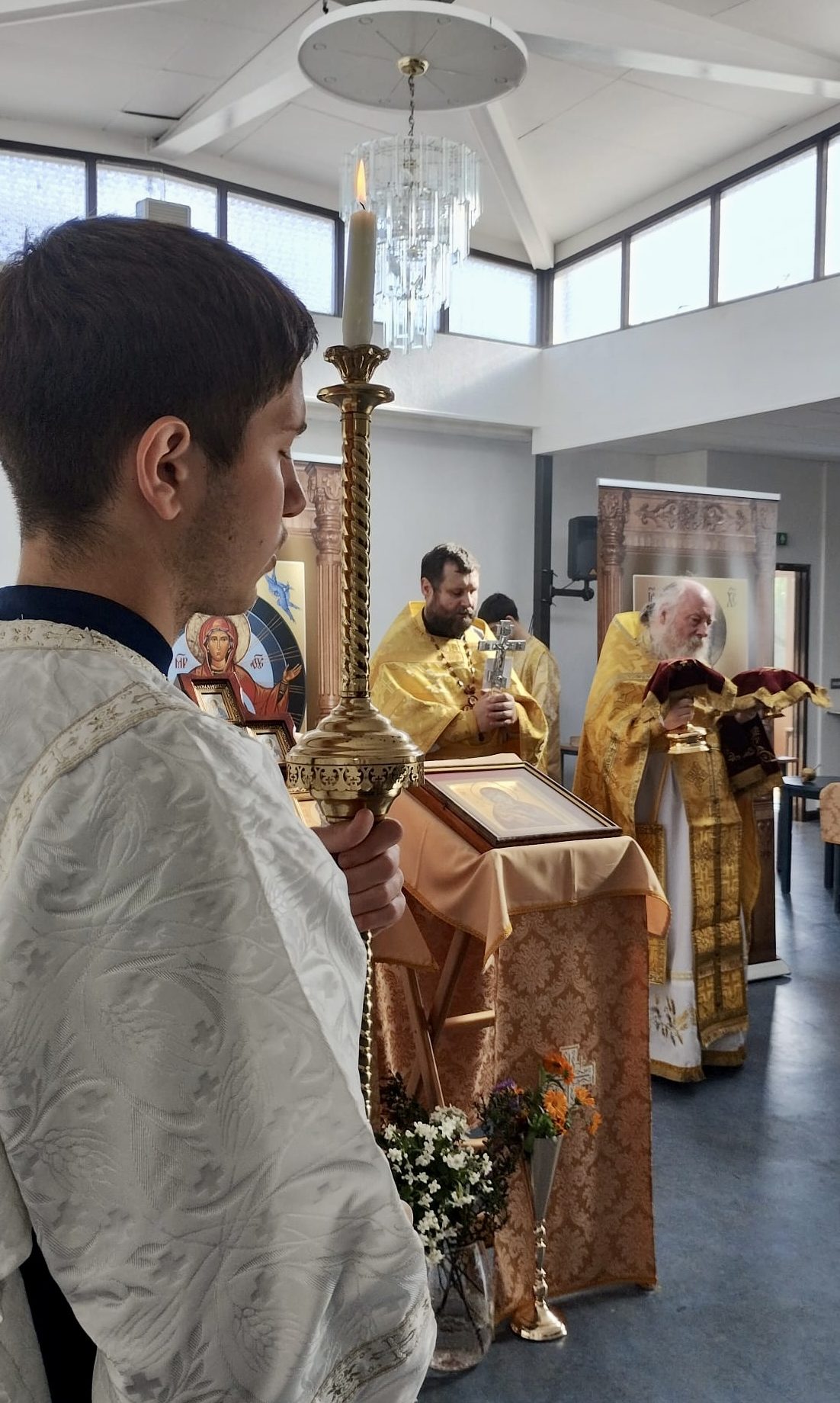 In the absence of both Olga and Masha, we are grateful to our young men, who in Joe’s case defied a sore and croaky throat to sing parts of the Liturgy, including a lovely Athonite setting of the first antiphon. Thanks also to Father Hierodeacon Avraamy for chanting on the kliros and lending his support. We look forward to our gentlemen contributing more traditional Russian and Byzantine chants to our Liturgy, and broadening our musical tradition.
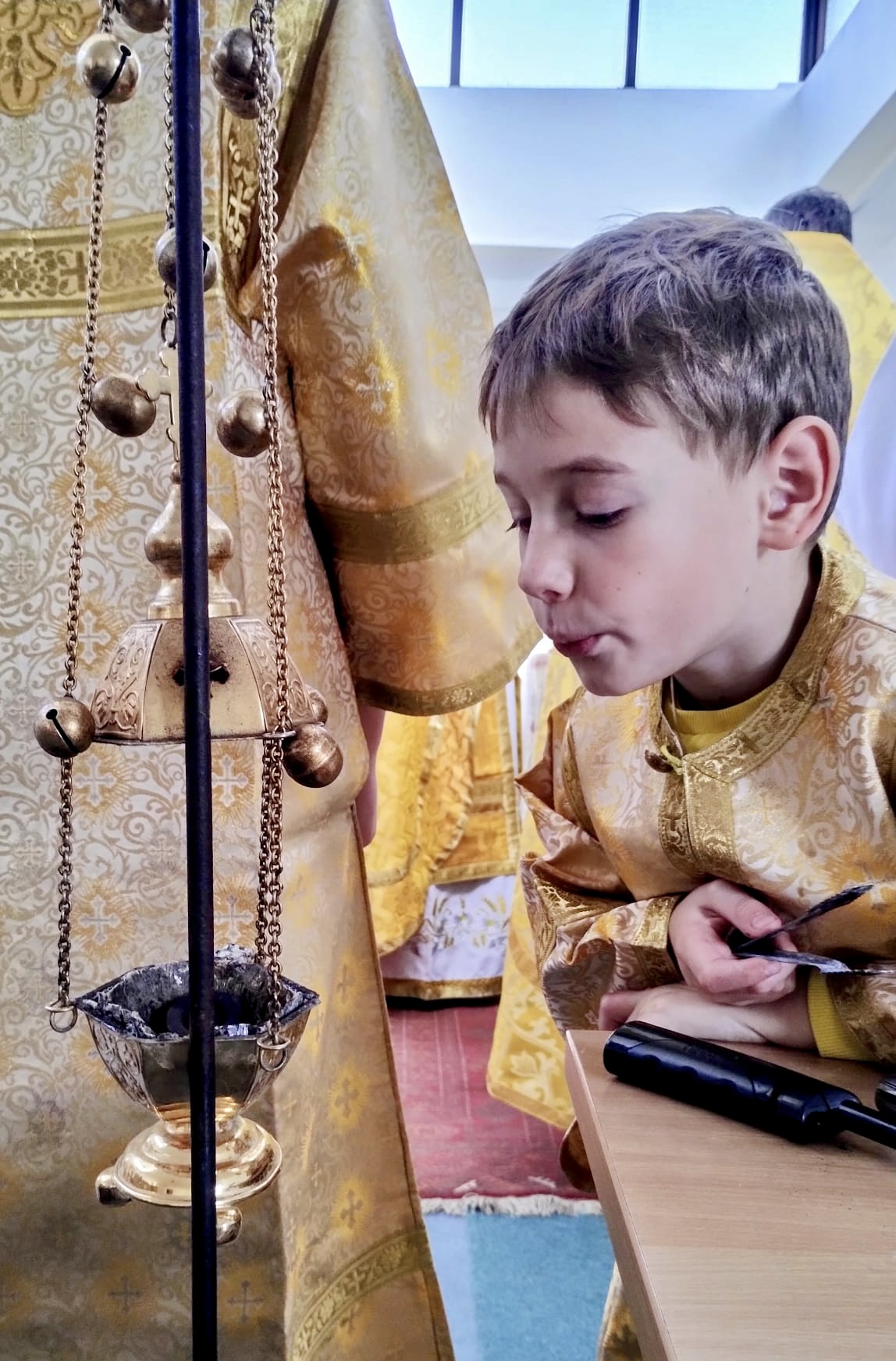 Though we previously asked offerings to be limited to finger-food for ease of clearing up and cleaning, this went unheeded, making a fair amount of work for a relatively small handful of people, so as of next week, let’s please stick to this simplified trapeza, and look forward to feast days for shared meals together. We will be strict in keeping to this plan for ease of clearing and cleaning St Philip’s, and to make this easier, may we also ask that parishioners take any used cups, plates etc., to the kitchen hatch when they have finished, so that our sisters are spared the task of having to go round church picking things up. Thank you.
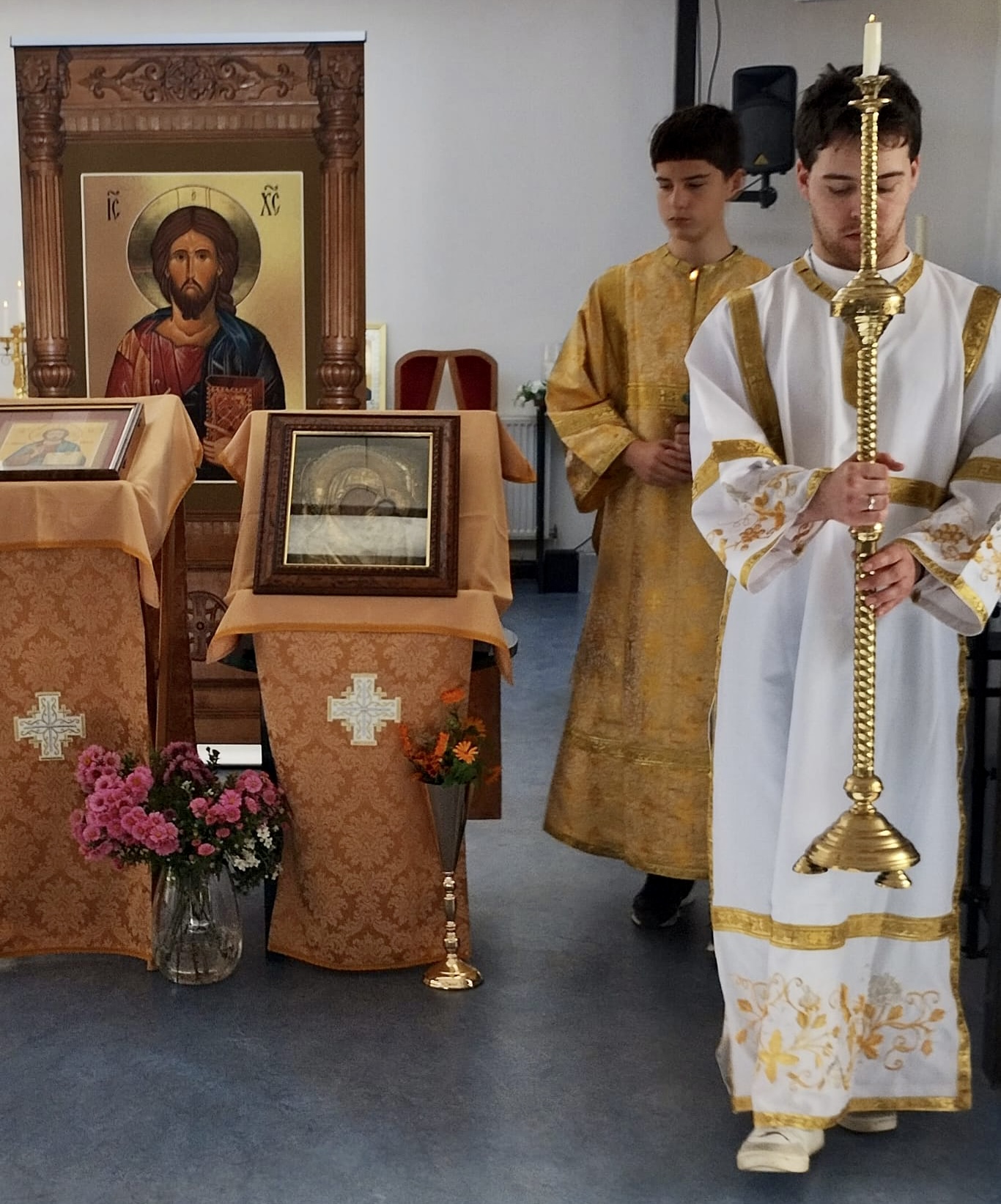 As announced on WhatsApp, through the generosity of the Oratorian Fathers, we will have the blessing of celebrating the feast of the Protecting Veil (Pokrov) on the Oratory Church on Tuesday 14 October (1st Old Style) and will commence the Hours and Liturgy at 10:45. It will be a joy to celebrate this wonderful feast of the maternal protection, and loving care of the Theotokos, and we will share refreshments in the lower sacristy after the Liturgy.
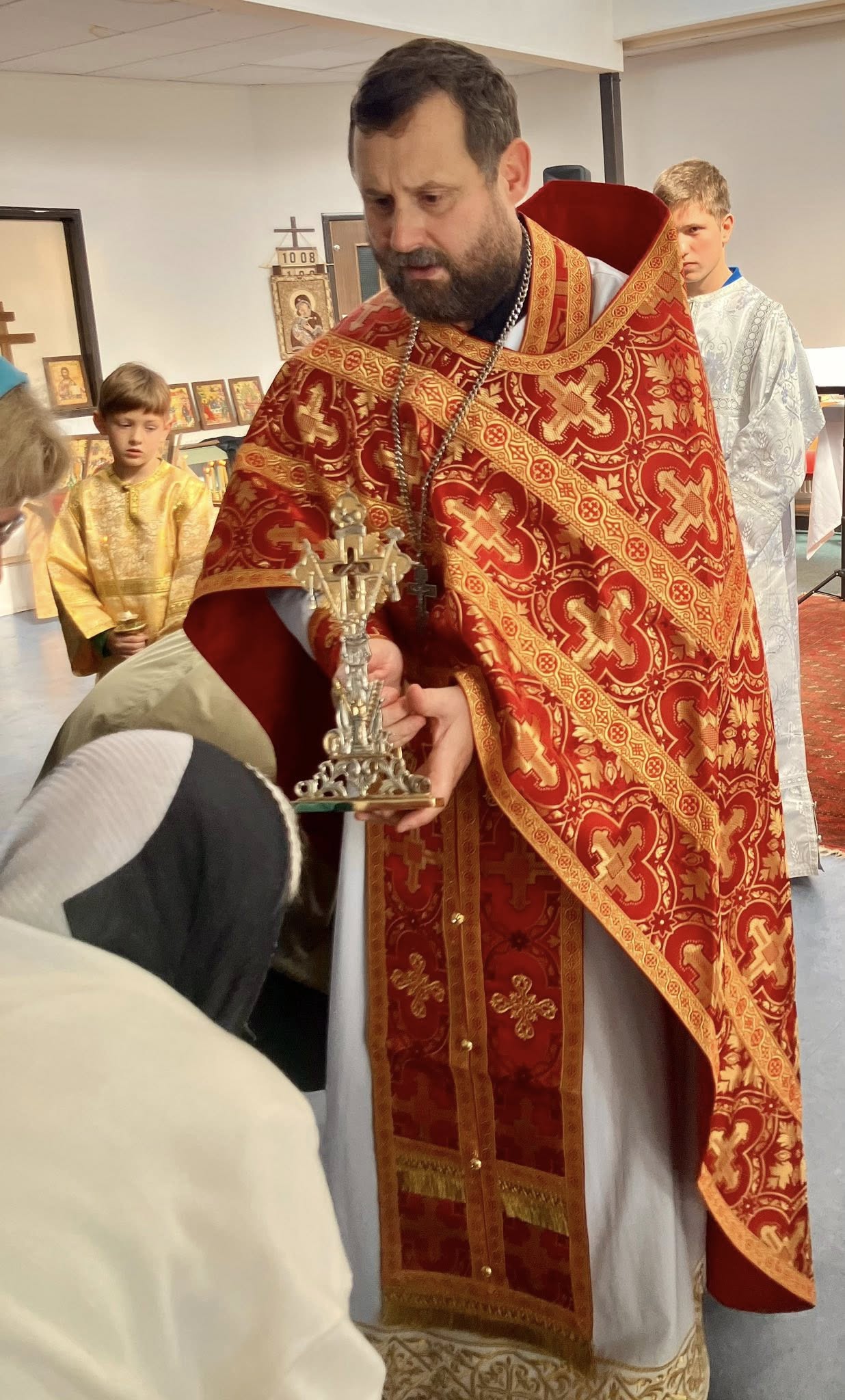 Dear brothers and sisters,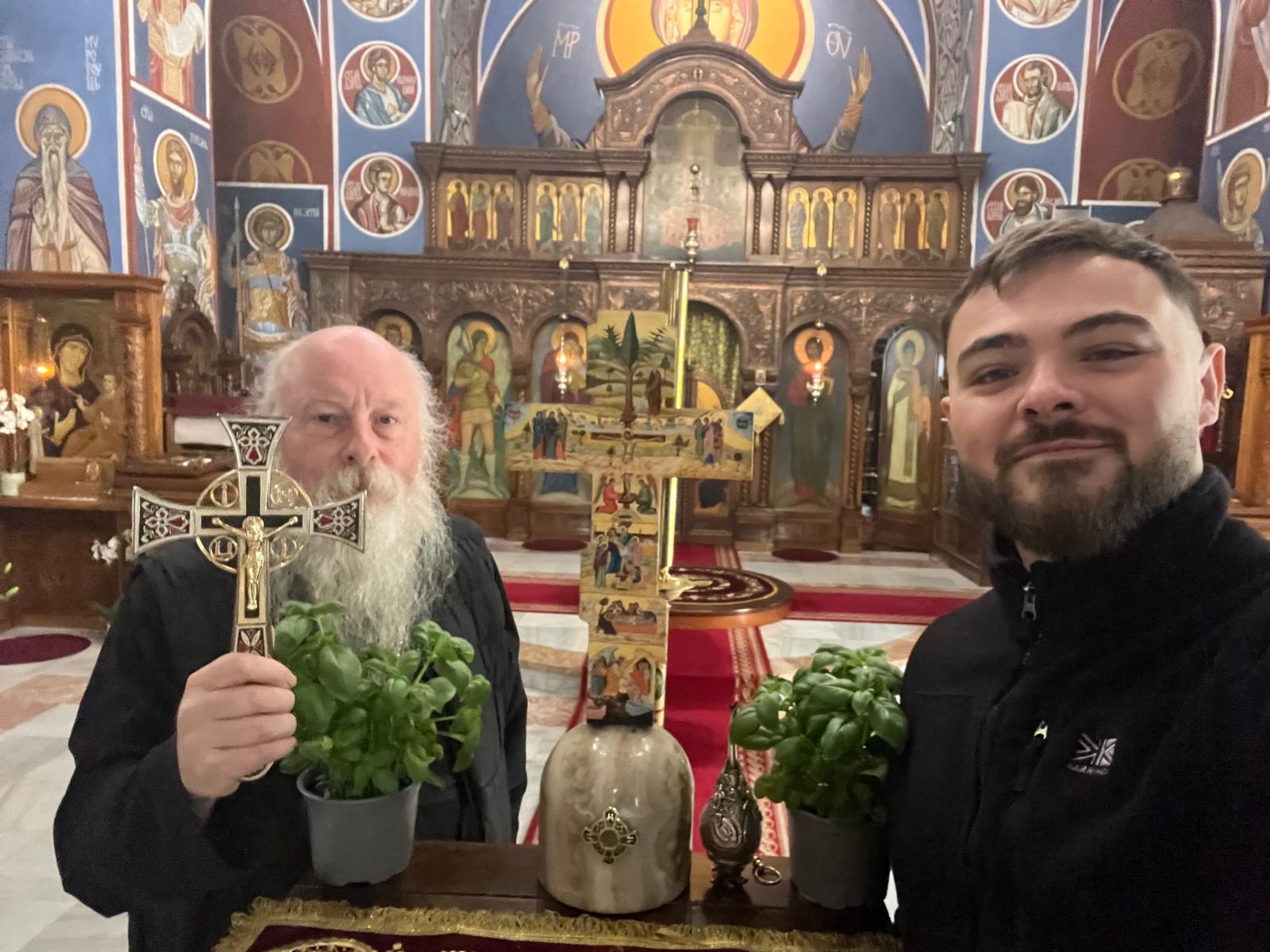
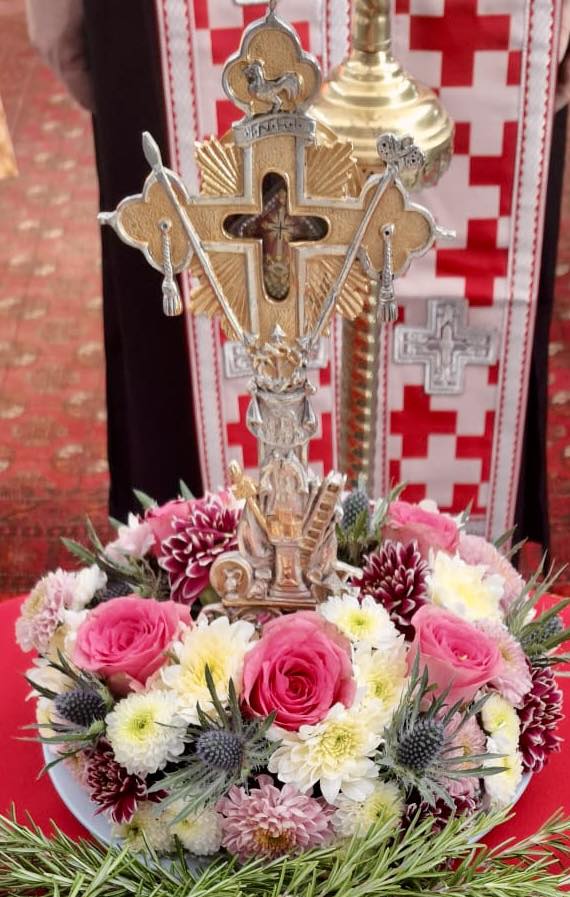
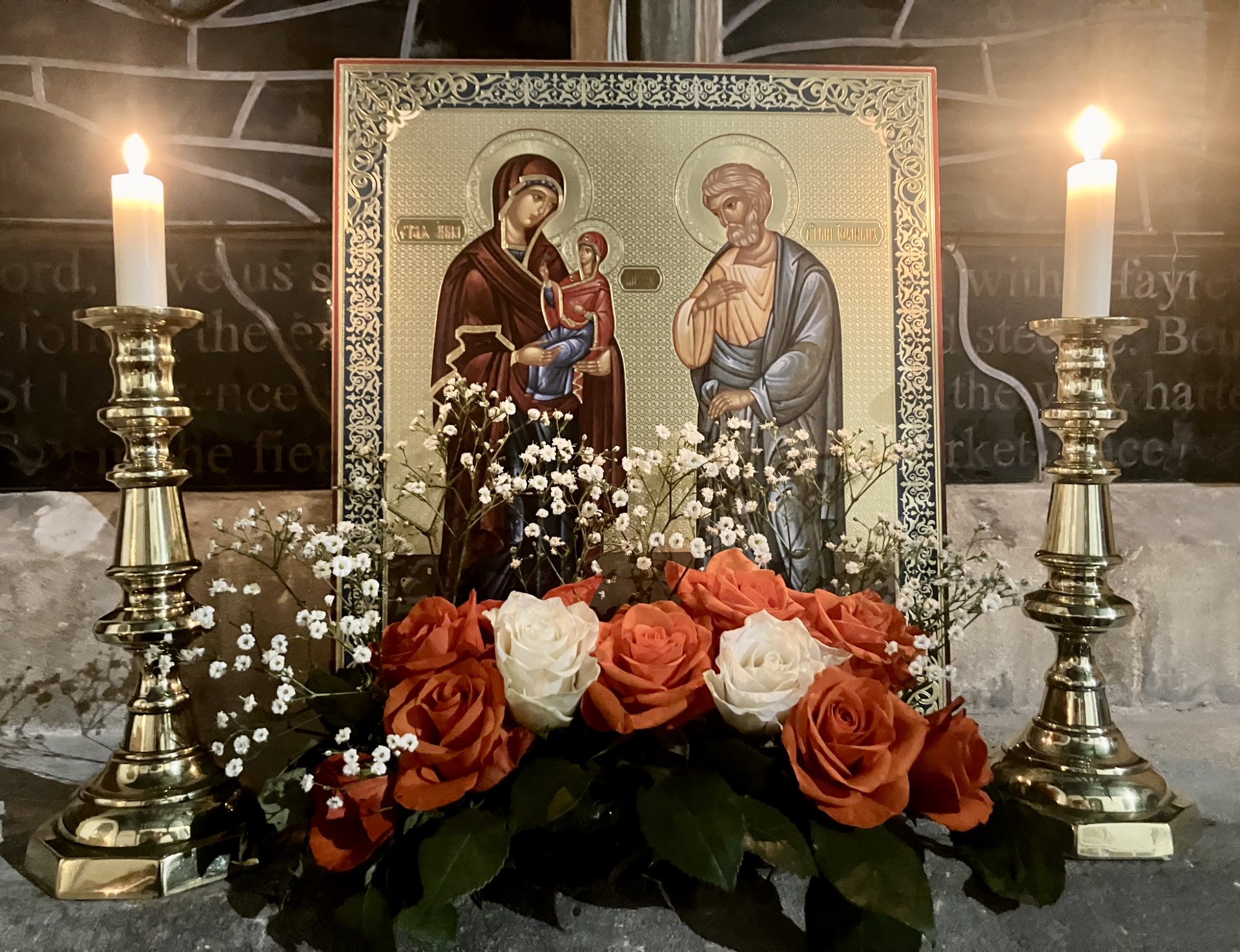
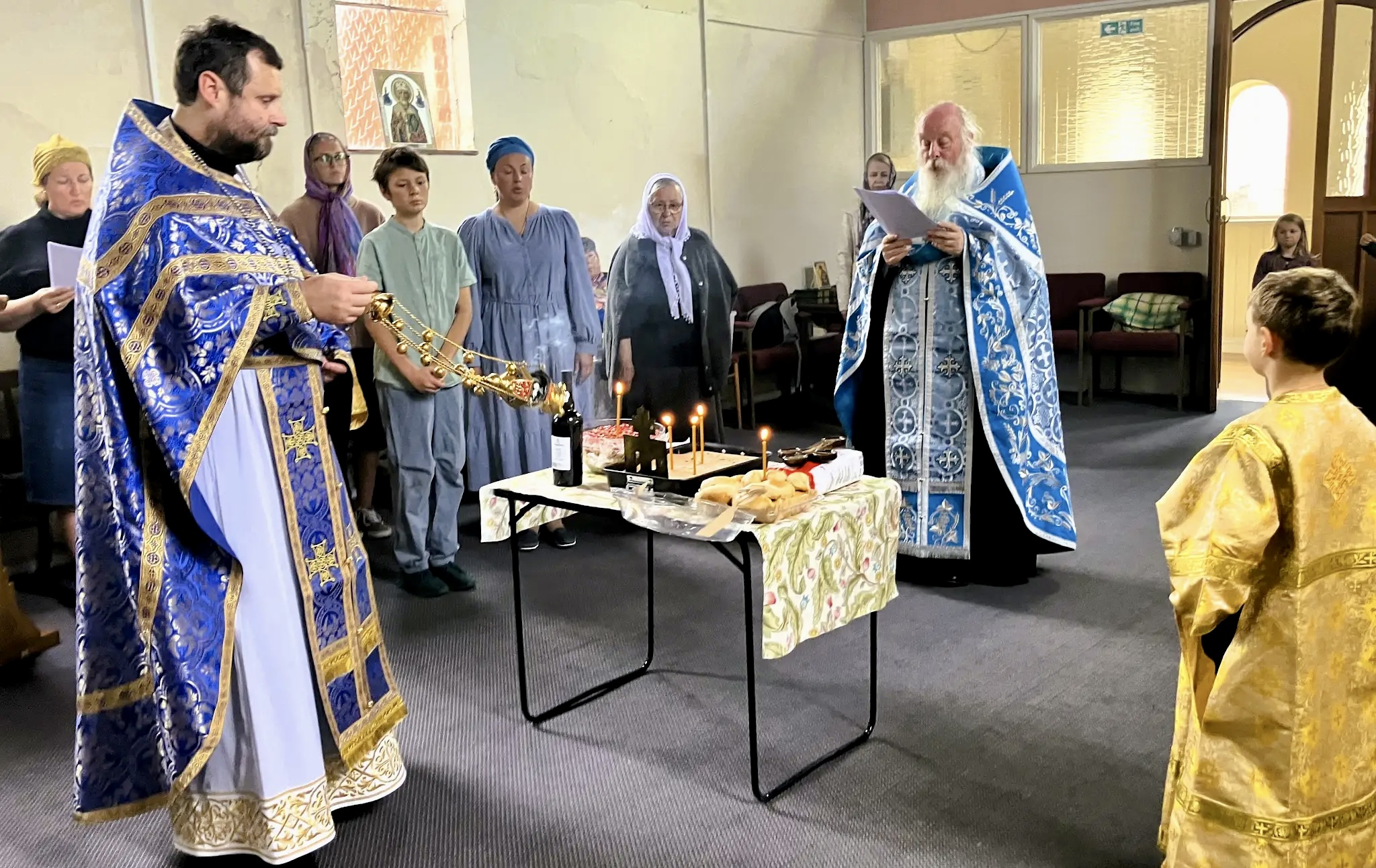
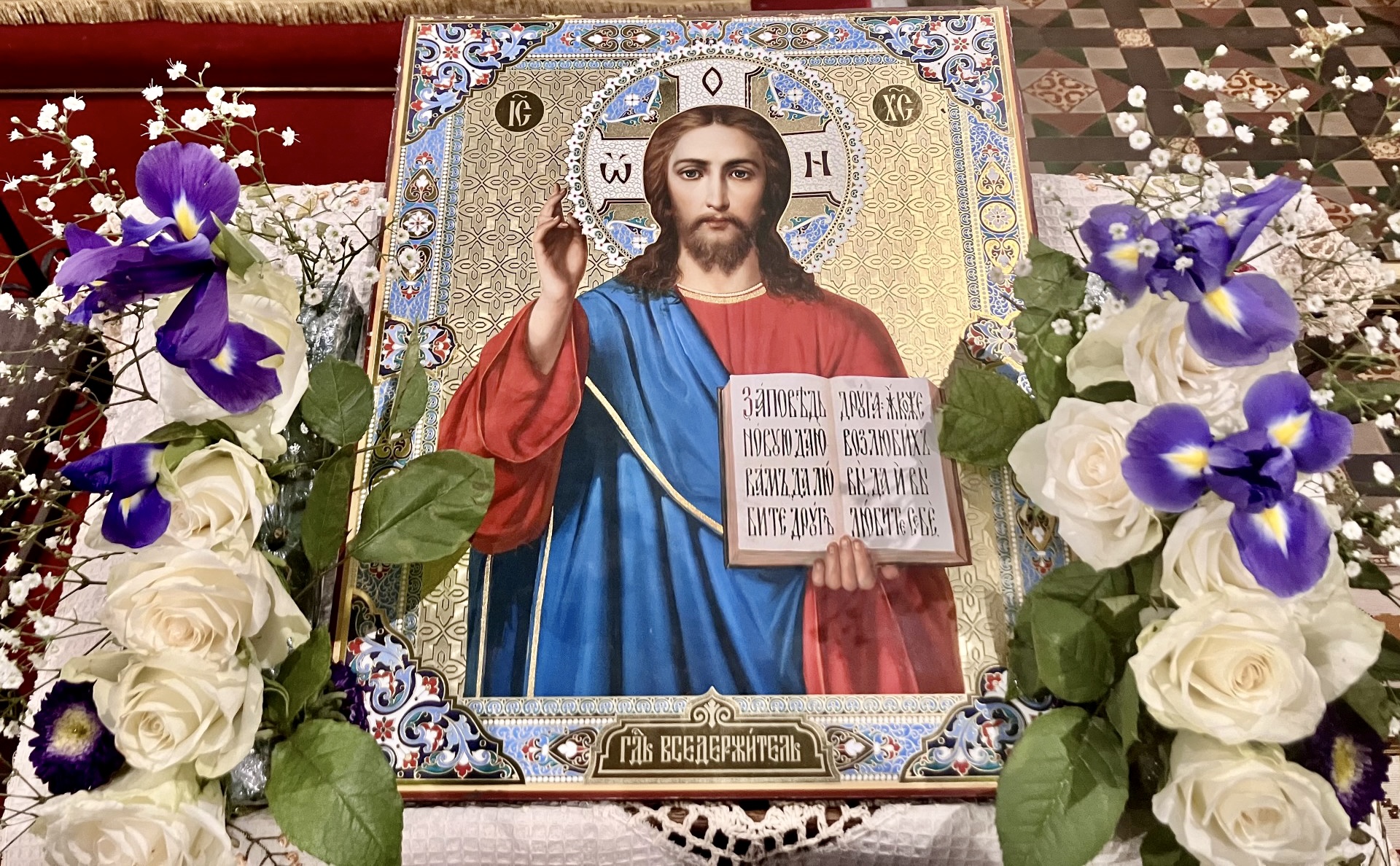
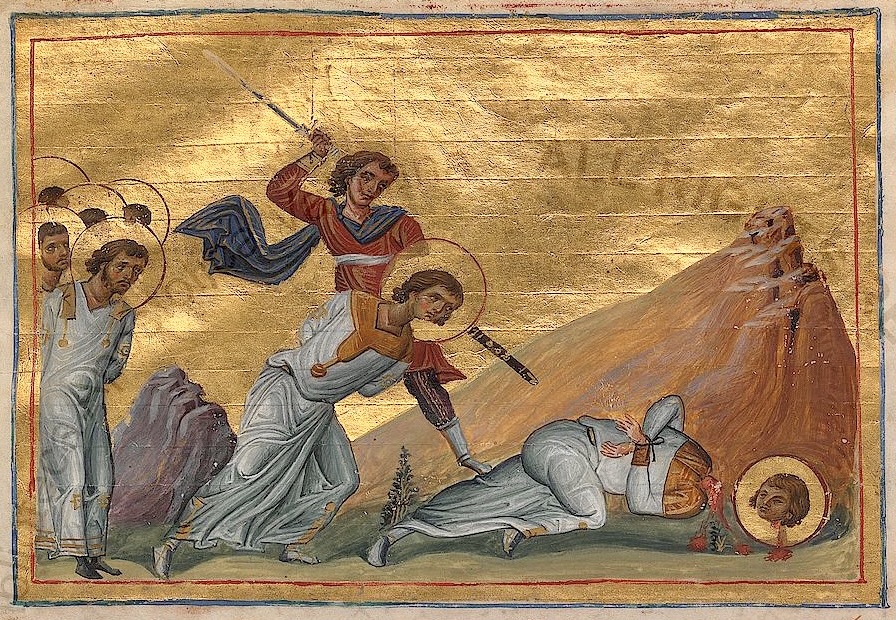 The Martyrs Eudoxius, Zeno, Macarius and their Companions received a martyric death for Christ under the emperor Maximian Galerius, the successor of the emperor Diocletian.
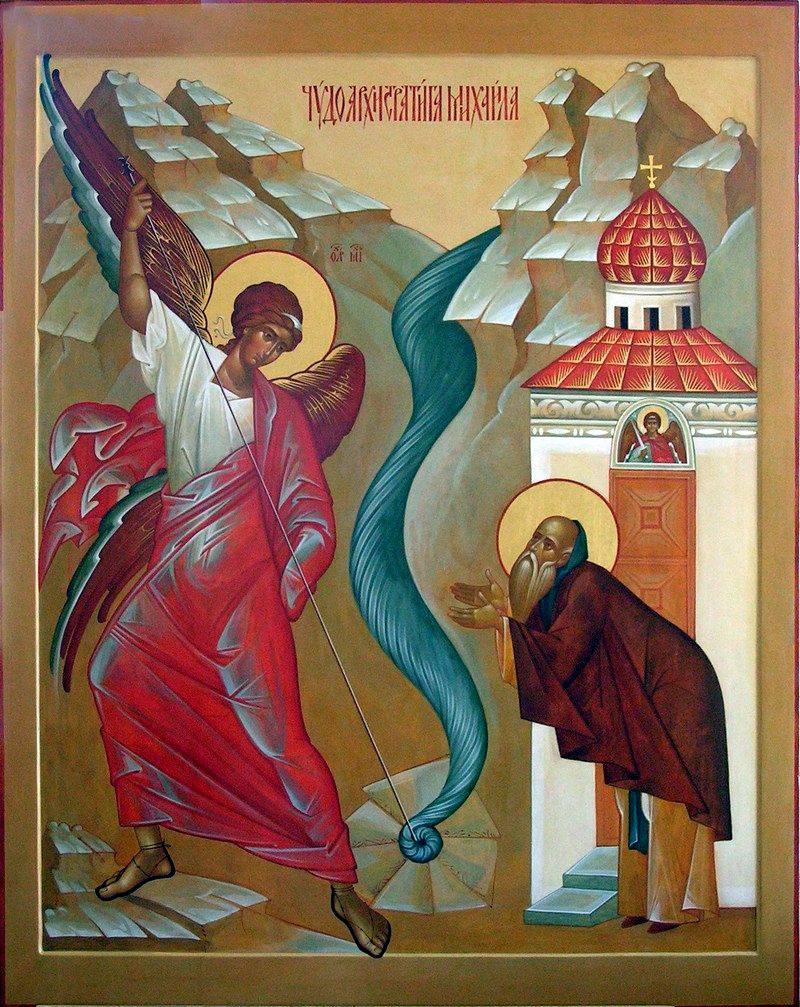 Ode I, Irmos: I will open my mouth, and with the Spirit will it be filled; and I shall utter discourse unto the Queen and Mother, and shall appear, keeping splendid festival; and, rejoicing, I will hymn her wonders.
 Dear brothers and sisters,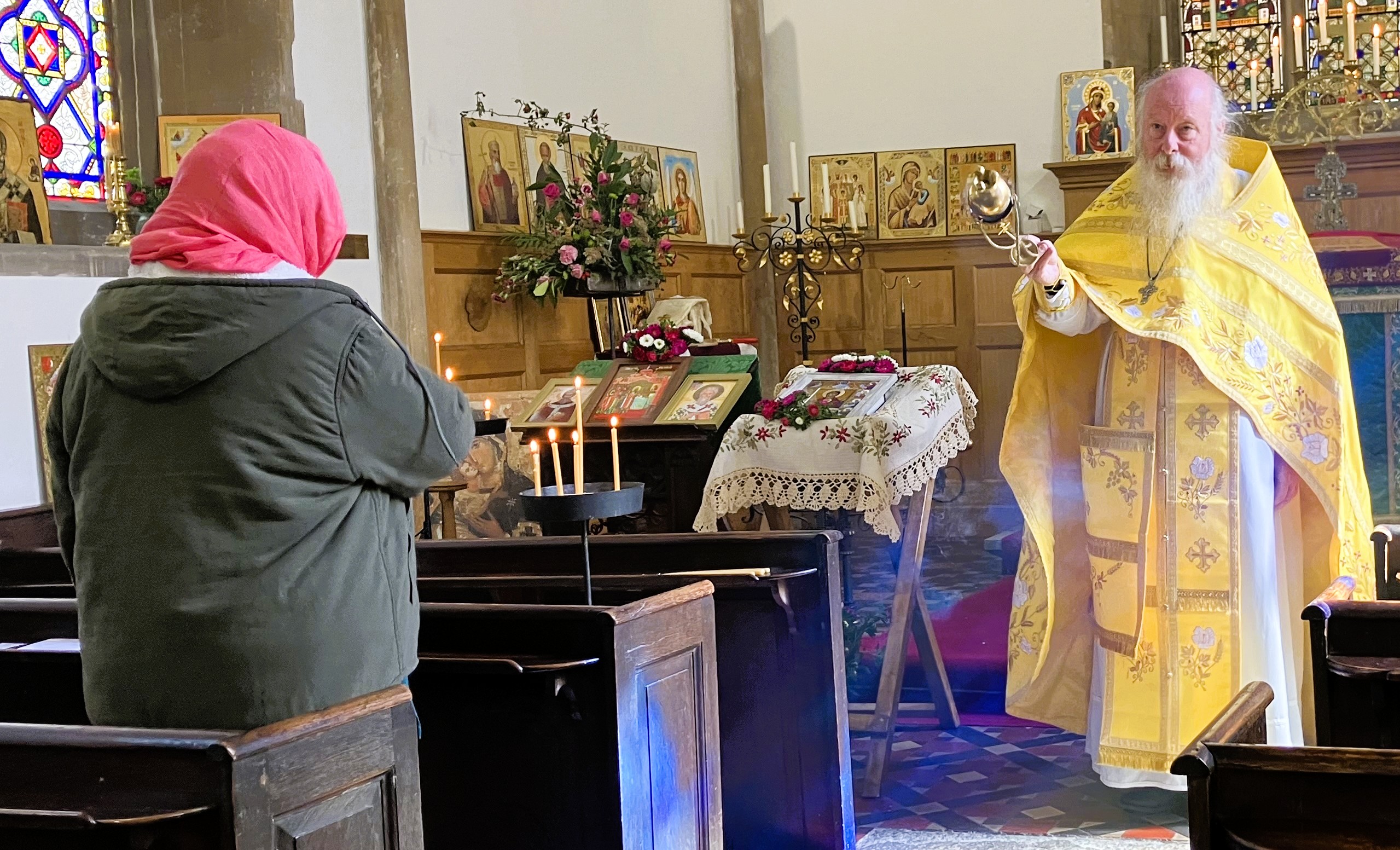
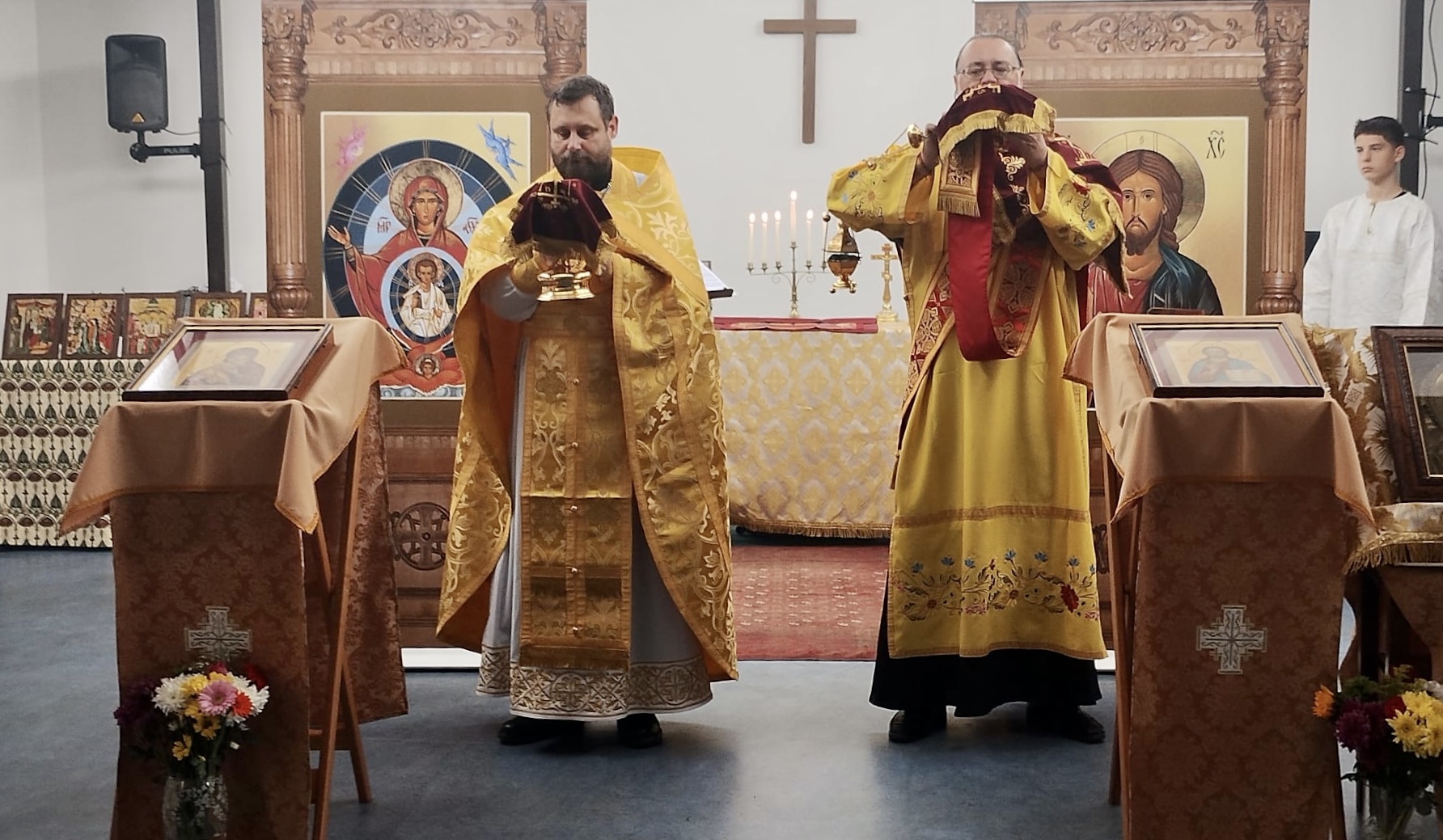
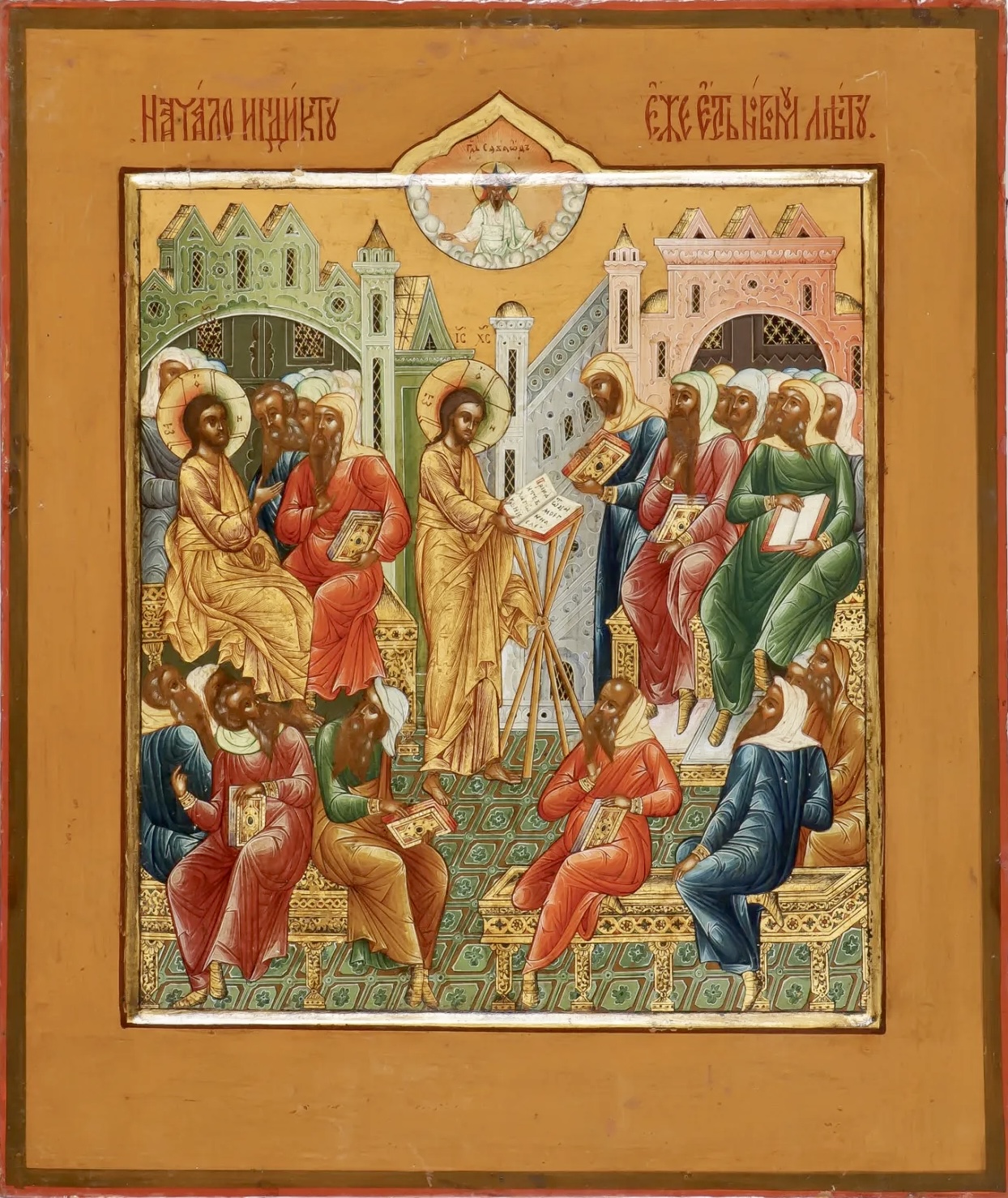 Ode 1, Irmos: O all ye people, let us chant a hymn of victory unto Him Who delivered Israel from the bitter bondage of Pharaoh and led them through the depths of the sea dry-shod, for He hath been glorified.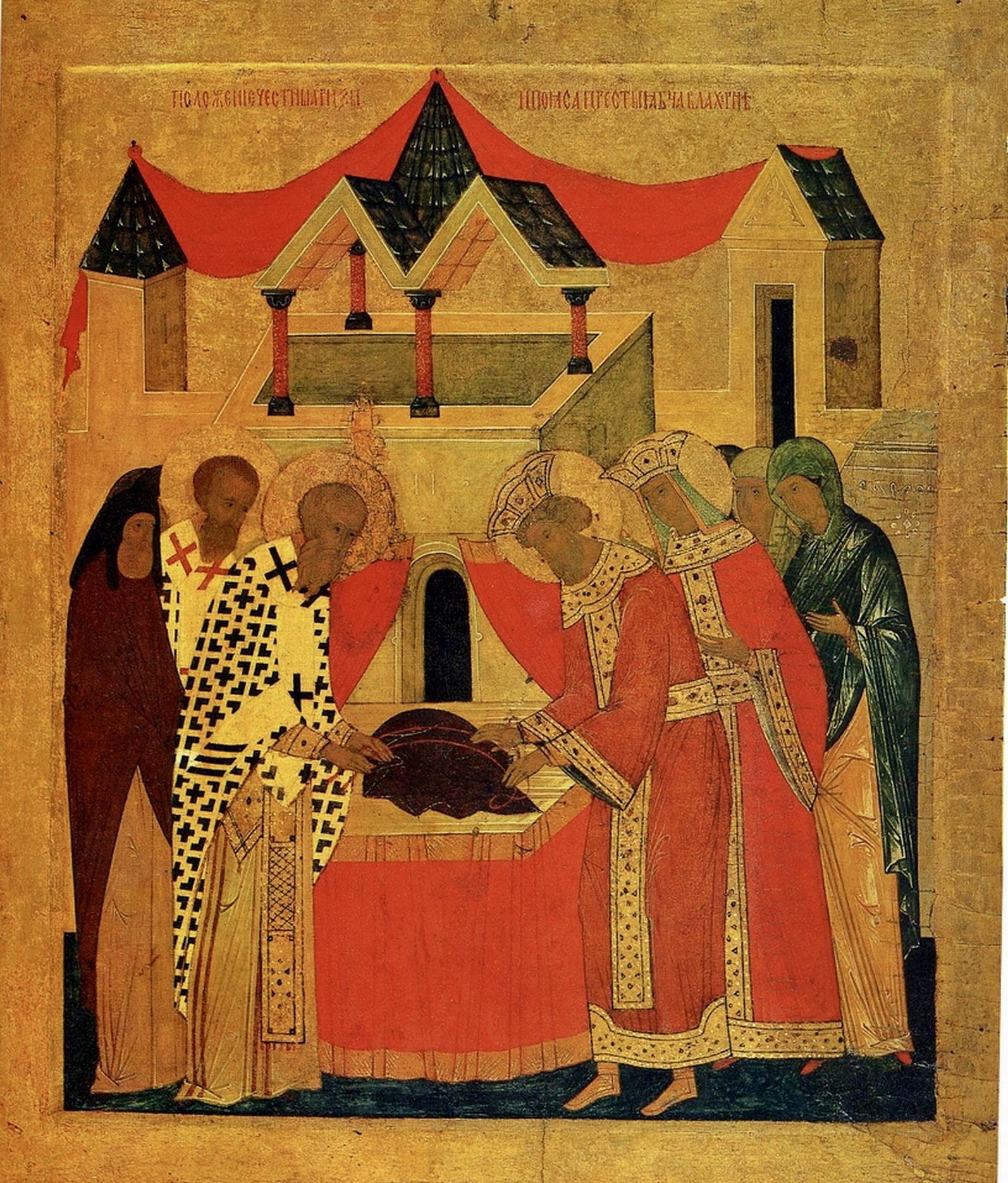
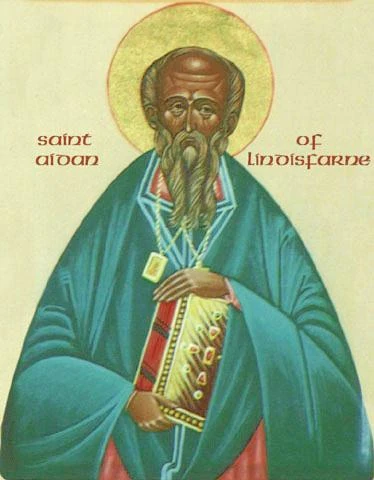
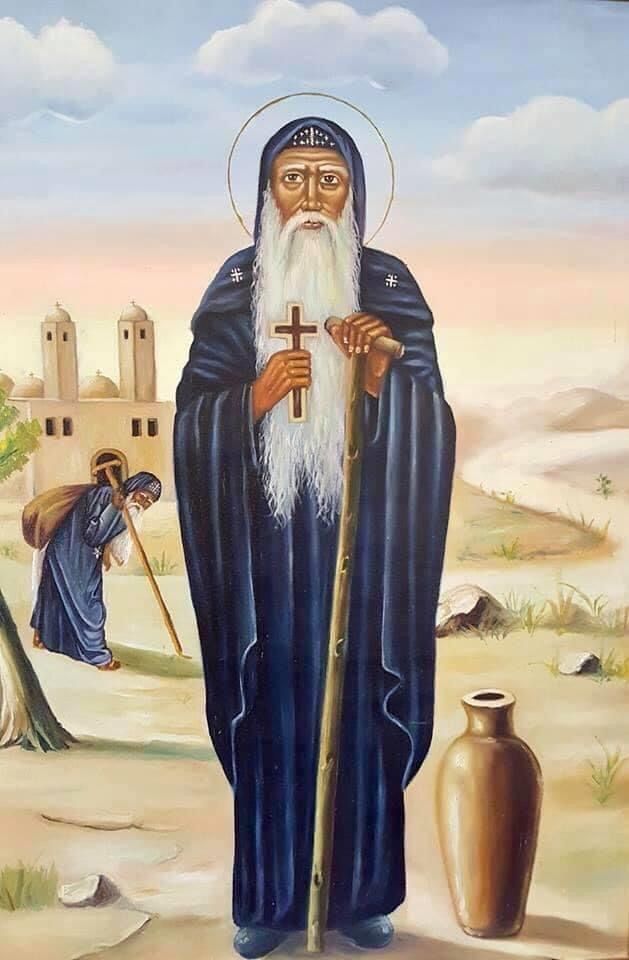

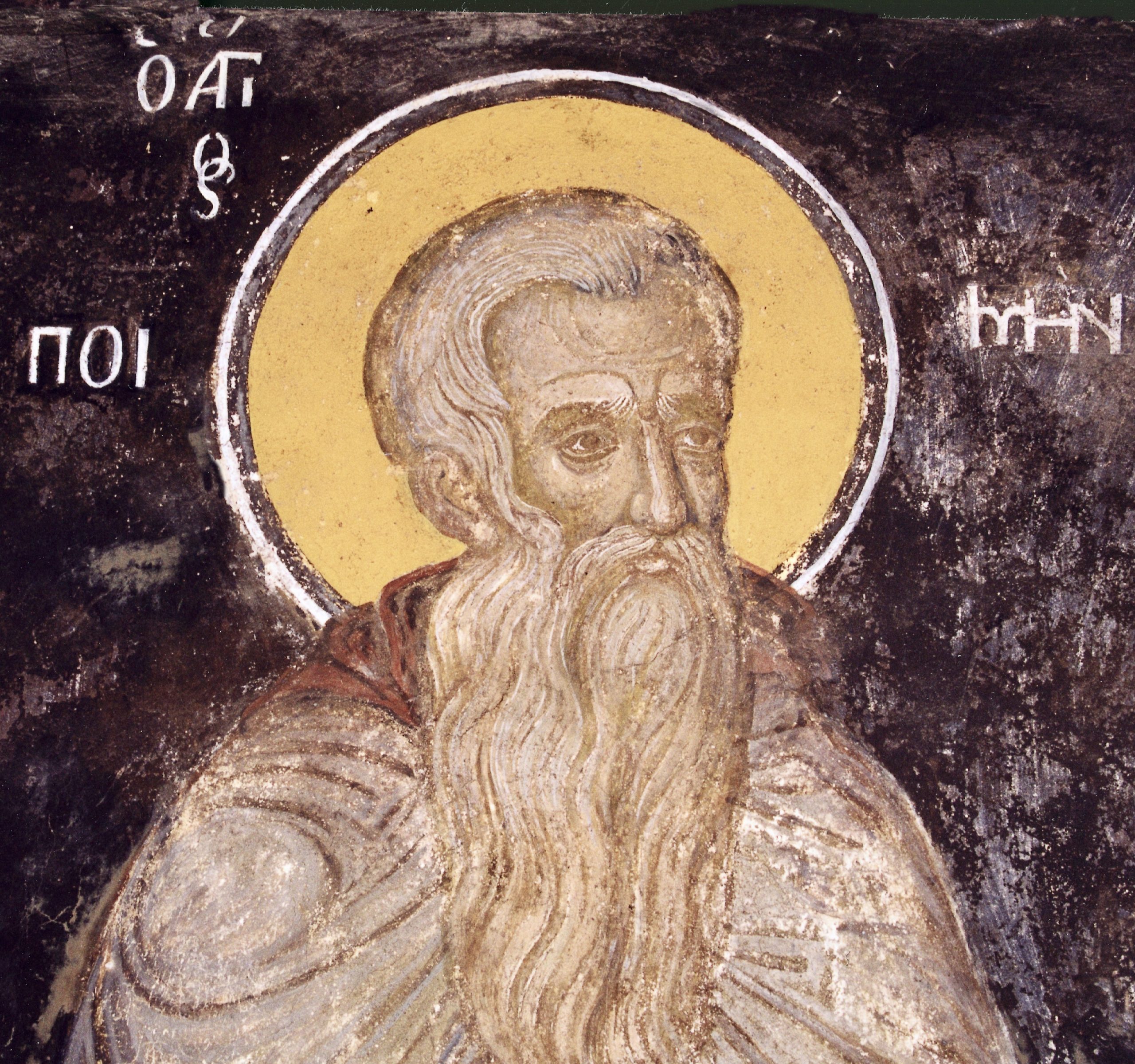 September 9 / August 27